wayground logo

Free Printable Worksheets

Font size

S
M
L
XL
Worksheets

End of term 3Par/Smi Revision Assessment

Total questions: 71

Worksheet time: 1hrs 12mins

Name
Class
Date
1.
Another word for prediction or educated guess is: ________________
a)
hypothesis
b)
conclusion
c)
experiment
d)
data
2.
The information you record in an experiment is called your ____________.
a)
data
b)
conclusions
c)
notebook
d)
inquiry
3.
The one variable you change is called the ___________ variable.
a)
independent
b)
dependent
c)
controlled
4.
Water is an example of:
a)
compound
b)
element
c)
solution
5.
A combination of substances that are not chemically combined is called a(n)____________. 
a)
mixture
b)
compound
c)
physical
6.
This picture represents which of the following?
a)
element
b)
compound
c)
mixture
7.
This picture represents which of the following?
a)
element
b)
compound
c)
mixture
8.
An element is made up of only one kind of _____.
a)
isotope
b)
plastic
c)
atom
d)
metal
9.
Glucose (C6H12O6) is an example of a...
a)
Element
b)
Compound
c)
Mixture
10.

What is salt water?

a)

Element

b)

Compound

c)

Mixture

11.

What is iron?

a)

Element

b)

Mixture

c)

Compound

12.

Which of the following is a Homogeneous mixture?

a)
b)
c)
d)
13.

Homogeneous Mixture is a (a)   type of mixture.

14.

Which of the following is a Heterogeneous Mixture?

a)
b)
c)
d)
15.

Which of the following is a heterogeneous mixture?

a)

brass

b)

sand

c)

Kool-aid

d)

vanilla yogurt

16.

Metals are shiny, good conductors, malleable, and ductile.

a)

True

b)

False

17.

A mixture of metals is called an (a)   .

18.

Bronze is an alloy of copper and _____.

a)

Steel

b)

Iron

c)

Tin

d)

Carbon

19.

Bronze is an alloy made of

a)

aluminum and magnesium

b)

copper and tin

c)

lead and tin

d)

copper and nickel

20.

Which of these metals would rust easily?

a)

Cast Iron

b)

Low-Carbon Steel

c)

Zinc

d)

Copper

21.
Which of these is a property of metals?
a)
It's malleable
b)
It can't conduct electricity
c)
They are used in food
d)
It's very brittle
22.
If a material can easily be drawn into the shape of a wire, it is
a)
Ductile
b)
Magnetic
c)
Malleable
d)
Reactive
23.
What two types of measurements make up DENSITY
a)
Mass and Volume
b)
Temperature and Mass
c)
Grams and Centimeters
d)
Volume and Weight
24.
Jack has a rock. The rock has a mass of 14g and a volume of 2cm3. What is the density of the rock?
a)
7 mL
b)
7 g/cm3
c)
28 g/cm3
d)
1/7 g/cm3
25.
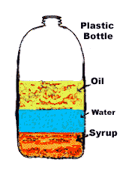
Why do the liquids form different layers?
a)
They have different densities.  
b)
They have different masses.  
c)
They have different volumes.  
d)
They are different temperatures.  
26.
Frank has a paper clip. It has a mass of 9g and a volume of 3cm3. What is its density?
a)
3 g/cm3
b)
1/3 g/cm3
c)
27 g/cm3
d)
39 g/cm3
27.
What units are used to measure mass?
a)
g
b)
cm3
c)
g/cm3
d)
cm3/g
28.
An object should float in a liquid if it is 
a)
Denser than the liquid 
b)
Less dense than the liquid
c)
Lighter than metal
d)
 Shaped like a ball 
29.
Which liquid is the least dense?
a)
oil
b)
water
c)
syrup 
d)
plastic bottle
30.
What is the formula for density?
a)
density = mass x volume
b)
density = mass / volume
c)
density = mass + volume
d)
density = mass - volume
31.
What is the volume of Object X?
a)
10.0 cm3
b)
15.0 cm3
c)
20.0 cm3
d)
25.0 cm3
32.
What units are used to measure Density?
a)
cm3/g
b)
g
c)
g/cm3
d)
cm3
33.

What is the formula for Mass?

a)

Mass/Volume

b)

Density x Volume

c)

Mass/Density

34.
Which of these organelles do animal cells not have?
a)
Nucleus
b)
Chloroplasts
c)
Cell membrane
d)
Lysosome
35.
This organelle is often referred to as the power house of the cell.
a)
Mitochondria
b)
Lysosome
c)
Chloroplast
d)
Vacuole
36.
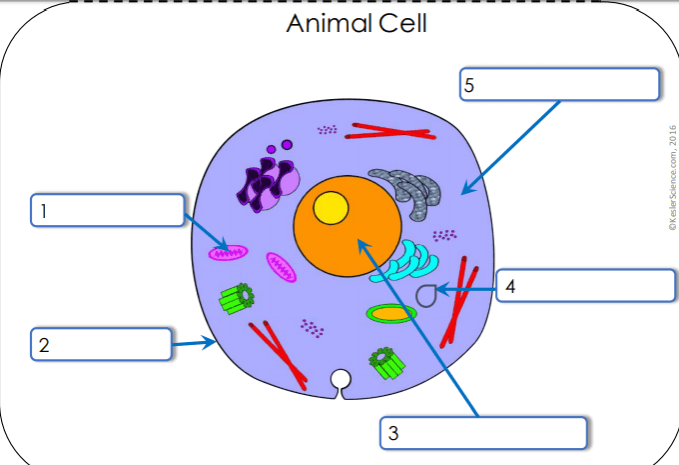
Which organelle is on the outside of an animal cell?
a)
Cell wall
b)
Cell membrane
c)
Cellular lining
d)
Cytoplasm
37.

What is the large sac that holds food, water, and waste?

a)

Cytoplasm

b)

Vacuole

c)

Nucleus

d)

Mitochondria

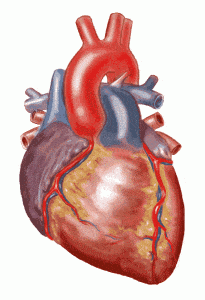
38.
This is a example of ........
a)
cell
b)
organ system
c)
organ
d)
tissue
39.
The ___________ is the basic unit of life
a)
organ
b)
cell
c)
atom
d)
tissue
40.

Which cell has a cell wall?

a)

Animal Cell

b)

Plant Cell

c)

Both

41.

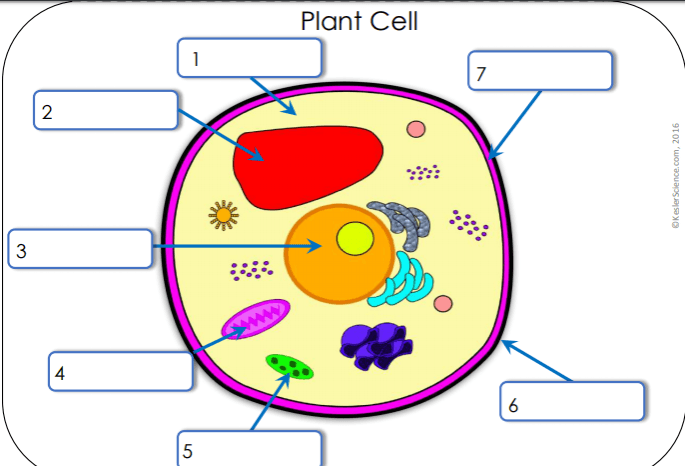
What is #3 in the diagram?

a)

vacuoles

b)

cell membrane

c)

chloroplast

d)

nucleus

42.

What is #2 in the diagram?

a)

vacuoles

b)

cell membrane

c)

chloroplast

d)

nucleus

43.

What is #5 in the diagram?

a)

vacuoles

b)

cell membrane

c)

chloroplast

d)

nucleus

44.

What is the SI unit of length?

a)

meter

b)

second

c)

ampere

45.

Which of the following quantities contain derived units only?

a)

time, speed, density

b)

speed, density, acceleration

c)

temperature, pressure, weight

46.

What is the SI unit of weight?

a)

pascal

b)

newton

c)

second

47.
What is base quantities ?
a)
the branch of science concerned with the nature and properties of matter and energy
b)
the branch of science that deals with the identification of the substances of which matter is composed
c)
physical quantities that cannot be defined in terms of other physical quantities
48.
What is derived quantities ?
a)
a tendency to do nothing or to remain unchanged.
b)
combination of two or more base quantities
c)
the quantity of motion of a moving body, measured as a product of its mass and velocity.
49.
The SI unit for time is the __?__.
a)
meter (m)
b)
liter (L)
c)
gram (g)
d)
second (s)
50.

SI stands for ___.

a)

Sports Illustrated

b)

Scientific Notation

c)

International System (of measurements)

d)

Instructional System (of measurements)

51.

Which Apple has the greatest Gravitational Potential Energy?

a)

Apple A

b)

Apple B

c)

Apple C

d)

Apple D

52.

What type of energy is transformed in the Energy Conversion shown in the image below?

a)

Nuclear Energy

b)

Chemical Energy

c)

Thermal Energy

d)

Electrical Energy

53.

What is the Energy Conversion that is shown in the image?

a)

Chemical to Mechanical

b)

Thermal to Chemical

c)

Chemical to Thermal

d)

Mechanical to Chemical

54.

The sun provides ____________ and ____________ energy that can be harnessed and used for solar power.

a)

chemical, sound

b)

mechanical, light

c)

sound, light

d)

light, thermal

55.

Energy can't be .....

a)

transformed.

b)

made or destroyed.

c)

converted.

d)

harnessed or produced.

56.
This is energy that is stored for later use. 
a)
kinetic energy 
b)
potential energy 
c)
mechanical energy 
d)
electromagnetic energy. 
57.
This is the energy that moves objects. 
a)
cool 
b)
nuclear 
c)
chemical 
d)
mechanical 
58.
This is the energy of vibrating molecules that move through matter. 
a)
sound 
b)
thermal 
c)
mechanical 
d)
electrical 
59.
The is the energy due to the splitting of atoms. 
a)
nuclear 
b)
chemical 
c)
mechanical 
d)
sound 
60.

Which is NOT a true statement about energy?

a)

it can change into another form of energy

b)

it can cause a temperature change

c)

it can cause movement

d)

it can be completely used up

61.

What form of energy is talking?

a)

A. mechanical

b)

B. light

c)

C. sound

d)

D. thermal

62.
This is the energy that can be released by breaking the bonds between compounds. 
a)
electromagnetic
b)
nuclear 
c)
kinetic 
d)
chemical 
63.

What type of energy do we get from the food we eat?

a)

light

b)

thermal

c)

chemical

d)

sound

64.

When a football player kicks a ball, he transfers energy to the ball. What happens as a result?

a)

the ball gains kinetic energy

b)

the ball loses sound energy

c)

the ball loses thermal energy

d)

the ball gains light energy

65.
________ is the ability to do work.
a)
Light
b)
Energy
c)
Heat 
d)
Sound
66.
Energy you can see is _________. 
a)
sound energy
b)
heat energy
c)
light energy
67.

What is potential energy?

a)

moving energy

b)

stored energy

c)

renewable energy

d)

non renewable energy

68.

What is kinetic energy?

a)

moving energy

b)

potential energy

c)

stored energy

d)

renewable energy

69.

A computer uses what type of energy to operate?

a)

Mechanical

b)

Light

c)

Electric

d)

Sound

70.

The picture shows what type of transformation

a)

Electrical to mechanical

b)

light to electric

c)

electrical to light

d)

light to light

71.
According to the Law of Conservation of Energy...
a)
energy changes form
b)
energy can be created and destroyed
c)
energy flows from one material to the next
d)
energy cannot be created or destroyed