
 Worksheets
End of Term Assessment Term 3 F4
Total questions: 60
Worksheet time: 10hrs 0mins
A person who is associated with starting a business is know as
Merchant
Entrepreneur
Salesman
Businessman
Concept: a business's records should never be mixed with an owner's personal records and reports
adequate disclosure
business entity
objective evidence
going concern
Concept: When a business activity is large enough to impact business decisions, it should be recorded clearly in the financial statements
realization of revenue
materiality
unit of measurement
consistent reporting
Concept: Financial statements are prepared with the expectation that business will remain in operation indefinately
going concern
materiality
accounting period cycle
matching revenue with expenses
Concept: The same accounting procedures must be followed in the same way each accounting period
accounting period cycle
objective evidence
consistent reporting
materiality
Concept: The revenue from business activities and the expenses associated with earning that revenue are recorded in the same accounting period
adequate disclosure
unit of measurement
historical cost
matching expenses with revenue
Concept: Business transactions are reported in numbers that have common values. Meaning all reporting should be done in terms of money
Unit of measurement
historical cost
materiality
matching expenses with revenue
Furniture is regarded as
Assett
Fixed Assett
Liability
Current Liability
Owners equity just refer to the Capital of the owner
True
False
Which one from the list below doesn't represent the Accounting equation?
A = C + L
A - L = C
A - C = L
C = A + L
How will you calculate profit?
Income - Expenses
Income + Expenses
Income x Expenses
Capital - Expenses
Assets can be seen as
Possessions that are used to run a business.
Expenses for the business
Items the business received from the owner
The full formula to calculate owners equity is, Capital + Income - Expenses - Drawings
True
Fales
What will happen to liabilities when a business takes out a loan?
Loans will increase
No effect
Loans will decrease
Purchase goods on credit from Sofea will be recorded in:
Sales Journal
Purchase Journal
Cash Book
Purchase Return Journal
Cash sales to Aminah will be recorded in:
Cash Book
Sales Journal
Purchase Journal
Sales Return Journal
Paid wages by cheque will be recorded in:
Purchase Journal
Sales Journal
Cash Book
Purchase Return Journal
Sold goods on credit to Sun Shine Trading
Sales Journal
Purchase Journal
Sales Return Journal
Cash Sales
Cashbook is used to record all cash and bank transactions
True
False
A credit customer returned some damaged goods to the business.
Sales Return Journal
Purchase Return Journal
Purchase Journal
Sales Journal
A receipt is used as a source document for
Credit sales
Credit purchases
Payment of cash
Return of goods to supplier
A cheque counterfoil is the source document for
Return inwards
Return outwards
Payment of cash
Payment of cheque
An article is subject to a 20% trade discount. Its list
price is $600. What is the sale price?
$120
$480
$580
$720
A retailer purchases goods worth $3 000. He receives
30 per cent trade discount and 5 per cent cash
discount. How much should he pay for the goods?
$1 995
$2 095
$2 100
$2 850
The Balance of Petty Cash is :
(a) An Expense
(b) Revenue
(c) An asset
(d) Liability
Cash book is a form of:
(a) Trial Balance
(b) Ledger
(c) Journal
(d) All of the above
Small payments are recorded in a book called
(a) Cash Book
(b) Small payments book
(c) Purchase book
(d) Petty cash book
Cheques received but deposited on the next day are recorded in:
(a) Cash column of the cash book
(b) Bank column of the cash book
(c) Both of these
(d) None of these
In petty cash Book, the system followed:
(a) Accrual System
(b) Imprest System
(c) Cash System
(d) None of these
Double entry in Cash Book is completed when:
(a) Salaries are paid by cheque
(b) Withdrawal of money from bank for personal use
(c) Deposited cash into bank
(d) None of these
In three column Cash Book, when does contra entry occurs?
(a) Withdrawal of cash from bank
(b) Payment to creditors
(c) Withdrawal of cash from bank for personal use
(d) all of the above
What will be journal entry when cash is withdrawn from bank for personal use?
(a) Drawing A/c debit, Bank A/c credit
(b) Cash A/c debit, Bank A/c credit
(c) Bank A/c debit, Drawing A/c credit
(d) Bank A/c debit, Capital A/c credit
While balancing three column cash book, the discount column are:
(a) Totaled but not adjusted
(b) Totaled and also adjusted
(c) Totaled but not balanced
(d) Balanced but not totaled
The Balance brought down on the DEBIT side of the bank column in Cash Book indicates
(a) Total amount withdrawn from the Bank
(b) Total amount deposited in the Bank
(c) Cash at Bank
(d) Bank Overdraft
If Rita sells goods for cash, it will be recorded in
Sales book
Purchases book
Cash book
Journal proper
Total of purchases book is
Posted to the credit of Purchases account
Posted to the debit of Purchases account
Posted to two column cash book
None of the above
Credit balance in bank column of the cash book indicates
Total Cheques
Total Cash
Bank Overdraft
Normal balance
Cash , being an asset is always said to have
Debit balance
Credit balance
No balance
Ledger is called book of
Primary entry
Secondary entry
Final entry
All of the above
Trial balance shows
Only debit balance
Only credit balance
Both credit and debit balance
None of the above

Which one is not belongs to liability?
Mobile Phone Bill
Bank Loan
Bank Balance
Owed To Friends
The value of all assets minus the value of all liabilities.
Financial obligations
Assets
Net Worth
Property
Debts and financial obligations (responsibilities).
Liabilities
Assets
Negative Net Worth
Property
Examples of Liabilities include which of the following:
Loans, credit cards, and real property
Loans, mortgage, and credit cards
Loans, Art collection, and savings account
Mortgage, credit card, and real property
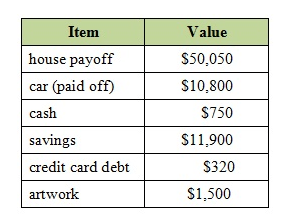

Current Assets are cash or other assets that are expected to be converted to cash within a year
True
False
Which of the following is a Non current asset?
Furniture
Other Receivables
Trade payables
All the above are or can be non-current assets
Gross profit is calculated by...
Revenue - Total Costs
Revenue + Variable Costs
Revenue - Cost of Sales
Revenue - Fixed Costs
Cost of sales is calculated by...
Opening stock + purchases - closing stock
Opening stock + purchases + closing stock
Adding up all of the stock bought during the year
Opening stock - closing stock
How do you calculate net profit?
Gross profit - expenses
Revenue - total costs
Gross profit - variable costs
Revenue - indirect costs
COGS stands for
cost of goods sales
cost of goods serviced
cost of goods sold
Revenue = 1000
Cost of Goods Sold = 200
Expenses = 300
Gross Profit = ?
800
500
700
300
Revenue = 1000
Cost of Goods Sold = 200
Expenses = 300
Net Profit = ?
800
500
700
300
Net Profit = 500
Revenue = 2000
Expenses = 1000
Cost of Goods Sold = ?
1500
1000
3000
500

