
 Worksheets
Kinematics
Total questions: 100
Worksheet time: 3hrs 20mins
A 10-g penny is dropped from a building that is 125 m high. The penny is initially at rest. Approximately how long does it take the penny to hit the ground?
3.2 s
4.5 s
10 s
15 s
20
A car in a drag race started from rest and accelerated constantly to a velocity of 50 m/s when it reached the end of a 500-m road. What was the car’s rate of acceleration?
–5.0 m/s2
-2.5 m/s2
0.5 m/s2
2.5 m/s2
5.0 m/s2

3. Which of the following best describes the motion of the car in regions C, D, and E of the velocity versus time graph?
It is slowing down until it reverses direction and speeds back up again.
It moves at a constant velocity in the negative direction.
It accelerates at a constant, nonzero acceleration except at point C when its acceleration is zero.
Its position changes at a constant rate.
It moves at a constant, positive acceleration throughout the trip.

What is the magnitude of the acceleration of the car in region A?
0 m/s2
3 m/s2
5 m/s2
10 m/s2
30 m/s2

What is the acceleration rate of the car at the 6-second clock reading?
0 m/s2
-15 m/s2
-30 m/s2
+30 m/s2
-60 m/s2

Rank the average velocities of the car in regions A, B, C, and E.
A > B > C = E
B = A > C = E
B > A = C = E
B > A = C > E
A > B > C = E
An airplane is flying horizontally at a velocity of 50.0 m/s at an altitude of 125 m. It drops a package to observers on the ground below. Approximately how far will the package travel in the horizontal direction from the point that it was dropped?
100 m
159 m
250 m
1020 m
1590 m
A placekicker kicks a football at a velocity of 10.0 m/s from a tee on the ground at an angle of 30° from the horizontal. Approximately how long will the ball stay in the air?
0.0 s
0.6 s
0.8 s
1.0 s
1.8 s

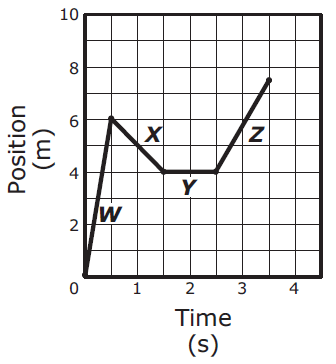
This graph depicts the motion of an object. During which time interval is the object at rest?
0-2 s
2-3 s
3-4 s
4-7 s
7-10 s
A car is traveling at an unknown velocity. It accelerates constantly over 5.0 seconds at a rate of 3.0 m/s2 to reach a velocity of 30 m/s. What was the original velocity of the car?
1.0 m/s
5.0 m/s
10 m/s
15 m/s
20 m/s
A plane takes off from rest and accelerates constantly at a rate of 1.0 m/s2 for 5 minutes. How far does the plane travel in this time?
15 km
30 km
45 km
90 km
150 km
A person drops a stone down a well and hears the echo 8.9 s later. If it takes 0.9 s for the echo to travel up the well, approximately how deep is the well?
40 m
320 m
405 m
640 m
810 m
If a ball is thrown straight upward with an initial velocity of 30.0 m/s, how much time does it take to reach its maximum height?
1.0 s
1.4 s
1.5 s
3.0 s
9.8 s
On an airless planet, an astronaut drops a hammer from rest at a height of 15 m. The hammer hits the ground in 1 s. What is the acceleration due to the gravity on this planet?
10 m/s2
15 m/s2
20 m/s2
25 m/s2
30 m/s2
A car uniformly accelerates from rest at 3.0 m/s2 down a 150-m track. What is the car’s final velocity?
30 m/s
90 m/s
150 m/s
450 m/s
900 m/s

An object’s position with time is depicted in the following graph. Based on the graph, at which time points will the object’s velocity be closest to zero?
0 s and 2 s
0 s and 4 s
1 s and 2 s
1 s and 3 s
2 s and 4 s
A cannonball is launched at an angle and travels above the flat ground. At what time point does a projectile reach its maximum height?
One-fifth of the total time in the air
One-fourth of the total time in the air
One-half of the total time in the air
Three-fifths of the total time in the air
Three-fourths of the total time in the air
A boy drops a stone from a cliff and counts the seconds until the stone hits the base. He counts 3 s. About how high is the cliff?
3 m
10 m
15 m
45 m
90 m
A boy is riding a bicycle at a velocity of 5.0 m/s. He applies the brakes and uniformly decelerates to a stop at a rate of 2.5 m/s2. How long does it take for the bicycle to stop?
0.5 s
1.0 s
1.5 s
2.0 s
2.5 s
A police officer finds 60 m of skid marks at the scene of a car crash. Assuming a uniform deceleration of 7.5 m/s2 to a stop, what was the velocity of the car when it started skidding?
20 m/s
30 m/s
45 m/s
60 m/s
90 m/s

The velocity–time graph of an object’s motion is shown in this graph. At 10 s, what is the object’s displacement relative to the initial time?
3 m
6 m
9 m
-6 m
-3 m
A projectile is launched with an unknown velocity at an angle of 30° from the horizontal of level ground. Which of the following statements is true?
The horizontal component of velocity is less than the vertical component of velocity.
The horizontal component of velocity is greater than the vertical component of velocity.
Both the horizontal and vertical components of velocity are equal.
The horizontal component of velocity is used to calculate the time that the projectile is in the air.
The vertical component of velocity is used to calculate the range of the projectile.
From rest, a ball is dropped from the top of a building. It takes 4 s to hit the ground. Approximately how tall is the building?
40 m
90 m
100 m
160 m
200 m

The position–time graphs of five different objects are shown in these graphs. If the positive direction is forward, then which object is moving backward at a constant velocity?
Object A
Object B
Object C
Object D
Object E
A student launches projectiles with the same velocity but at different angles (0–90°) relative to the ground. He measures the range of each projectile. Which angle pairs have the same range?
10° and 20°
30° and 45°
30° and 60°
45° and 60°
10° and 90°
An object free-falls from rest a distance D. How far will the object fall from rest in twice the elapsed time?
D
2 D
2 D
3 D
4 D
A car is traveling at 30 m/s. The driver applies the brakes, and the car uniformly decelerates at 9 m/s2. How far does the car travel before coming to a complete stop?
2 m
50 m
100 m
200 m
450 m

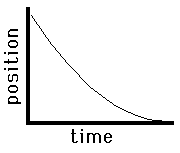
The position–time graph shown here is typical of which type of motion?
Motion with a constant positive velocity
Motion with zero velocity
Motion with a constant positive acceleration
Motion with zero acceleration
Motion with a constant negative acceleration
If you drop a ball from a 100-m-tall building, approximately how far will the ball fall in 2 s?
10 m
20 m
40 m
50 m
100 m
An ice skater moving at 10 m/s comes to a complete stop in 0.5 s. What is the rate of acceleration?
5 m/s2
10 m/s2
20 m/s2
-20 m/s2
-10 m/s2
Which equation is not found on the AP paper?
vf=vi+at
Δx=1/2(vf+vi)(t)
vf^2=vi^2+2aΔx
Δx=viΔt+1/2aΔt^2
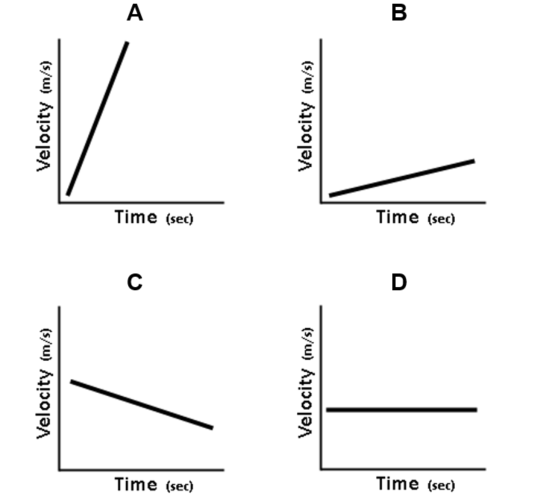
A car accelerates from rest at a constant rate 5 m/s^2 . Which of the following statements is true?
A. The car travels 5 m in every second
B. The car decreases its velocity 5 m/s in every second
C. The car increases its velocity 5 m/s in every second
D. The car’s velocity doesn’t change
A rock is thrown straight up from the edge of a cliff. The rock reaches the maximum height of 15 m above the edge and then falls down to the bottom of the cliff 35 m below the cliff. What is the traveled distance of the rock?
A. 30 m
B. 35 m
C. 50 m
D. 65 m
A projectile is fired from the surface of the Earth with a speed of 200 meters per second at an angle of 30° above the horizontal. If the ground is level, what is the maximum height reached by the projectile?
A) 5 m
B) 10 m
C) 500 m
D) 1,000 m
E) 2,000 m
An object moving in a straight line has a velocity v in meters per second that varies with time t in seconds according
to the following function: v=4+0.5t^2
The instantaneous acceleration of the object at t = 2 seconds is
2 m/s^2
4 m/s^2
5 m/s^2
6 m/s^2
8 m/s^2
An object moving in a straight line has a velocity v in meters per second that varies with time t in seconds according
to the following function: v=4+0.5t^2
The displacement of the object between t = 0 and t = 6 seconds is
22 m
28 m
40 m
42 m
60 m
Starting from rest, a vehicle accelerates on a straight level road at the rate of 4.0 m/s2 for 5.0 s.
What is the speed of the vehicle at the end of this time interval?
1.3 m/s
10 m/s
20 m/s
80 m/s
100 m/s
Starting from rest, a vehicle accelerates on a straight level road at the rate of 4.0 m/s2 for 5.0 s.
What is the total distance the vehicle travels during this time interval?
10 m
20 m
25 m
40 m
50 m
Find the dot product of the two vectors P and Q.
P = {5 i + 2 j + 3 k}
Q = {-2 i + 5 j + 4 k}
-12
12
-10
0
10
Find the dot product of the two vectors P and Q.
P = {5 i + 2 j + 3 k}
Q = {-2 i + 5 j + 4 k}
-12
12
-10
0
10
Wind blowing at 20 knots
direction




Charlie shoots a basketball from a height of 6 feet with an initial upward velocity of 18 feet per second. How long will it take the ball to reach the maximum height?
0.6 seconds
11 seconds
6 second
this graph has a minimum
Step 2 find the magnitude of < 4,5 >
41
√41
Find the unit vector of the vector PQ. P ( 0,5) Q ( 1,7). Find 2 answers.
< 1/ √5, 2/ √5 >
< .89, .45 >
< .45, .89 >
Find a unit vector in the direction of <6, -8>
<0.6, -0.8>
< .06, -.08>
<1/10, -1/10>
<0, -2>
Find a unit vector in the direction of <6, -8>
<0.6, -0.8>
< .06, -.08>
<1/10, -1/10>
<0, -2>
Find the unit vector of the vector PQ. P ( 0,5) Q ( 1,7). Find 2 answers.
< 1/ √5, 2/ √5 >
< .89, .45 >
< .45, .89 >



The graph above shows the velocity v as a function of time t for an object moving in a straight line. Which of the following graphs shows the corresponding displacement x as a function of time t for the same time interval?


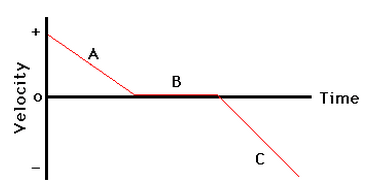
The graph provided is a velocity vs. time graph for thing that can move and is indeed moving. Which of the following is true about the speed of the object during the time interval from 0 to 6 s.
It increases during the entire interval.
It remains the same.
It first increases and then decreases.
It first decreases and then increases.

The graph on the right shows the velocity v as a function of time t for a thing moving in 1D motion. Which of the following graphs shows the corresponding displacement x as a function of time?


An object thrown up in the air has the following vector quantities for velocity and acceleration.
v= (+) , a= (-)
v= (+) , a= (0)
v= (0) , a= (-)
v= (0) , a= (0)

The object below is moving in a straight line and is slowing down over the entire time interval because the slope is negative.
True
False
Billy is traveling at a constant velocity of 5 m/s. After 3 seconds of traveling at this velocity he accelerates at a rate of 2 m/s^2 for the next 5 seconds. After the total 8 seconds what distance did billy travel? ( type the number only, NO unit)
(a)
An object is dropped from rest from the top of a 800 m cliff on Earth. If air resistance is negligible, what is the distance the object travels during the first 8 s of its fall? ( use 10 m/s^2)
180 m
60 m
320 m
120 m
Starting from rest, object 1 falls freely for 2.0 seconds, and object 2 falls freely for 4.0 seconds. Compared to object 1, object 2 falls:
half of the distance
twice the distance
four times the distance
a square of the distance
You are given the vx-t graph for an object moving along the x-axis with constant acceleration. Which of the following could you not determine from the information given in this graph alone?
the object’s x-acceleration at any time t
the object’s x-velocity at any time t
the object’s position at any time t
more than one of the above
misleading question—you could determine all of these from the vx-t graph alone
When will terminal speed occur?
The falling object travels at constant speed
The falling object falls at 9.8m/s
The falling object falls at 9.8 s2m
The falling object is at rest

This is the x-tgraph of the motion of a particle. Of the four points P, Q, R,and S, the velocity vx is greatest (most positive) at
P
Q
R
S

This is a motion diagram of an object moving along the x-direction with constant acceleration. The dots 1, 2, 3, … show the position of the object at equal time intervals ∆t.At the time labeled 3, what are the signs of the object’s velocity vx and acceleration ax?
vx< 0, ax= 0
vx< 0, ax< 0
vx> 0, ax< 0
vx< 0, ax> 0
This is a motion diagram of an object moving along the x-direction with constant acceleration. The dots 1, 2, 3, … show the position of the object at equal time intervals ∆t. Which of the following vx-tgraphs best matches the motion shown in the motion diagram?


This is a motion diagram of an object moving along the x-direction with constant acceleration. The dots 1, 2, 3, … show the position of the object at equal time intervals ∆t. Which of the following ax–tgraphs best matches the motion shown in the motion diagram?


This is a motion diagram of an object moving along the x-direction with constant acceleration. The dots 1, 2, 3, … show the position of the object at equal time intervals ∆t. Which of the following vx-tgraphs best matches the motion shown in the motion diagram?
An object moves along the x-axis with constant acceleration. The initial position x is positive, the initial velocity is negative, and the acceleration is positive.
Which of the following vx-t graphs best describes this motion?

Which of the following ax–t graphs (graphs of acceleration vs. time)best matches the motion of the glider as it goes down?


Which of the following vx–t graphs (graphs of velocity vs. time) best matches the motion of the glider?


A car in a drag race started from rest and accelerated constantly to a velocity of 50 m/s when it reached the end of a 500-m road. What was the car’s rate of acceleration?
–5.0 m/s2
-2.5 m/s2
0.5 m/s2
2.5 m/s2
5.0 m/s2

