
 Worksheets
REVISION PHYSICS FORM 4 kssm
Total questions: 50
Worksheet time: 44mins
Which of the following is not a SI base unit ?
Yang manakah antara yang berikut bukan unit asas S.I.?
Meter
Meter
Kilogram
Kilogram
Ampere
Ampere
Hour
Jam
A student draws graph y against x. The relationship between y and x is y = r + px, r and p are constants. The gradient of graph y against x is
Seorang pelajar melukis graf y lawan x. Hubungan antara y dan x ialah y=r+px, r dan p adalah pemalar. Kecerunan graf y lawan x ialah
p
r
y
x
Which of the following physical quantity is a derived quantity ?
Yang manakah antara kuantiti fizik berikut adalah kuantiti terbitan?
Mass
Jisim
Temperature
Suhu
Length
Panjang
Area
Luas
Which of the following is a vector quantity?
Yang manakah antara berikut adalah kuantiti vektor?
Age of sun
Usia matahari
Acceleration of gravity
Pecutan graviti
Mass of a ball
Jisim bola
Distance between Ipoh and Melaka
Jarak antara Ipoh dan Melaka
Which of the following is a S.I. base unit ?
Yang manakah antara berikut ialah kuantiti asas S.I.?
Decimeter
Desimeter
Meter
Meter
Kilometer
Kilometer
Megameter
Megameter
Which of the following is a scalar quantity ?
Yang manakah antara berikut ialah kuantiti skalar?
Distance
Jarak
Displacement
Sesaran
Weight
Berat
Momentum
Momentum
Which of the following shows the relationship of base quantities for acceleration ?
Yang manakah menunjukkan hubungan kuantiti-kuantiti asas untuk pecutan?


what is relationship between v and t ?
apakah perhubungan diantara v dan t?
v is directly proportional to t
v berkadar terus dengan t
v is increases linearly to t
v meningkat secara linear dengan t
v is decreases linearly to t
v berkurang secara linear dengan t
v is inversely proportional to t
v berkadar songsang dengan t
physical quantities can be divided into
base quantities
derived quantities
magnitude quantities
unit
physical quantities are
quantities that can be measured using scientific instruments
quantities that have can be seen
quantities that can be found in the laboratory
quantities that are created by scientist and physicist
tick the correct base quantities with the units
length - cm
temperature - degrees celcius
speed - kilometre per hour
amount of substance - mol
what is the unit for force?
newton
kilogram
kilogram per metre
kilogram per second square
what is the different between scalar and vector quantity?
scalar quantity has direction
vector quantity has direction
scalar quantity is base quantity
vector quantity is base quantity
my _________ is 50 kilogram
mass
weight
height
tick scalar quantities
force
temperature
volume
area


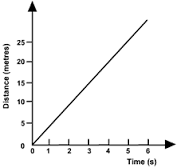
What is the line on this graph showing?
moving away from starting point at a constant speed
moving back towards the starting point at a constant speed
acceleration (getting faster)
deceleration (getting slower)

The normal force is always _________ to the surface
parallel
perpendicular
paradox
Pythagorean
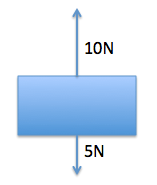
What happens when two forces act in the same direction?
They cancel each other out.
The stronger one prevails.
Their strengths are added.
Their sum divided by two is the total force.
The momentum of an object is in the same direction as its
force.
velocity.
acceleration.
inertia.
According to Newton’s third law of motion, when a hammer strikes and exerts force on a nail, the nail
creates a friction with the hammer.
disappears into the wood.
exerts an equal and opposite force on the hammer.
moves at a constant speed.
A person walks 70 meter east, then 40 meter west. What is the total distance traveled by the person?
110 meters
30 meters
55 meters
30 km
A person walks 70 meter east, then 40 meter west. What is the total displacement traveled by the person?
110 meters
30 meters
55 meters
30 km
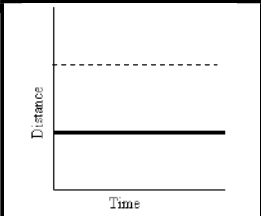
What is its final velocity?
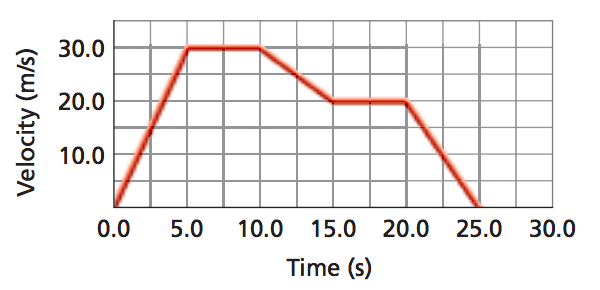

If the car is going 55 m/s, how many meters will it travel before it stops?

What is the type of motion of the object from the ticker tape chart above?
constant acceleration
velocity decreases uniformly
constant velocity
at rest

