
Font size
 Worksheets
Chapter 2: Hydrocarbon
Total questions: 54
Worksheet time: 34mins

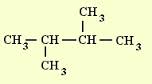
Which of the following has the lowest boiling point?
A. C5H12
B. (CH3)2CHC2H5
C. (CH3)4C
D. cyclopentane
Which of the following is a saturated hydrocarbon?
A. C2H4
B. C5H8
C. C4H10
D. C6H12
When ethene gas was passed through a hot potassium manganate (VII) solution, the product formed was
A. HCOCH3
B. CH3CH2OH
C. C2H4(OH)2
D. CO2 and H2O
Organic compound in the same homologous series have the following characteristic, except ....
Same general formula
Same functional group
Similar chemical properties
Same physical properties
The empirical formula of an organic compound is CH2O. The molecular formula that is suitable for that organic compound is ….
C2H6O2
C2H6O
C4H5O2
C5H10O5

The name for this compound is ....
2-ethylpropane
1,1-dimethylpropane
2-methylbutane
3-methylbutane

The name for the compound is ....
2,3-dimethylpropane
3,4-dimethylpropane
2,3-dimethylpentane
3,4-dimethylpentane
In which of the following reactions is oxygen use up?
Addition
Elimination
Combustion
Substitution

The structure of some hydrocarbon are shown above. The hydrocarbon that classified into saturated compound are ....
F, G, H
F, G, I
G, I, K
F & G

The compound which are the members of homologous series are ….
F & G
G & I
I & J
H & K
The product resulted if methane substituted by Cl2 is ….
CH3Cl & HCl
CH2Cl & HCl
C2H5Cl & HCl
C2H4Cl2 & HCl
The alkanes below which form as gas in room temperature is ….
C4H10
C5H12
C10H22
C20H42
The alkanes which will have the highest boiling point is ….
pentane
2-methylbutane
2,3-dimethylpropane
hexane

How many chemical bonds can each carbon atom form?
1
2
3
4
What can you tell about methane (CH4) from its molecular formula?
It contains four carbon atoms.
It contains one hydrogen atom.
It contains four hydrogen atoms.
It forms groups of four molecules.


What is the name of the ester molecule?
methyl propanoate
propyl methanoate
ethyl ethanoate
methyl butacoate
Which of the following statements is NOT correct about the preparation of ethanoic acid?
Ethanoic acid is prepared in the laboratory by the oxidation of ethanol
Acidified potassium dichromate(VI) will change from orange to green
Ethanoic acid produces vinegar smell
Acidified potassium dichromate(VI) acts as the reducing agent
Which of the following is NOT the properties of alcohols?
volatile
flammable
neutral in pH
undergo hydration process
What are the changes of colour of acidified potassium manganate(VII) in the oxidation reaction with alcohols?
from orange to green
from green to orange
from colourless to orange
from purple to colourless
Which of the following is NOT an example of an addition reaction for alkenes?
hydration
halogenation
dehydration
hydrogenation
Which of the following will react with Br2(l)
hexene
cyclohexane
hexane
hexanol
What process is used to separate crude oil in hydrocarbons with different chain lengths?
distillation
fractional distillation
cracking
polymerisation
Where in the fractionating column are shorter chain hydrocarbon molecules obtained?
At the top
At the bottom
Fractional distillation separates crude oil based on the different __________ of the molecules in the mixture
melting point
boiling point
freezing point
chemical reactivity
Molecules collected at the bottom of the fractionating column tend to be...
more viscous, less flammable and less volatile
less viscous, more flammable and more volatile
more viscous, more flammable and less volatile
less viscous, less flammable and more volatile
What are the 2 products of complete combustion?
carbon dioxide + hydrogen
carbon dioxide + water
carbon monoxide + water
carbon monoxide + hydrogen
What are the products of incomplete combustion?
carbon monoxide
water
carbon
hydrogen
What is the term given to the process by which longer chain hydrocarbons are broken down into shorter length alkanes and alkenes?
fractional distillation
evaporation
cracking
polymerisation
What conditions are needed for cracking?
high temperature
high pressure
catalyst
low temperature
C10H22 --> C5H12 + C3H6 + ?
C2H4
C3H4
CO2
CH4
When testing for alkenes (unsaturation) bromine water turns from...
orange --> blue/black
colourless --> pink
brown --> colourless
brown --> clear
Limewater turning cloudy is the test for...
carbon dioxide
water
hydrogen
oxygen
Crude oil is made up of:
Ethane
Butane
A mixture of different hydrocarbons
Extremely large hydrocarbons which are broken up once extracted
Each member of a homologous series differs from the next by a
–CH2 group
–CH group
–CO2 group
–CH4 group
Which of the following can be used to distinguish between alkanes and alkenes?
add a few drops of aqueous bromine
add a few drops of Universal indicator
add a piece of blue litmus paper
add a piece of red litmus paper
Which of the following statement is correct?
Alkenes can turn aqueous bromine from reddish-brown to colourless.
Alkenes can turn aqueous bromine from colourless to reddish-brown.
Alkanes can turn aqueous bromine from reddish-brown to colourless.
Alkanes can turn aqueous bromine from colourless to reddish-brown.
Alkanes undergo substitution by chlorine only in the presence of
UV light
oxygen
water
aqueous bromine
What is the product formed from the fermentation of rice with the presence of yeast?
ethanoic acid
ethane
ethene
ethanol
Which of the following process used to produce margarine in industry?
halogenation of alkene
hydrogenation of alkene
esterification reaction
saponification

