Wayground logo

Free Printable Worksheets

Font size

S
M
L
XL
Worksheets

Basic Chemistry Midterm Exam

Total questions: 60

Worksheet time: 1hrs 3mins

Name
Class
Date
1.

How would you find the mass of an object?

a)

Measure its dimensions with a ruler, and then multiply length x width x height

b)

Water displacement

c)

use a balance/scale

d)

use a timer

2.

Matter is anything that has:

a)

mass

b)

volume

c)

mass and volume

d)

substance

3.
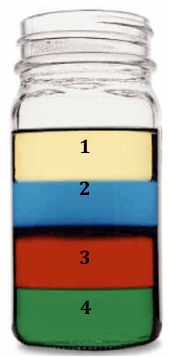
Put the liquids in order from most dense to least dense?
a)
4, 3, 2, 1
b)
1, 2, 3, 4
c)
3, 4, 2, 1, 
d)
4, 3, 1, 2
4.
Why does ice float?
a)
Liquid water is less dense than solid water.
b)
Solid water is less dense than liquid water.
c)
Gaseous water is less dense than solid water.
d)
Liquid water is less dense than gaseous water.
5.

Helium is a ____________.

a)

liquid

b)

solid

c)

gas

6.

A state of matter that has a definite volume and shape.

a)

solid

b)

liquid

c)

gas

d)

matter

7.

Which of the following is NOT a physical change?

a)

grinding

b)

cutting

c)

boiling

d)

burning

8.

The SI base units for length and time are

a)

centimeter and second

b)

meter and hour

c)

centimeter and hour

d)

meter and second

9.

What are some tools you can use to measure length?

a)

Ruler

b)

Beaker

c)

Thermometer

d)

Pan Balance

10.

A substance that cannot be separated or broken down into simpler substances by chemical means is?

a)

Mixture

b)

Element

c)

Compound

d)

Molecule

11.

The smallest part of any substance is?

a)

Element

b)

Compound

c)

Atom

d)

Molecule

12.
What is the atomic mass of this element? 
a)
Potassium
b)
K
c)
19
d)
39.098
13.
What element is this? 
a)
Oxygen
b)
Carbon
c)
Hydrogen
d)
Helium
14.

How are the elements arranged on the periodic table?

a)

Atomic number

b)

Atomic mass

c)

Alphabetically

d)

Chemical symbol

15.

What do elements in the same group (family) have in common with each other?

a)

Properties and valence electrons

b)

Atomic number and valence electrons

c)

Chemical symbol and atomic mass

d)

Atomic mass and atomic number

16.
What is the relationship between elements and atoms? 
a)
Elements are made of one type of atom and atoms are the smallest part of the element.
b)
Elements are made of two or more types of atoms and atoms are the smallest part of the element. 
17.

Electrons are located around the nucleus in energy levels. The first energy level is...

a)

Closest to the nucleus.

b)

Furthest from the nucleus.

c)

Able to hold the most electrons.

d)

Not able to hold any electrons.

18.

How many protons does the element in this image contain?

a)

14

b)

7

c)

15

d)

18

19.
Each row in a periodic table is called a 
a)
Group
b)
Period
c)
Row
d)
Column
20.
The atomic number tells you what?
a)
number of electrons
b)
number of protons
c)
number of neutrons
d)
both electrons and protons in an atom.
21.
Which group of the periodic table is composed of inert (not reactive)  gases?
a)
alkali metals
b)
alkaline earth metals
c)
halogens
d)
noble gases
22.
Elements which are shiny, conduct electricity and heat are called
a)
metal
b)
nonmetal
c)
metalloid
d)
nonexistent
23.
The atoms along the staircase are called 
a)
metals
b)
nonmetals
c)
metalloids
d)
noble gases
24.
Which is an alkali metal?
a)
Magnesium
b)
Iron
c)
Sodium
d)
Europium
25.

The vanadium atom (atomic number 23) in its ground state has the electronic configuration:

a)

1s2 2s2 2p6 3s2 3p6 3d3 4s2

b)

1s2 2s2 2p6 3s2 3p6 3d2 4s3

c)

1s2 2s2 2p6 3s2 3p6 3d1 4s2 4p2

d)

1s2 2s2 2p6 3s2 3p6 3d2 4s2 4p1

26.

The electron configuration of an atom is 1s22s22p6. The number of electrons in the atom is

a)

8

b)

7

c)

9

d)

10

27.

What electron configuration matches an oxygen atom?

a)

1s22s22p63s2, 3p64s23d104p5

b)

1s22s22p4

c)

1s22s22p6

d)

1s22s22p63s23p64s23d1

28.

Which of the following is true for the elements in the Periodic Table?

a)

There are fewer metals compared to non-metals.

b)

The size of the atoms increases with increasing nucleon number.

c)

The metallic property increases on going down a group.

d)

The reactivity increases on going down a group.

29.
Why does electronegativity increase across a period?
a)
Adding more energy levels makes the ve- further from the nucleus
b)
There are more valence electrons in the outer shell
c)
There are more protons  in the nucleus
d)
There are less protons in the nucleus
30.
What atom matches this electron configuration?
1s22s22p63s23p64s23d10
a)
Zinc
b)
Copper
c)
Nickel
d)
Germanium
31.

What is the shape of an s orbital?

a)

sphere

b)

dumbbell

c)

double dumbbell

d)

TOO COMPLEX TO KNOW IT.

32.

What is the shape of a p orbital?

a)

sphere

b)

it's just too complex to think about it

c)

dumbbell

d)

I don't know this stuff.

33.
A chemical bond resulting from the electrostatic attraction between positive and negative ions is called a(n)
a)
covalent bond.
b)
ionic bond.
c)
charged bond.
d)
dipole bond.
34.
How many valence electrons does a bromine atom have?
a)
1
b)
2
c)
6
d)
7
35.
If I gain electrons I become
a)
Positive because I've added to my atom
b)
negative because I've added electrons
c)
same because i'm balanced
d)
equal because now I have electrons
36.
Metals tend to 
a)
gain electrons
b)
lose electrons
37.
What is the correct formula for the compound, lithium oxide?
a)
LiO
b)
Li2O
c)
LiO2
d)
Li2O2
38.

Which one of these uses a covalent bond?

a)

KCl

b)

BaCl

c)

HCl

d)

CaCl2

39.

Which one of these uses an ionic bond?

a)

CO

b)

H2O

c)

BaO

d)

SO2

40.

Which one of these compounds uses a bond that shares electrons?

a)

NaCl

b)

SO2

c)

SrCl2

d)

MgO

41.

Which one of these compounds uses a bond that involves an electron transfer?

a)

HF

b)

CO

c)

MgO

d)

N2S9

42.
 A lone pair is defined as
a)
A pair of bonding electrons
b)
One non-bonding electron
c)
A pair of non-bonding electrons
d)
A pair of electrons on the central atom
43.
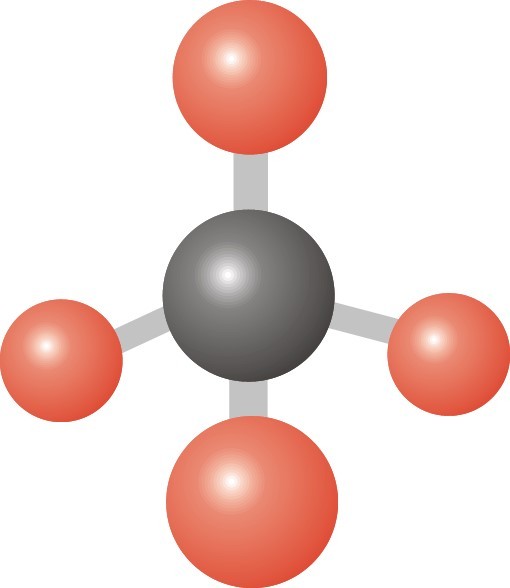
Who could this molecule be?
a)
CH4
b)
CO2
c)
PCl5
d)
BF3
44.
Which molecule below would have this shape?
a)
BF3
b)
CH4
c)
PCl5
d)
CO2
45.
Choose the correct shape for this molecule:
a)
Trigonal planar
b)
Trigonal pyramidal
c)
Bent
d)
Tetrahedral
46.
Choose the correct shape for this molecule:
a)
linear
b)
Trigonal pyramidal
c)
Bent
d)
Tetrahedral
47.

The geometry of a molecule with 4 bonded pairs of electrons and 0 lone pairs of electrons, AB4

a)

Tetrahedral

b)

Trigonal Planar

c)

Bent

d)

Trigonal Pyramidal

e)

Linear

48.
How many electrons should Oxygen have around its Lewis dot model?
a)
5
b)
6
c)
7
d)
8
49.
*
a)
trigonal pyramid
b)
linear
c)
bent
d)
angular
50.
What group is Potassium located in?
a)
1
b)
2
c)
3
d)
16
51.
H20 is the symbol for what?
a)
Sodium
b)
Potassium
c)
Hydrogen Peroxide
d)
Water
52.

Which element has a higher electronegativity value?

a)

Niobium

b)

Tin

c)

Cadmium

d)

Iodine

53.

Which element has a lower electronegativity value?

a)

Calcium

b)

Barium

54.

Electronegativity trends are the same as:

a)

Atomic radius trends

b)

Ionization energy trends

c)

Both of these

d)

None of these

55.

What does electronegativity do as you go across a period?

a)

decrease

b)

no pattern

c)

stay the same

d)

increase

56.

Which is the correct order of electronegativity from lowest to highest?

a)

Zinc, Nickel, Iron, Scandium

b)

Iron, Nickel, Zinc, Scandium

c)

Scandium, Iron, Nickel, Zinc

d)

Scandium, Iron, Zinc, Nickel

57.
Which has the greater EN: 
N or C?
a)
C
b)
N
58.
In a polar covalent bond, electrons are shared ___________.
a)
equally
b)
unequally
c)
between non-metals with similar electronegativities
d)
between a metal and a non-metal
59.
If Boron bonds with Hydrogen, a ____________ bond forms.
a)
polar covalent
b)
nonpolar covalent
c)
metallic
d)
ionic
60.

Water is a polar molecule because of unequal sharing of electrons between the oxygen and hydrogen atoms bonded together.

a)

true

b)

false