
 Worksheets
Earth Layers & the Rock Cycle
Total questions: 62
Worksheet time: 32mins
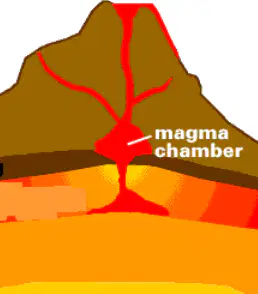
If the model below represents a volcano and its relationship to the layers of the Earth, from which of the Earth's layers does the magma come?
inner core
crust
outer core
mantle
Which of the following best describes the mantle?
A. The mantle has properties of gases and liquids only.
B. The mantle has properties of liquids only.
C. The mantle has properties of solids only.
D. The mantle has properties of both liquids and solids.
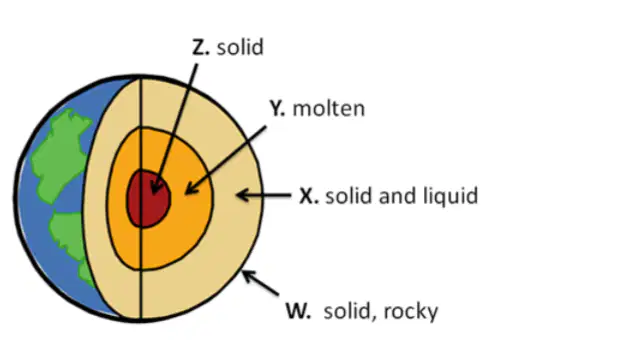
What is the name of the layer of the Earth that is labeled with the letter W?
crust
mantle
outer core
inner core

What can metamorphic rocks be made from?
sedimentary rocks
igneous rocks
other metamorphic rocks

What is the name of the layer of the Earth that is labeled with the letter X?
outer core
crust
mantle
inner core

The Earth's core is made of two parts - the inner and outer core. The inner core is made mostly of
liquid metal.
nonmetallic gas.
solid metal.
nonmetallic liquid.
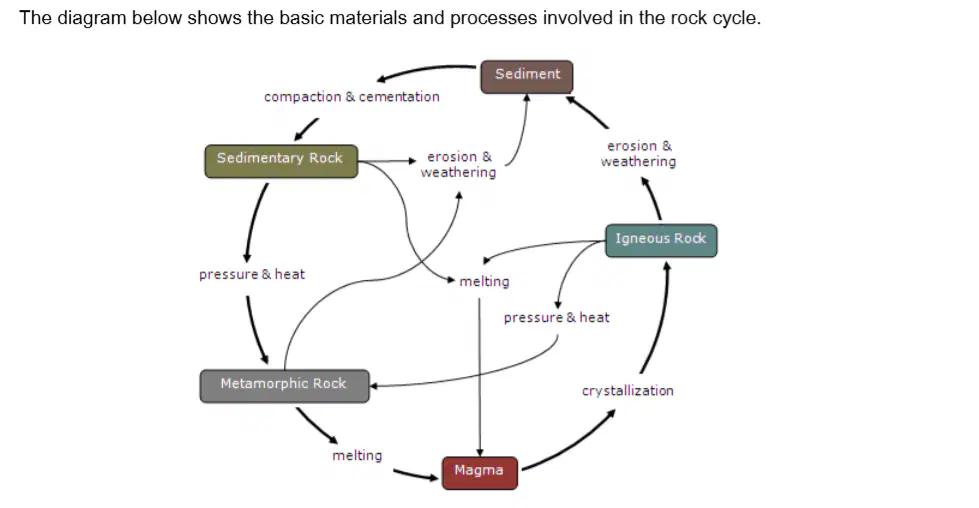
The diagram below shows the basic materials and processes involved in the rock cycle. Which process is involved in breaking down solid rock and turning it into sediment?
A. cementation
B. melting
C. compaction
D. weathering

Which of Earth's layers is the thinnest?
mantle
crust
inner core
outer core
Which choice below shows the steps of the formation of sedimentary rock in the correct order?
A. weathering → erosion → deposition → compaction/cementation
B. weathering → erosion → compaction/cementation → deposition
C. compaction/cementation → erosion → weathering → deposition
D. erosion → weathering → deposition → compaction/cementation

Which of the following lists Earth's compositional layers starting with Earth's center and ending with the outermost layer?
crust, mantle, core
mantle, crust, core
core, mantle, crust
crust, core, mantle
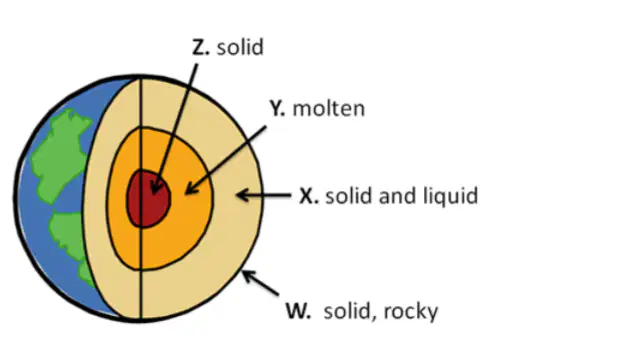
Look at the model of the Earth above. Which layer of the Earth is labeled Y?
the inner core
the outer core
the crust
the mantle
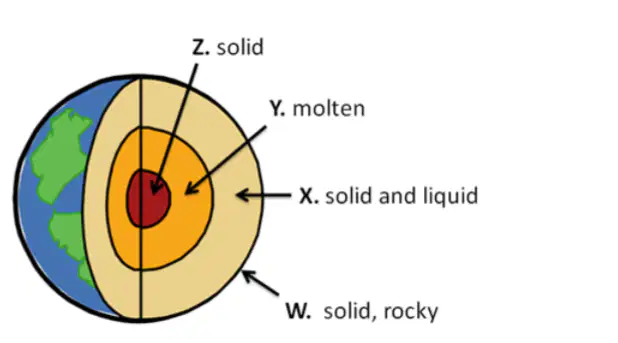
What is the name of the layer of the Earth that is labeled with the letter Z?
mantle
crust
inner core
outer core
_______ rock is formed when debris is buried, compressed and cemented together.
Magma
Igneous
Metamorphic
Sedimentary
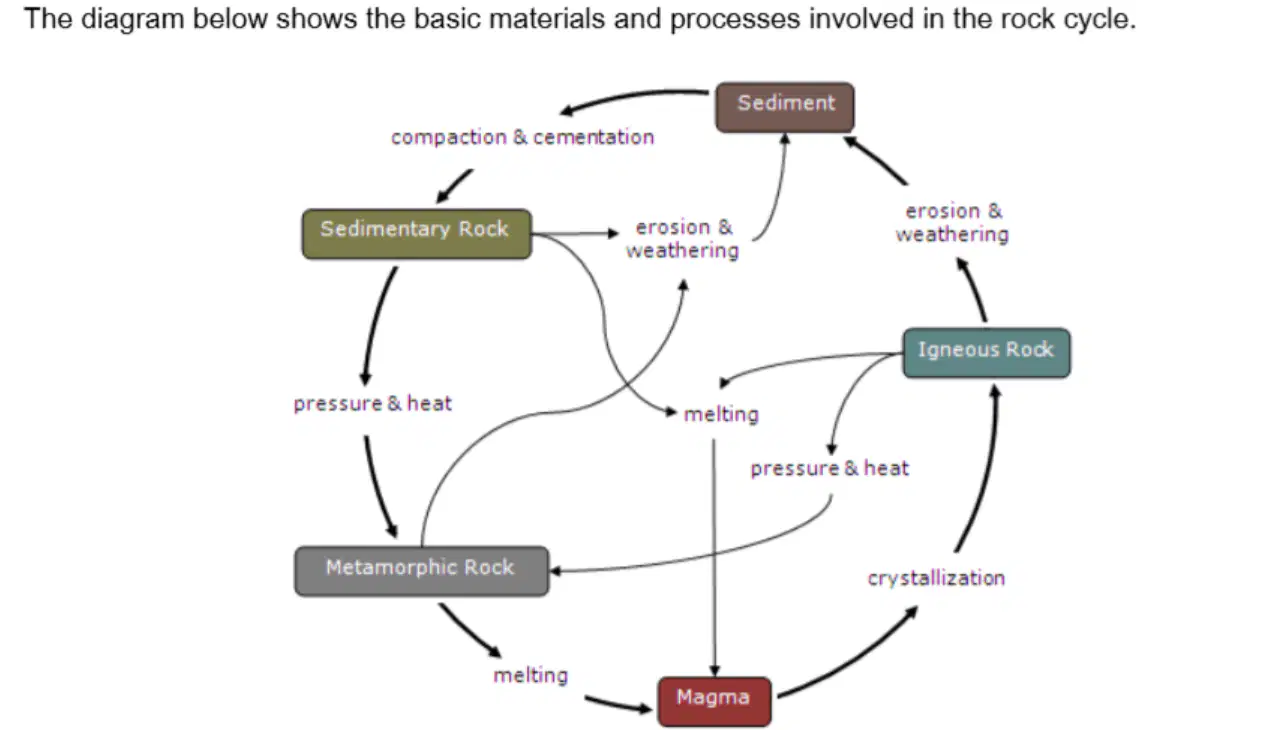
The diagram below shows the basic materials and processes involved in the rock cycle. Which of the following processes moves rock materials across the surface of the Earth?
erosion
crystallization
compaction
melting

Directions: What is the correct order of steps for a layer of sediment to become sedimentary rock?
1. The sediment is deposited by wind, flowing water, or other natural processes. 2. The sediment is gradually buried and compacted. 3. Dissolved minerals completely cement the sediment together.
1. The sediment is gradually buried and compacted. 2. The sediment is deposited by wind, flowing water, or other natural processes. 3. Dissolved minerals completely cement the sediment together.
1. Dissolved minerals completely cement the sediment together. 2. The sediment is deposited by wind, flowing water, or other natural processes. 3. The sediment is gradually buried and compacted.

Which one of the Earth's layers is the thinnest?
inner core
crust
mantle
outer core
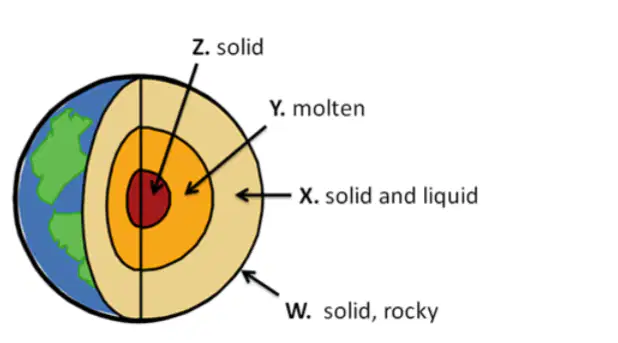
Which arrow on the picture below is pointed at the Earth's mantle?
A. W
B. Y
C. Z
D. X
The hard and brittle outer layer of the Earth is known as the _______.
core
atmosphere
mantle
lithosphere
Which of the following lists Earth's compositional layers in order of increasing density?
A. crust, core, mantle
B. crust, mantle, core
C. core, mantle, crust
D. mantle, crust, core
The two most abundant elements in Earth's core are
iron and nickel
nickel and silicon
silicon and oxygen
iron and magnesium
When rocks return to the Earth's mantle, they can eventually melt and become magma. _______ and _______ are the main factors that control this change.
Temperature
Pressure
Density
Composition
Which of the following would be the best model of the Earth's layers?
a water balloon
a potato
a peach
a basketball
What is the name for the process of recycling materials that make up the Earth's crust and mantle?
the carbon cycle
the water cycle
the nitrogen cycle
the rock cycle
Which layer of the Earth is the coolest in temperature?
the inner core
the crust
the outer core
the mantle
The main agents that cause metamorphic rocks to form are
melting and cooling.
heat and pressure.
weathering and erosion.
deposition and compaction.
The Earth's mantle is
cooler than both the crust and the core.
hotter than both the crust and the core.
hotter than the crust but cooler than the core.
cooler than the crust but hotter than the core.
Some rocks are pushed deeper into the Earth. As these rocks experience greater heat and pressure, what type of rock will they turn into if they do not melt?
sedimentary
molten
metamorphic
igneous

What type of rock are mid-ocean ridges made of?
sedimentary rock
fossilized rock
metamorphic rock
igneous rock

Look at the diagram of the rock cycle below. Which part of the cycle is missing?
mineral integration
crystallization
sedimentation
melting
Most of the Earth's volume is contained in the _______ .
A. outer core
B. inner core
C. mantle
D. crust
Which of the following is located at the center of the Earth?
mantle
atmosphere
core
crust

What is the name of the layer of the Earth that is labeled with the letter W?
inner core
crust
outer core
mantle

Which type of rock contains minerals arranged in crystals and forms when molten rock cools and turns solid?
igneous rock
metamorphic rock
sedimentary rock
fossilized rock
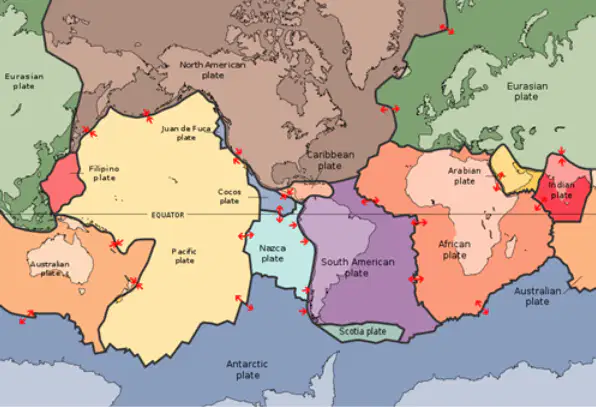
The diagram below shows the Earth's primary tectonic plates. Which of the following statements is true?
The Earth's mantle is made up of tectonic plates.
The Earth's lithosphere is made up of tectonic plates.
The Earth's lithosphere is entirely made up of liquid magma.
The Earth's mantle is made up of continents.

Layers of sand and other sediments that become sedimentary rock:
always contain the remains of both plants and animals.
can contain the remains of plants, animals, or both.
can contain the remains of plants but not animals.
can contain the remains of animals but not plants.
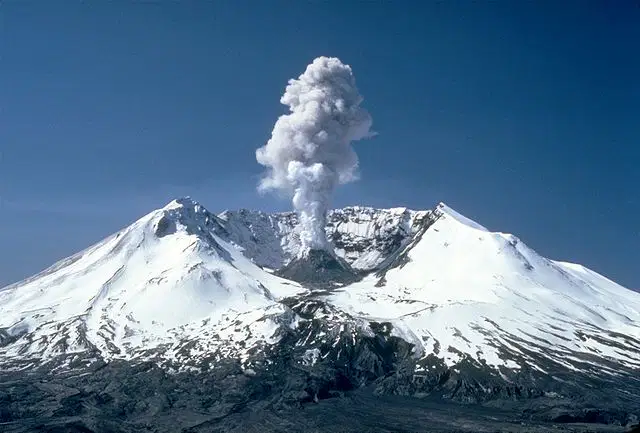
A volcano is a geological formation that can erupt and release lava, ash, and gases. What is a volcano?
A mountain that erupts
A river that flows
A forest that grows
A desert that expands
The mantle is the thick middle layer located between the Earth's ______ and Earth's core.
crust
ocean
atmosphere
surface

The mantle has properties of both ______ and ______.
(a)
The hottest layer of the Earth is:
Crust
Mantle
Outer Core
Inner Core
Metamorphic rocks can be formed from ______ rocks, ______ rocks, or other ______ rocks.
igneous rocks, sedimentary rocks, or other metamorphic rocks.
igneous rocks
metamorphic rocks
metamentaty rocks
The inner core of the Earth is very dense and made mostly of a solid metal - ______.
iron
gold
silver
copper
Solid rock is broken down into sediment by the processes of ______.
weathering
erosion
deposition
compaction
What is weathering?
The process of breaking down rocks and minerals through natural forces.
The movement of tectonic plates.
The formation of new rocks from magma.
The process of photosynthesis in plants.
Erosion is the transporting of the broken rock material, or sediments, to a new location, where it is ____.
deposited
eroded
dissolved
evaporated
What is compaction in the context of sedimentary rocks?
The process of sediments being pressed together under their own weight
The chemical alteration of minerals within the rock
The transportation of sediments by wind or water
The melting of rocks into magma
Cementation in sedimentary rock formation is:
the process of sediments being compacted and glued together
the melting of rocks to form magma
the erosion of rocks by wind and water
the cooling and solidification of magma
The estimated temperature range of Earth's core is:
1000-2000°C
2000-3000°C
3000-5000°C
5000-7000°C
Earth's layers, from outside to the center, are the crust, the mantle, the outer core, and the inner core. Which is at the very center of Earth?
inner core
crust
mantle
outer core
The Earth's hottest and most dense layer is the ____.
mantle
crust
outer core
inner core
Sedimentary rock is formed by layers of sediments settling on top of other layers of sediment.
True
False
Erosion is the process by which blowing wind or running water carries away pieces of earth material.
True
False
The Earth's lithosphere is the rocky, rigid, and brittle outer layer of the planet. True or False?
True
False
21. The Earth's compositional layers in order of increasing density are: crust, mantle, core. The layers increase in density with depth (i.e., the layer at the surface of the Earth—the crust—is the least dense, and the layers toward the center of the Earth—the mantle and the core—are more dense) as a result of the composition of materials in each layer as well as an increase in pressure with depth.
crust, mantle, core
core, mantle, crust
mantle, crust, core
core, crust, mantle
What is the composition of the Earth's core?
The Earth's core is made mostly of iron, with lesser amounts of nickel.
The Earth's core is made mostly of silicon, with lesser amounts of oxygen.
The Earth's core is made mostly of magnesium, with lesser amounts of aluminum.
The Earth's core is made mostly of carbon, with lesser amounts of sulfur.
What are the main factors responsible for rocks melting and becoming magma?
Heat and pressure
Cold and pressure
Heat and cold
Pressure and cold
What is magma and how does it relate to lava?
Magma is melted rock trapped beneath the Earth's surface, pushed upward by convection currents, and when it reaches the Earth's surface, it is called lava.
Magma is a type of sedimentary rock found on the ocean floor, and when it solidifies, it becomes lava.
Magma is a type of volcanic ash that cools and hardens into lava when it contacts water.
Magma is a gaseous substance found in the Earth's atmosphere, and when it condenses, it forms lava.
25. Which would represent the layers of the Earth best with its three layers of skin, flesh, and pit that could be designated the crust, mantle, and core of the Earth.
Peach
Water balloon
Basketball
Potato
What is the rock cycle?
The rock cycle is the name given to the process that the materials of the Earth's crust and mantle go through as they are naturally recycled, changed, and reformed.
The rock cycle is a type of bicycle used for mountain climbing.
The rock cycle is a musical genre that combines rock and classical music.
The rock cycle is a method of training rocks to perform in circuses.
What is the temperature of the earth at the inner core and the crust?
The temperature of the earth is the hottest at the inner core and is the coolest at the crust.
The temperature of the earth is the same at the inner core and the crust.
The temperature of the earth is the coolest at the inner core and the hottest at the crust.
The temperature of the earth is moderate at both the inner core and the crust.
What is a metamorphic rock?
A metamorphic rock is rock that has changed in composition or form, usually due to heat and pressure. Metamorphic rocks can be formed from igneous rocks, sedimentary rocks, or other metamorphic rocks.
A metamorphic rock is a type of rock that forms from the cooling and solidification of magma or lava.
A metamorphic rock is a rock that is formed from the accumulation and compaction of mineral and organic particles.
A metamorphic rock is a rock that is formed by the evaporation of water, leaving behind minerals.
30. After sedimentary rock has formed, it can be further buried, pushed, or pulled into the Earth's interior. When the depth is great enough, heat and pressure cause the mineral structure of the rock to change, and the rock becomes a metamorphic rock. Greater amounts of heat can melt rock to form magma. Magma rises upward because it is less dense than the surrounding rock. When magma cools enough, it turns to solid, igneous rock. If this igneous rock is uplifted and exposed at the Earth's surface, it can be weathered and eroded to form new sediments, which can eventually become new sedimentary rocks. What type of rock is formed when magma cools?
Sedimentary rock
Metamorphic rock
Igneous rock
Magma

What is the thickest layer of the Earth?
Crust
Mantle
Outer Core
Inner Core

