
 Worksheets
Space Invaders Unit Review
Total questions: 59
Worksheet time: 30mins
The phases of the moon are caused by
the moon revolving around the sun and Earth.
Earth revolving around the sun and the sun's light being reflect off the moon.
the moon revolving around Earth and the moon reflecting sunlight towards Earth
the moon revolving around Earth with sunlight reflecting off of Earth towards the moon.
Which is the correct alignment for a solar eclipse?
sun - moon - Earth
moon - sun - Earth
Earth - sun - moon
moon - Earth - sun

This is a ___________ crescent moon.
new
waning
full
waxing

Based on the image, which letter represents a solar eclipse?
A
B
C
D

The model shows the phases of the moon during a one month period. Which one of the moons in this picture shows the position during the full moon?
A
B
E
G
Why do we not experience eclipses every month?
The moon is stubborn.
The Moon's orbit is tilted
Moon is smaller than the Sun
Earth's orbit is tilted
The seasons are caused by the ________ of the axis and the Earth's _____________ around the sun.
tilt, revolution
tilt, rotation
curve, revolution
curve, rotation


Why does the sun appear to move across the sky?
Earth's orbit around the sun
Earth's rotation on its axis
the sun's rotation
movement of the stars
Among the Earth, Sun, and Moon, what makes the Earth unique? Only the Earth –
can generate energy
lacks an atmosphere
is made mostly of rock
contains water in liquid form
The imaginary line through Earth that extends
from the North Pole to the South Pole and is the
center of Earth’s rotation
Axis
Tilt
Orbit/Revolve
Sun
When the full moon passes into Earth’s shadow,
Solar Eclipse
Lunar Eclipse
Sun
Moon
A celestial body that revolves around a planet
Sun
Star
Moon
Earth
A curved path followed by a satellite as it revolves
around an object
Rotation
Sun
Star
Orbit/Revolve
Divisions of the year based on
changes due to varying amounts of
sunlight received caused by the tilt of Earth during
its revolution
Seasons
Lunar/Moon Phases
Solar Eclipes
Lunar Eclipse
A star and the group of planets and other celestial bodies that are held by its gravitational attraction and revolve around it
Sun
Moon
Seasons
Solar System
The luminous star around which Earth and other planets revolve
Star
Sun
Earth
Moon

How long does it take the Earth to orbit the Sun?
365 days
34 hours
one season
295 days
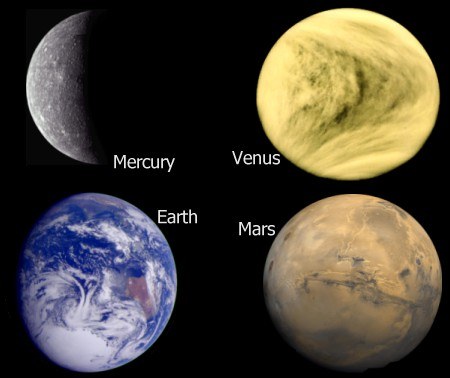

Which planet is NOT one of the
"Gas Giants"?
Uranus
Venus
Neptune
Saturn

What is the largest planet in
our solar system?
Neptune
Jupiter
Uranus
Mars

This table shows the rotation period and revolution period for 6 planets, and Earth’s moon, all relative to Earth’s periods. Which 2 planets have shorter days than Earth?
Jupiter and Saturn
Venus and Mercury
Mars and Jupiter
Saturn and Moon

a small rocky body orbiting the sun, ranging from the size of a small house to dust particles
nebula
terrestrial planets
collision
asteroids

The data below shows characteristics of the four known terrestrial planets in our solar system.
Based on the data and your understanding of the characteristics that support life, which planet is most likely Earth?
Planet W
Planet X
Planet Y
Planet Z

Which planet would be the most likely place to observe for life?
Planet A
Planet B
Planet C
Planet D

The two most abundant gases in Earth’s atmosphere are nitrogen and oxygen.
Which planet would most likely be able to support life from Earth?
Planet A
Planet B
Planet C
Planet D
Which of the following characteristics of the Earth are essential to the existence of life?
1.Earth’s size causes acceleration due to gravity to be 9.8 m/s^2.
2.Earth’s atmosphere is composed of mostly nitrogen with oxygen and carbon dioxide.
3.Earth’s surface has an abundance of silicon oxide in the form of sand.
4.Earth’s surface temperature ranges from -88°C to 58°C.
5.Earth’s magnetic field repels some solar radiation from reaching the surface.
Characteristics 2 and 4
Characteristics 1, 2, and 4
Characteristics 2, 4, and 5
Characteristics 1 and 3

The table shows characteristics of planets in our solar system.
Which planet could most likely support human life?
Planet A
Planet B
Planet C
Planet D

Scientists have determined that there is a particular distance from the Sun that is most likely to allow life to inhabit a planet. This area is called the inhabitable zone and is shaded in the diagram below. Also, the planet needs liquid water and oxygen present.
According to the information above, why would Planet E NOT be a good place to look for life?
Too Hot
No Oxygen
Too Cold
No Water
After World War II, the US was locked in a space race with
China
England
Germany
the Soviet Union
In which mission did the US first land a man on the moon?
Explorer
Apollo 11
Sputnik 1
Challenger
True or False: The force of gravity on the ISS is about equal to the force of gravity on Earth.
True
False
During the ____ ____ , the United States and the Soviet Union engaged a competition to see who had the best technology in space.
Blue Moon
Cold War
Civil War
None of the above
The Space Race was considered important because...
it showed the world which country had the best science, technology, and economic system.
the Soviet Union was much more advanced in science and technology.
the United States is the largest country in the world.
we had an opportunity to win many medals.
Sputnik I was the name of the first successful satellite built by the _________ on October 4, 1957.
Canadians
South Americans
Soviet Union
the United States
On September 12, 1962, John F. Kennedy delivered a monumental speech at Rice University. He discussed....
the meaning of democracy.
why we choose to go to the moon.
how to fly a space craft.
the path to success.
Which country placed the first man in space and orbited the Earth?
The United States
The Soviet Union
England
France
Yuri Gagarin was a cosmonaut from the _________ __________.
Soviet Union
Great Plains
United States
Big Easy
The race to the moon was called the ______ ________.
Amazing Race
Fastest Race
Space Race
Hardest Race
Did the United States launch their first satellite into space before or after the Soviet Union?
Before
After

