wayground logo

Free Printable Worksheets

Font size

S
M
L
XL
Worksheets

Energy Flow and Phase Change

Total questions: 64

Worksheet time: 22mins

Name
Class
Date
1.

Equal volumes of 40 degree Celsius water and 60 degree Celsius water are mixed. What is the final temperature of the water?

a)

100 degrees Celsius

b)

50 degrees Celsius

c)

20 degrees Celsius

d)

80 degrees Celsius

2.
What is the definition of CONDUCTION?
a)

When heat is transferred from objects as rays of electromagnetic energy.

b)

A hot liquid or air that  expands (becomes less dense) and rises or becomes more dense and sinks.

c)

When heat transfers between objects that are touching.

3.

Heat conduction requires

a)

electricity

b)

the electromagnetic spectrum and particles

c)

air or water flow

d)

direct contact

4.

Heat transfer always moves ...

a)

cold to hot

b)

hot to cold

5.

If you walk barefoot on hot asphalt, energy is transferred by which process?

a)

Convection

b)

Radiation

c)

Conduction

d)

Reflection

6.

The following diagram shows water in contact with an ice cube and warmer air. Which way will energy flow?

a)

From the air to the water

b)

From the water to the air

c)

From the ice cube to the air

d)

From the ice cube to the water

7.

Energy is transferred as heat between two objects of ___________ temperatures.

a)

different

b)

same

8.
Which direction is heat flowing in the picture?
a)
from the hand to the ice
b)
from the ice to the hand
c)
heat is not being transferred
d)
there is no way to tell
9.
The transfer of heat energy by direct contact, or touch, is __________________?
a)
radiation
b)
convection
c)
conduction
d)
greenhouse effect
10.

Where do we see conduction in a pot of boiling water on the stove?

a)

The water absorbs heat by touching the hot metal pot.

b)

The steam from the hot water rises out of the pot.

c)

The heat from the fire can be felt on all sides.

11.

Equal volumes of 20 degree Celsius water and 40 degree Celsius water are mixed. What is the final temperature of the water?

a)

30 degrees Celsius

b)

20 degrees Celsius

c)

60 degrees Celsius

d)

50 degrees Celsius

12.

Phase change going from Liquid to Solid...

a)

Melting

b)

Freezing

c)

Condensation

d)

Evaporation

13.

Phase change going from a Gas to a Liquid...

a)

Freezing

b)

Melting

c)

Evaporation

d)

Condensation

14.

Phase change going from a Liquid to a Gas...

a)

Evaporation

b)

Melting

c)

Freezing

d)

Condensation

15.

Phase change going from a Solid to a Liquid...

a)

Freezing

b)

Condensation

c)

Melting

d)

Evaporation

16.

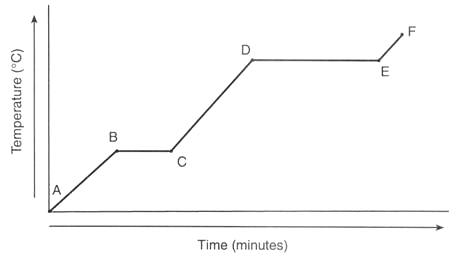
Is the substance gaining or losing energy?

a)

Gaining

b)

Losing

17.

Are the particles moving faster or slower as time goes on?

a)

Faster

b)

Slower

18.

What state/phase is the object likely from points A to B?

a)

Solid

b)

Liquid

c)

Gas

19.

What is happening to the particles in the substance between points A and B?

a)

Melting

b)

Freezing

c)

Speeding Up

d)

Slowing Down

20.

What is happening to the particles in the substance between points D and E?

a)

Melting

b)

Freezing

c)

Evaporation

d)

Condensation

21.

Is the substance gaining or losing energy?

a)

Gaining

b)

Losing

22.

Are the particles moving faster or slower as time goes on?

a)

Faster

b)

Slower

23.

Where on the graph are phase changes taking place?

a)

1

b)

2

c)

3

d)

4

e)

5

24.
When molecules flow around each other, they are in this phase
a)
solid
b)
liquid
c)
gas
25.

Sam had a solid and added enough energy for it to turn into a liquid. What did the molecules look like?

a)
The molecules moved in place.
b)
The molecules moved away from each other.
c)
The molecules didn't move.
d)
The molecules moved around each other.
26.
What is the energy that an object has because it is moving?
a)
kinetic
b)
potential
c)
electric
d)
wind
27.
What takes place when a liquid changes to a gas?
a)
condensation
b)
melting
c)
evaporation
d)
freezing
28.
What is a group of atoms joined together called?
a)
an atom
b)
molecule
c)
matter
d)
compound
29.
What takes place when a solid changes to a liquid?
a)
condensation
b)
melting
c)
evaporation
d)
freezing
30.
What is the average kinetic energy of a substance called?
a)
volume
b)
temperature
c)
pressure
d)
movement
31.
What takes place when a liquid changes to a solid?
a)
condensation
b)
melting
c)
evaporation
d)
freezing
32.
What takes place when a gas changes to a liquid?
a)
melting
b)
freezing
c)
evaporation
d)
condensation
33.
What takes place when a solid changes to a liquid?
a)
condensation
b)
freezing
c)
melting
d)
evaporation
34.
If you have a liquid that changes to a gas, explain it's freedom of movement in both phases.
a)
molecules move away from each other, then around each other
b)
molecules move in place, then around each other
c)
molecules move around each other, then away from each other
d)
molecules move around each other, then in place
35.

If molecules in a substance move in place and enough energy is transferred into the substance to make the molecules slide past each other

a)

it will be a solid

b)

it will be a liquid

c)

it will be a gas

36.
Before: molecules move around each other, After: molecules move in place
a)

Before the substance was a solid and later a liquid.

b)

Before the substance was a gas, and later a liquid.

c)

Before the substance was a liquid and later a solid.

d)

Before the substance was a liquid, and later a gas.

37.

Equal volumes of 5 degree Celsius water and 45 degree Celsius water are mixed. What is the final temperature of the water?

a)

40 degrees Celsius

b)

50 degrees Celsius

c)

25 degrees Celsius

d)

30 degrees Celsius

38.
If energy is taken out of the substance, and the substance changed into a liquid,
a)
the substance started as a solid
b)
the substance started as a liquid
c)
the substance stayed the same
d)
the substance started as a gas
39.
Are there molecules moving in a solid brick?
a)
yes
b)
no
c)
maybe
40.
What happens to molecules when kinetic energy increases?
a)
they move slower
b)
they move faster
c)
they get heavier
d)
it depends on the types of molecules
41.
When molecules move slower, kinetic energy
a)
increases
b)
stays the same
c)
decreases
d)
none of these
42.
Boiling is ...
a)
liquid to gas
b)
gas to solid
c)
gas to liquid
d)
solid to liquid
43.
During a phase change what happens to temperature?
a)
it increases
b)
it decreases
c)
depends; if being heated it increases, if being cooled it decreases
d)
stays constant
44.
All changes in the state of matter of a substance requires a change in 
a)
mass
b)
temperature
c)
permission
d)
energy
45.
Change from gas to liquid...
a)
condensation
b)
evaporation
c)

freezing

d)

melting

46.

Change from Liquid to Solid is called......

a)

melting

b)

freezing

c)

condensation

d)
evaporation
47.
change from liquid to gas is called....
a)

freezing

b)

melting

c)
condensation
d)

evaporation

48.
Melting is ...
a)
liquid to solid
b)
solid to liquid
c)
solid to gas
d)
gas to liquid
49.

What phase change is evident in the picture?

(The water collecting on the outside of the glass)

a)

evaporation

b)

condensation

c)

melting

d)

freezing

50.

What is happening to the butter in the picture?

a)

It changes from solid to gas.

b)

It changes from liquid to solid.

c)

It changes from liquid to gas.

d)

It changes from solid to liquid.

51.

What is the reason for the droplets of water on plants early in the morning?

a)

The water vapor in the air condenses during the night.

b)

The water content of the plant evaporates.

c)

The plant changes from solid to liquid.

d)

The water in the plants changes to solid.

52.
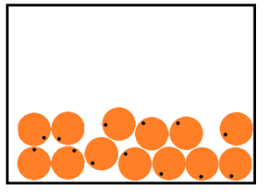
In a solid, the particles
a)
vibrate in place
b)
slide past one another
c)
overcome the strong attraction
53.
7. All phase changes (changing states) requires energy to be added or taken away.
a)
True
b)
False
54.

Which line segment demonstrates evaporation occurring?

a)
B-C
b)
C-D
c)
D-E
d)
E-F
55.
As substance goes from D to E what happens to the distance between the particles?
a)
particles get closer together
b)
particles disappear
c)
particles get far apart
56.
The temperature at which a substance in the liquid state freezes is the same as the temperature at which the substance_________- 
a)
melts
b)
sublimes
c)
boils
d)
condenses
57.
What causes a solid to melt?
a)

An increase of energy.

b)

A decrease of energy.

c)

Particles fly off into the air.

d)

Particles from the air come together as a liquid.

58.

Which phase change absorbs energy to take place?

a)

freezing

b)

condensation

c)

evaporation

d)

all of the above

59.

The drops of water that appear on the outside of a glass of cold juice on a warm day are an example of?

a)

melting

b)

condensation

c)

evaporation

60.
At which point is this substance a liquid?
a)
A
b)
C
c)
E
61.
At what point(s) is a phase change occuring?
a)
A
b)
B and D
c)
D
d)
C and A
62.
Why does the graph have two flat lines at "b" and "d"?
a)
Those are times when we took the water off the hot plate
b)
Those are phase changes where temperature doesn't change while adding heat
c)
The line is flat because the water is all in the solid or gas phase
d)
The line is flat because temperature increases the most at those locations
63.
What is happening at "D" on the graph?
a)

water is boiling

b)

water is condensing

c)
water is melting
d)

water is freezing

64.

What phase of matter is illustrated in "E"

a)
solid
b)
liquid
c)
gas
d)
melting