
 Worksheets
Levels of Organization
Total questions: 58
Worksheet time: 22mins
The brain is made up of many tissues. This information can be used to determine that the brain is
unicellular
multicellular
part of bacteria
able to function independenly
In most animals, combinations of various tissues make up functional units called
epithelial cells
organs
organ systems
populations
The stomach helps break down food for digestion. Which BEST describes the stomach?
It is part of a cell with a fuction
It is a single cell that performs a life function
Made up of a small number of cells that perform a single function
Composed of millions of cells of different types working together to perform a function
Why is your skin considered to be an organ?
It is part of an organism.
It is made of cells.
It is made of tissues.
It acts as a barrier.
Which type of cell forms overlapping layers to protect the body?
Muscle cell
Nerve cell
Red blood cell
Skin cell
Which type of cell carries oxygen throughout the body?
Muscle cell
Nerve cell
Red blood cell
Skin cell
Which type of cell contracts and relaxes?
Muscle cell
Nerve cell
Red blood cell
Skin cell
Which statement best describes skin cells' structure and function?
These cells are disc-shaped and flexible, which allows them to easily transmit and receive signals from all over the body.
These cells are flat and form overlapping layers to protect the body.
These cells are long and thin so they can contract and relax to move the body.
These cells are disc-shaped and flexible so they can easily travel through the body and transport oxygen.
Which statement best describes muscle cells' structure and function?
These cells are disc-shaped and flexible, which allows them to easily transmit and receive signals from all over the body.
These cells are flat and form overlapping layers to protect the body.
These cells are long and thin so they can contract and relax to move the body.
These cells are disc-shaped and flexible so they can easily travel through the body and transport oxygen.
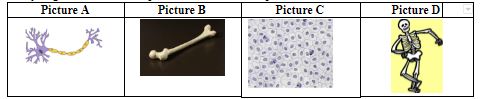
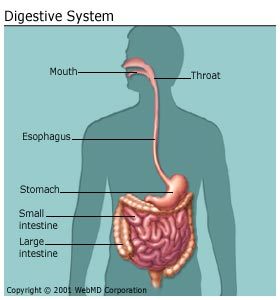
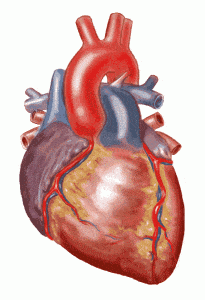
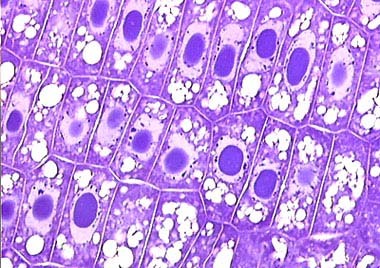
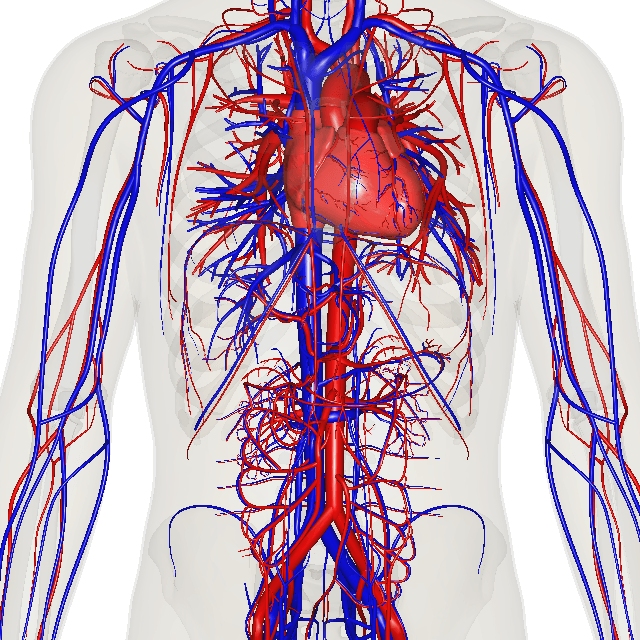
Which picture represents an organ?
A
B
C
D
How does an organ system differ from an organ?
A system is more complex and contains several organs
A system is not made up of cells like an organ is.
A system is only found in very large organisms.
A system is just one part of an organ.

This picture represents which of the levels of organization?
atom
organ
organelle
cell

This picture represents which of the levels of organization?
tissue
organelle
organ
organ system

This picture represents which of the levels of organization?
organ
organism
tissue
organ system

This picture represents which of the levels of organization?
tissue
organism
organ
organ system
What cells carry electrical signals?
Red blood cells
Nerve cells
Sperm cells


What type of cell is this?
Neuron (Nerve Cell)
Sperm Cell
Bone Cell
Cancer Cell

What type of cell is this?
Ovum (Egg Cell)
Sperm Cell
Myocyte (Muscle Cell)
Cancer Cell

What type of cells are these?
muscle cells
ciliated cells
nerve cell
root hair cells
How is a sperm cell adapted?
It has a tail, so can swim towards the egg
It has no nucleus
It has lots of chloroplasts
It has lots of branches
How has the egg adapted to feed the growing baby?
It has a cell wall
It has yolk in the cytoplasm
It has lots of chloroplasts
It has a nucleus
Which specialised cell is long and branched
Egg
Sperm
Nerve cell
Red Blood Cell

What is the name of this plant cell?
Hairy Root Cell
Root Hair Cell
Palisade Cell
Sperm Cell
How are palisade cells adapted to carry out their job?
They are long and branched
They have hairs
They don't have a nucleus
They have lots of chloroplasts to feed the plant
Where in the body can we find ciliated cells?
Everywhere
Heart
Liver
Lungs and Airways
Palisade cells are found in...
human hearts
paliotic cells in the kidney
the surface of leaves to carry out photosynthesis
viruses that cause disease
What adaptation does a root hair cell have
Lots of chloroplasts for photosynthesis
It has animal cell parts
It can eat worms
Long extension of the cell wall to absorb water and nutrients
What is a Specialised cell? (Tick all that apply)
A cell that is adapted to do a certain job in the body
An Unspecialised cell
A cell that has been modified/changed to do a certain job
A type of white blood cell

Identify this specialised cell that helps in movement.
muscle cell
nerve cell
sperm
plnt cell
Ciliated cells...
in the airways help to trap and remove dust and germs
in the lungs kill viruses
are found in the human brain
have a double membrane around their cell

How are red blood cells adapted for their job?
No nucleus to make more space for oxygen
no chloroplasts
no cell wall
long tail to help them swim
Why do very active cells have lots of mitochondria?
Mitochondria release energy to power cells
Mitochondria help cells to divide in two
Mitochondria help give the cell their shape
Mitochondria make hormones
What is another name for the extensions on nerve cells?
(a)
How are the muscles adapted to their function?
they have small hairs
They do not have a nucleus
They are held together in bundles
They are long and branched
Which of the following is an adaptation of a red blood cell?
Contain haemoglobin
Contain a nucleus
Small hairs
A tail to allow movement
True or false: Root hair cells do not contain chloroplasts.
True
False
Which of these is/are correctly matched?
cardiac muscle- forms wall of heart
smooth muscle- responsible for voluntary movement
skeletal muscle- responsible for involuntary body activities
What is the function of red blood cells?
Help to digest your food.
Provide nutrients to your organs.
Help you breathe.
Carry oxygen throughout your body.

