wayground logo

Free Printable Worksheets

Font size

S
M
L
XL
Worksheets

Social Studies Review 3

Total questions: 93

Worksheet time: 54mins

Name
Class
Date
1.

Who is the current Vice President?

a)

Hillary Clinton

b)

Michael Pence

c)

Kamala Harris

d)

Phil Murphy

2.
Why did President Obama not run for President in 2016? 
a)
He did not have enough votes 
b)
He wanted to retire 
c)
According to The Constitution he could not 
d)
Trump won 
3.
Who makes/ passes the laws in our nation? 
a)
President 
b)
Supreme Court 
c)
Congress 
d)
Governors 
4.
What war gave American its independence? 
a)
Revolutionary War 
b)
Civil War 
c)
WWI 
d)
WWII
5.
Who did America fight against in the Revolution? 
a)
Spain 
b)
France 
c)
Native Americans 
d)
Britain 
6.
What caused the Revolutionary War? 
a)
Native Americans pushing back from losing land 
b)
High taxes in France 
c)
High taxes and lack of power in the colonies 
d)
Spanish government putting taxes on citizens in the US 
7.

How many states are in the United States?

a)

13

b)

50

c)

25

d)

100

8.

Which national holiday celebrates and honors soldiers that died fighting for our country?

a)

Soldier's Day

b)

Veteran's Day

c)

Memory Day

d)

Memorial Day

9.

What country is SOUTH of the United States?

a)

Canada

b)

Mexico

c)

Oklahoma

d)

East

10.

This African-American activist fought for civil rights in the 1960s. We celebrate his birthday as a federal holiday.

a)

Martin Luther King, Jr.

b)

Martin Lawrence, Jr.

c)

Barack Obama

d)

Dwayne Johnson

11.

What body of water is bordered by Texas and Mexico?

a)

The Texico Sea

b)

Pacific Ocean

c)

Rio Grande River

d)

Gulf of Mexico

12.

Which of the following is NOT a service provided by our government to help our communities?

a)

Police

b)

Fire Department

c)

Grocery Stores

d)

Schools

13.

30* 20" North Latitude and 81* 40' West Longitude is an expression of

a)

absolute location

b)

compass rose

c)

elevation

d)

relative location

14.

A compass is a tool that is used to describe one component of motion. Which component of motion does a compass describe?

a)

Direction

b)

Distance

c)

Time

d)

Speed

15.

Imaginary lines that circle the Earth parallel to the Equator.

a)

Latitude

b)

Longitude

c)

Equator

d)

Projection

16.

Imaginary lines that circle the Earth from Pole to Pole, measuring distance east or west of the Prime Meridian.

a)

Latitude

b)

Longitude

c)

Scale

d)

Hemisphere

17.

Which of these tells you this distance north or south of the Equator?

a)

Latitude

b)

Longitude

c)

International Dateline

d)

Meridians

18.

A "half sphere," used to refer to one-half of the globe when divided into North, South, East, and West.

a)

Scale

b)

Latitude

c)

Longitude

d)

Hemisphere

19.

What element is missing from this map?

a)

scale

b)

title

c)

legend

d)

compass rose

20.

Which continent is marked by the number "1"?

a)

Asia

b)

South America

c)

Africa

d)

Europe

21.

Using the compass rose, what direction would you travel from Raleigh to Charleston

a)

Northwest

b)

Southwest

c)

Southeast

d)

Northeast

22.

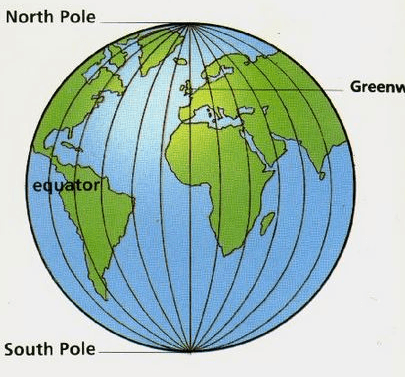
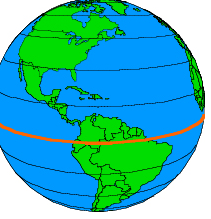
These two drawings of a globe show lines of longitude, or meridians, and lines of latitude, or parallels. Which kind of lines meet at the poles?

a)

both latitude and longitude

b)

neither latitude nor longitude

c)

latitude

d)

longitude

23.
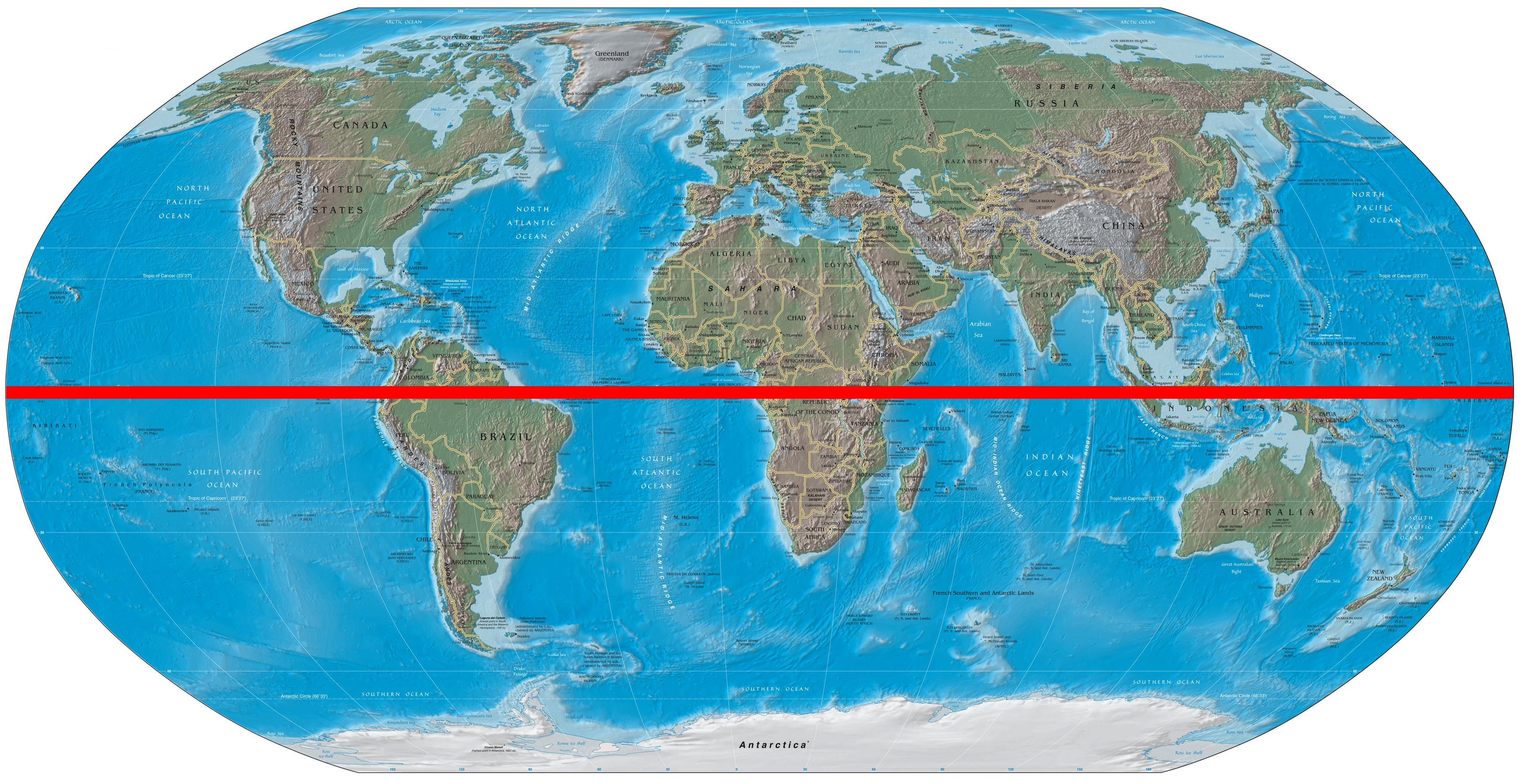
What is the name of this line at 0 degrees latitude?
a)
Prime Meridian
b)
Equator
c)
North Pole
d)
South Pole
24.
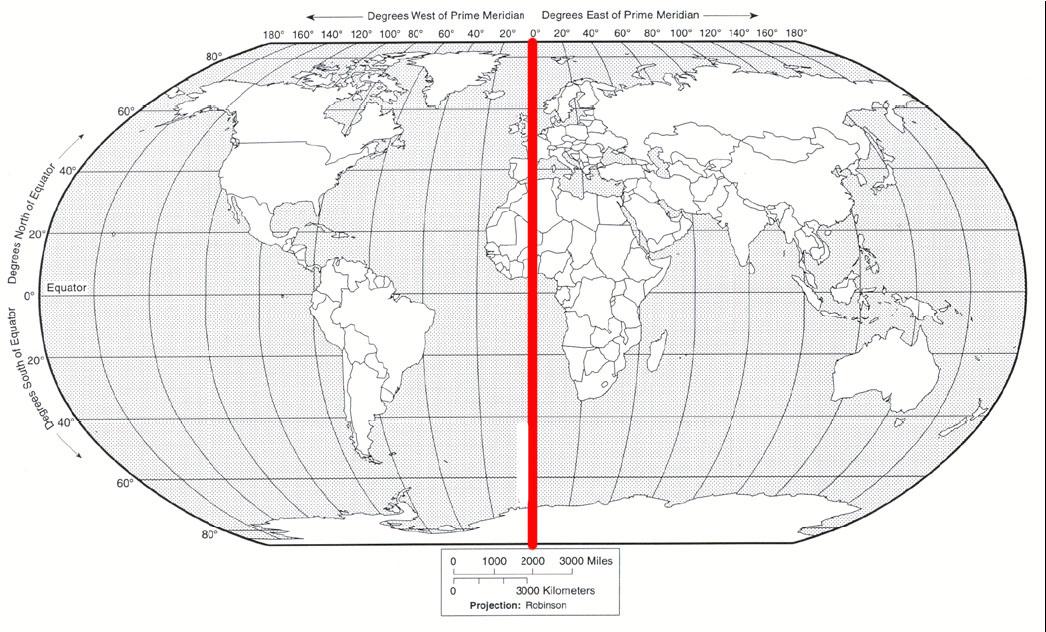
What is the name of the line at zero degrees longitude?
a)
Equator
b)
Prime Meridian
c)
North Pole
d)
South Pole
25.
a)
The map show the lines of longitude.
b)
The map shows the lines of latitude.
26.
a)
The map shows lines of longitude.
b)
The map shows lines of latitude.
27.
Lines of Longitude run from the _____ to the ______.
a)
East, West
b)
North, South
c)
South, East
d)
North, West
28.
Latitude lines run from the _____ to the  _______.
a)
West, East
b)
North, South
c)
North, East
d)
South, West
29.
The equator breaks the Earth into what two hemispheres?
a)
Eastern and Southern
b)
Northern and Southern
c)
Western and Eastern
d)
Northern and Western
30.
The Prime Meridian separates the Earth into what two hemispheres?
a)
Northern and Southern
b)
Western and Eastern
c)
Northern and Eastern
d)
Southern and Western
31.
Antarctica, Australia, and most of South America are in what hemisphere? 
a)
Northern 
b)
Southern 
c)
Western 
d)
Eastern
32.
Asia and Australia are in what hemisphere?
a)
Northern
b)
Southern
c)
Western
d)
Eastern
33.
North and South America are in what hemisphere?
a)
Northern
b)
Southern
c)
Western
d)
Eastern
34.
Europe, Asia and North America are in what hemisphere?
a)
Northern
b)
Southern
c)
Western
d)
Eastern
35.
Lines of latitude are also called  __________.
a)
hemispheres
b)
Parallels
c)
Meridians
d)
Tropics
36.
Lines of longitude are also called  ____________.
a)
Hemispheres
b)
Meridians
c)
parallels
d)
International Date Lines
37.
What is geography?
a)
the study of Earth
b)
the study of fossils
c)
the study of people
d)
the study of history
38.
Which of the following is a cardinal direction?
a)
northwest
b)
east
c)
southeast
d)
lake
39.
Map scale shows what?
a)
directions
b)
cities
c)
distance
d)
time
40.
Which of the following states border Ohio?
a)
Cleveland
b)
Texas
c)
Lake Erie
d)
Indiana
41.
We live on which continent?
a)
North America
b)
South America
c)
Europe
d)
Australia
42.
If one inch is equivalent to five miles.  How many miles is ten inches?
a)
60
b)
20
c)
50
d)
100
43.
What does a compass rose show?
a)
Key
b)
Distance
c)
Directions
d)
States
44.
What can you learn from a population density map?
a)
How many lakes there are
b)
How many states there are
c)
How many mountains there are
d)
How many people there are
45.
What is a synonym for (fertile) soil?
a)
cool
b)
poor
c)
dark
d)
rich
46.
What is a cash crop?
a)
plants grown by farmers to sell
b)
rich soil for planting
c)
pesticides
d)
animals used for trading
47.
What is another name for agriculture?
a)
living
b)
sewing
c)
farming
d)
hunting
48.
An atlas is a book of what?
a)
maps
b)
people
c)
bodies of water
d)
regions
49.

Which theme answer the question "Where is it?"

a)

Human Environment Interaction

b)

Place

c)

Location

d)

Region

50.

Which theme answers the question "How do ideas travel in and out of this place?"

a)

Human Environment Interaction

b)

Place

c)

Location

d)

Movement

51.

Which theme answers the question "What is it like there?"

a)

Place

b)

Human Environment Interaction

c)

Region

d)

Location

52.

Which theme answers the question "How have people adapted to the environment there?"

a)

Human Environment Interaction

b)

Place

c)

Movement

d)

Region

53.

Which theme answers the question "How can this place be divided into areas that have things in common?"

a)

Movement

b)

Region

c)

Place

d)

Location

54.

The country is 34 degrees north and 127 degrees east.

a)

Place

b)

Location

c)

Region

d)

Movement

55.

The ocean has become very polluted.

a)

Place

b)

Location

c)

Human Environment Interaction

d)

Region

56.

Greenville has the Danish Festival every year.

a)

Location

b)

Movement

c)

Place

d)

Region

57.

California is part of the western United States.

a)

Location

b)

Place

c)

Movement

d)

Region

58.

I called my friend to tell her what happened.

a)

Human Environment Interaction

b)

Movement

c)

Location

d)

Place

59.

I received a present in the mail from my grandma.

a)

Movement

b)

Place

c)

Location

d)

Human Environment Interaction

60.

Which theme looks at what it's like to live somewhere including human and physical characteristics?

a)

Movement

b)

Location

c)

Region

d)

Place

61.

Which theme involves the way people, goods, and ideas are shared?

a)

Human Environment Interaction

b)

Place

c)

Movement

d)

Location

62.

Which theme involves looking at certain areas that have something in common?

a)

Place

b)

Location

c)

Region

d)

Movement

63.

The transportation of goods, people, diseases, and ideas.

a)

Location

b)

Place

c)

Human-environment interaction

d)

Movement

e)

Region

64.

When places share a common characteristic

or set of characteristics

a)

Location

b)

Place

c)

Human-environment interaction

d)

Movement

e)

Region

65.

The description of a location. What is it like there?

a)

Movement

b)

Region

c)

Human Environment Interaction

d)

Location

e)

Place

66.

The relationship between people and their environment

a)

Movement

b)

Region

c)

Human Environment Interaction

d)

Location

e)

Place

67.

Provides the exact address of a place or an estimate of where it can be found.

a)

Relative Location

b)

Absolute Location

68.

This picture to the right best represents which theme of

a)

Movement

b)

Region

c)

Human Environment Interaction

d)

Location

e)

Place

69.

The image above represents which theme of

geography?

a)

Location

b)

Region

c)

Human Environment Interaction

d)

Movement

e)

Place

70.

The image above best represents which theme of

geography?

a)

Movement

b)

Region

c)

Human Environment Interaction

d)

Location

e)

Place

71.

An example is giving someone directions and telling them you're waiting across the road from 7/11 gas station.

a)

Absolute Location

b)

Relative Location

72.

Depend on, adapt to, or modify the environment.

a)

Movement

b)

Region

c)

Human Environment Interaction

d)

Location

e)

Place

73.
Which feature is a land mass surrounded by water but smaller than a continent?
a)
Island
b)
peninsula
c)
Gulf
d)
Lake
74.
Which feature is a natural stream of fresh water that empty into a larger body of water?
a)
Lake
b)
River
c)
Tributary
d)
Ocean
75.
What are parts of a sea or ocean partly surrounded by land?
a)
Lake
b)
Mountain
c)
Gulf/Bay
d)
River
76.
These are elevated areas that are smaller than mountains. 
a)
Valleys
b)
Plateaus
c)
Moutains
d)
Hills
77.
What are pieces of land surrounded by water on three sides?
a)
Island
b)
Hill
c)
Gulf
d)
Peninsula
78.
What landforms extend above the surrounding terrain?
a)
Hill
b)
River
c)
Mountain
d)
Peninsula
79.
What are vast, flat areas with low elevations?
a)
Mountains
b)
Great Plains
c)
Hills
d)
Plains
80.
What are streams of water that flow into larger rivers?
a)
Deltas
b)
Rivers
c)
Tributaries
d)
Waterfalls
81.
What are streams of water that flow into larger rivers?
a)
Deltas
b)
Rivers
c)
Tributaries
d)
Waterfalls
82.
What are bodies of water surrounded by land?
a)
Oceans
b)
Rivers
c)
Lakes
d)
Deltas
83.
What are large, flat areas of land that are higher than the surrounding land?
a)
Peninsulas
b)
Mountains
c)
Plains
d)
Plateaus
84.

Each of these colored areas of land is a ___________.

a)

continent

b)

country

c)

island

d)

state

85.

This is a narrow waterway that could also be called a channel, a passage, or a narrow.

a)

river

b)

sound

c)

cape

d)

strait

86.

What is this large piece of land sticks out into the water and is almost completely surrounded by water called?

a)

archipelago

b)

paisade

c)

cape

d)

peninsula

87.

This boat is passing through a long, narrow bit of sea between tall cliffs called a __________.

a)

river

b)

palisade

c)

canyon

d)

fjord

88.

Which 2 of these pictures shows a jungle?

a)
b)
c)
d)
89.

Which feature is a land mass surrounded by water but smaller than a continent?

a)

Island

b)

peninsula

c)

Gulf

d)

Lake

90.

Which feature is a natural stream of fresh water that empty into a larger body of water?

a)

Lake

b)

River

c)

Tributary

d)

Ocean

91.

What are parts of a sea or ocean partly surrounded by land?

a)

Island

b)

Peninsula

c)

Gulf/Bay

d)

River

92.

a large, hot, dry area of land with very few plants

a)

dessert

b)

savannah

c)

desert

d)

jungle

93.
A _____ is a body of salt water, smaller than an ocean.
a)
ocean
b)
sea
c)
river
d)
lake