
 Worksheets
REVISION TOPIC CHAPTER 1-5 SC F2
Total questions: 50
Worksheet time: 27mins
What is biodiversity?
Maintaining something at a stable level
All of the living and non-living things in an environment
All of the members of the same species in an area
All of the different types of living things
Which of the following is NOT a characteristic of plant that has monocotyledon seed?
Has parallel vein leaves
Has tap root
Has woody stem
Non-flowering plant
What is an endemic species?
Species that can be found anywhere
Animals that became endangered
Organisms that can only be found in restricted habitat
Plants that can undergo photosynthesis
Which of the animals below are reptiles? CHOOSE ALL CORRECT ANSWERS!
croccodiles
alligators
chickens
fish
frogs

The diagram shows the classification of animals. What is represented by X?
Leech
Planaria
Milipede
Starfish
Tick the correct statements about non-flowering plants
Conifers reproduce by producing spores
Mosses reproduce by producing spores
Ferns have vascular system
Mosses have vascular system
Choose the ways to preserve and conserve the diversity and stability of biodiversity in our country.
Do an illegal logging
Recycle used materials so that natural resources can be used sparingly
Increase the enforcement of laws
Do an open burning
Tick the correct statements about non-flowering plants
Conifers reproduce by producing spores
Mosses reproduce by producing spores
Ferns have vascular system
Mosses have vascular system
Tick the characteristic of dicotyledon plant
Have network-like veins
Non-woody stem
Woody stem
Fibrous root
The characteristics of Fish are:
Body covered with slimy hard scales
Breathe through gills
Internal fertilisation
Lay eggs

The diagram shows the relationship between organisms J, K and L in a habitat. What can J, K and L represent?
J - producer. K - consumer. L - consumer
J - consumer. K - producer. L - decomposer
J - decomposer. K - consumer. L - producer
J - decomposer. K - producer. L - consumer

A
B
C
D

What is the type of interaction above
Prey-predator
Mutualism
Comensalism
Parasitism
A ______________ is a group of organisms of the same species that live in the same habitat.
ecosystem
community
niche
population
An organism that eats other organisms.
host
parasite
consumer
decomposer
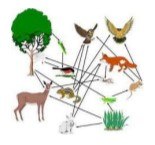
An arrangement of interrelated food chains illustrating the flow of energy between interdependent organisms.
predator
food web
ecosystem
food chain
What is the other name of living and non living things?
Dead and alive stuff
Biotic and Abiotic Factor
Both are correct

Can a puddle be also an ecosystem?
Yes
No

The diagram shows two gases P and Q in a gas cycle. Which of the following are gases P and Q?
P: Oxygen ; Q: Carbon dioxide
P: Carbon dioxide; Q: Oxygen
P: Nitrogen; Q: Carbon dioxide
P: Nitrogen; Q: Oxygen
Select the reasons of energy loss in the food chain. (more than one answer)
Respiration carried out
Movement of the organism
Other organism took it
The consumer do not eat the whole organism (its food)
Which of the following is not the source (源) of carbohydrates?


__________ helps to maintain a constant body temperature in our body.
Fibre
Vitamins
Energy giving food
Water

Rickets is caused by the deficiency (缺乏) of __________.
vitamin A
vitamin B
vitamin C
vitamin D

The diagram shows a food test that was carried out on a food sample.
Brick red precipitate is formed in the test tube.
Which of the following is the food sample tested?
Egg yolk
Olive oil
Honey
Peanut

The diagram shows the apparatus used in food test.
A red precipitate is formed when sample X is heated together with a few drops of Millon’s reagent.
What is the nutrient that can probably be found in solution X?
Oil
Protein
Glucose
Starch

What colour will starch turn brown iodine solution into?
blue-black
colourless
red
yellow

Fat is completely digested (完全被消化) in the ________.
stomach
mouth
small intestine (小肠)
large intestine (大肠)
What is the enzyme that break down fats?
Amylase
Maltose
Protease
Lipase

The structure shown is a villus. How does the structure enables the digested food to be absorbed easily?
This structure has a one-cell thick wall.
This structure has a thick wall.

People who live in cold climate (气候) need MORE food to maintain body temperature as compared to people who live in hot climate.


Measles, chicken pox, influenza is an examples of infectious diseases, yes or no.
Yes
No
Which of the following is disease that is not infectious?
Tinea
Tuberculosis
Dengue fever
cancer

Based on the image, what is the true reason people need to wear that type of face mask.
wear by healthy person to protect from sick person.
to cover nose and mouth of sick person so that they cannot infect others
To filter small particle or smoke and dust from entering mouth
What is the meaning of antigen?
ability of the body system to resist pathogens before it is infected
protein produced by white blood cells into the bloodstream
foreign substance that come from outside the body and induces the production of antibodies
an animal that transmit pathogen

This graph refer to
Passive natural immunity
Passive artificial immunity
Active natural immunity
Active artificial immunity
Which one is the correct statement for passive natural immunity?
temporary and short-lived
fast and temporary
occurs when a person recovers from an infection
occurs when a vaccine is injected into the body
What is a vector?
pathogen
organism that carries pathogen
type of infectious disease
type of emerging disease
Infectious disease are spread by (i)__________ , transmitted by infected person called (ii) ______________.
pathogens, vector
vector, pathogens
pathogen, host
host, medium
Not all viruses are pathogen. True of false
true
false
Which is the diseases that can prevented through vaccination
Tetanus
Dengue
Tuberculosis
Headache

One molecule of water consists of
1 oxygen atom and 1 hydrogen atom
2 oxygen atom and 1 hydrogen atom
2 oxygen atom and 1 nitrogen atom
1 oxygen atom and 2 hydrogen atom

Mark for the correct statement about the gas released in test tube Q.
produces a 'pop' sound with a glowing wooden splinter
produces a 'pop' sound with a burning wooden splinter
lights up a glowing wooden splinter

In the electrolysis of water, if the volume of oxygen collected is 10cm3, predict (预测) the volume of hydrogen collected?
5cm3
10cm3
15cm3
20cm3

Which of following is the correct statement about solution and suspension?
Solution is clear, while suspension is cloudy
Solution contains undissolved substances, while suspension contains dissolved substances
Light cannot penetrate (透过) solution, while light can penetrate (透过) suspension
Which of the following methods of water purification (水净化) can eliminate (消除) odour (异味)?
Boiling
Distillation
Chlorination
Sedimentation
The first step in water treatment plant is ____________.
chlorination to kills microorganisms
fluoridation to prevents tooth decay
screening to removes large objects such as fish and twigs
Oxidation to removes unpleasant odour

Diagram shows a UHT milk. It is example of ...
Suspension
Solute
Colloids

What is these phrases suspended particles means
A homogenus mixture from two or more substances
Substance that dissolves in other substances
Solids that do not dissolve in liquids
Substance that dissolves other substances

