Wayground logo

Free Printable Worksheets

Font size

S
M
L
XL
Worksheets

YBTCC Team Competition (Sections IX and X)

Total questions: 54

Worksheet time: 1hrs 17mins

Name
Class
Date
1.
Name the equipment
a)
thermometer
b)
test tube rack
c)
beaker
d)
dropper pipette 
2.
Name the equipment 
a)
thermometer
b)
dropper pipette 
c)
burette
d)
stirring rod 
3.

this equipment name is . . . .

a)

beakers

b)

erlenmeyer flasks

c)

watch glass

d)

petri dishes

4.

this equipment name is . . . .

a)

beakers

b)

erlenmeyer flasks

c)

watch glass

d)

petri dishes

5.
What piece of equipment is used to measure precise quantities of liquids?
a)
dropper
b)
mortar and pestle
c)
graduated cylinder
d)
wash bottle
6.
What piece of equipment is used to measure temperature?
a)
spring scale
b)
thermometer
c)
triple beam balance
d)
pipette
7.
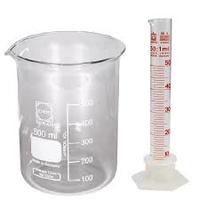
Identify the primary function of the lab equipment seen in the image.
a)
Mixing liquids
b)
Measuring liquid volume
c)
Mixing solids
d)
Measuring mass
8.

Which of the following pieces of chemistry lab equipment produces a flame from gas that is used for heating substances?

a)

Bunsen burner

b)

Beaker

c)

Crucible

d)

Erlenmeyer Flask

e)

Funnel

9.

Which of the following pieces of chemistry lab equipment is a glass cylinder used for mixing, heating, and stirring substances?

a)

Beaker

b)

Pestle

c)

Crucible tongs

d)

stirring rod

10.

What is a graduated cylinder used for?

a)

Measuring volume

b)

Measuring weight

c)

Pouring liquids

d)

Heating substances

e)

Measuring temperature

11.

Which of the following pieces of chemistry lab equipment is used to transfer liquids from one place to another?

a)

Pipette

b)

Stirring rod

c)

Scoopula

d)

Triangle

e)

Wire gauze

12.

Which of the following is a test tube?

a)

A

b)

B

c)

C

d)

D

13.

Please check all of the pieces of laboratory equipment that can safely be heated.

a)

Graduated Cylinder

b)

Funnel

c)

Beaker

d)

Flask

e)

Test Tube

14.

Check all proper uses for this piece of equipment.

a)

Measuring precise and accurate volume amounts

b)

Heating Solutions

c)

Transferring Solutions

d)

Mixing Solutions

e)

Identifying Mass

15.

Check all the pieces of laboratory equipment you would need to pick up a hot test tube.

a)

hot gloves

b)

test tube tongs

c)

test tube rack

d)

googles

e)

beaker

16.
What should you do before you start lab?
a)
Read all the procedures
b)
Make sure your work area is neat
c)
Get teachers permission
d)
All of the above
17.
If your lab partner gets chemicals in his/her eyes, the first thing you should do is
a)
Clean up spilled chemical
b)
Call 9-11
c)
Take them to eye wash and tell the teacher immediately
d)
Make the person sit down to calm their nerves
18.
If you break glassware during a lab you should
a)
tell the teacher immediately
b)
Clear people out of the area and leave broken glass for a janitor
c)
Tell the teacher on the way out of class at the end of the period
d)
Try to clean it up yourself quickly so you won�t bother anyone
19.
When heating a substance in a test tube, the test tube should be pointed
a)
Towards you
b)
Away from you and others
c)
Away from others
d)
Towards others and away from you
20.
Why are safety symbols important?
a)
So you know wha to do
b)
They are cool
c)
They tell you specific dangers
d)
They tell you how to do an experiment
21.
When should you wear safety goggles?
a)
When you look in the sun
b)
When working with chemicals, acids and bases and heating devices
c)
Anytime your in lab
d)
None of the above
22.
If you are not using chemicals you do not need goggles or gloves
a)
TRUE
b)
FALSE
23.

When are you allowed to remove lab safety equipment?

a)

when your group is done

b)

when the goggles start fogging up

c)

when most of the groups are done

d)

when directed by the teacher

24.

When preparing for lab, you should...

a)

tie back long hair

b)

not wear baggy clothes

c)

wear closed-toe shoes

d)

watch the Marvel movies so you know what superpowers to expect if you mess anything up

25.

Never leave ___ unattended.

a)

a dissected pig

b)

a test tube

c)

an active heat source

d)

a freshman

26.

Never take ___ out of the lab without the knowledge AND consent of your science teacher.

a)

chemicals

b)

supplies

c)

equipment

d)

lab reports

27.

What symbol is this?

a)

Disposal

b)

Biological

c)

Extreme temperature

d)

Sharp Object

28.

What symbol is this?

a)

Open Flame

b)

Toxic

c)

Chemical

d)

Electrical

29.

What symbol is this?

a)

Toxic

b)

Flammable

c)

Chemical

d)

Disposal

30.

What symbol is this?

a)

Biological

b)

Disposal

c)

Extreme temperature

d)

Fume

31.

What symbol is this?

a)

Irritant

b)

Chemical

c)

Electrical

d)

Flammable

32.

What symbol is this?

a)

Fume

b)

Extreme Temperature

c)

Toxic

d)

Open Flame

33.

Substances like mercury may be poisonous if touched, inhaled or swallowed

a)

chemical

b)

biological

c)

toxic

d)

disposal

34.
What does this symbol mean 
a)
fire safety 
b)
eye protection safety 
c)
animal safety 
d)
extreme temperatures 
35.
Part of lab safety includes reading the lab procedure...
a)
before doing the lab
b)
while doing the lab
c)
after doing the lab
d)
only if you think you really need it
36.
When working in the lab, you always...
a)
work with only members of your group with a business-like attitude
b)
ask questions when in doubt about procedures
c)
clean up after yourself 
d)
all of the above
37.
Who invented the Bunsen Burner?
a)
Albert Einstein
b)
Robert Bunsen
c)
George Burner
d)
Charles Darwin
38.
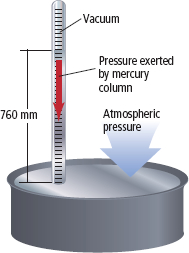
A device that is used to measure atmospheric pressure is a ___________.
a)
barometer
b)
thermometer
c)
kilometer
d)
micrometer
39.
Explain what would happen to the column of mercury in the barometer as shown if the atmospheric pressure fell.
a)
As the pressure falls, the column of mercury will drop lower.
b)
As the pressure falls, the column of mercury will remain unchanged.
c)
As the pressure falls, the column of mercury will rise higher.
d)
As the pressure falls, the density of the mercury will increase.
40.
Pressure is the effect of
a)
the weight of all the air above pressing down
b)
water vapor in the atmosphere
c)
greenhouse gases
d)
solar radiation
41.
What would you use to measure this?
a)
Grams
b)
Kilograms
42.
How heat is transfered?
a)
From high to low temperature
b)
From low to high
c)
Up to down
d)
Left to right
43.
The lowest possible temperature is
a)
0 F
b)
0 K
c)
0 C
d)
273 K
44.
Mass is measured in
a)
grams
b)
grams and kilograms 
c)
kilograms 
d)
centimetres 
45.

What property do these tools measure?

a)

volume

b)

mass

c)

length

d)

temperature

46.

Volume is _____________.

a)

how much matter in an object

b)

how much something weighs

c)

how much a container can hold

d)

how many atoms

47.

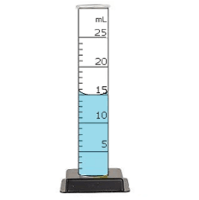
What is the volume of the water?

a)

10mL

b)

15mL

c)

20mL

d)

25mL

48.

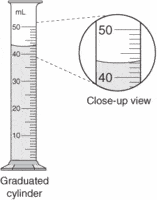
What is the volume of liquid in this graduated cylinder?

a)

43mL

b)

40mL

c)

44mL

d)

45mL

49.

How much liquid is represented?

a)

56 mL

b)

50.6 mL

c)

58 mL

d)

50.8 mL

50.

instrument used to find mass

a)

triple beam balance

b)

graduated cylinder

c)

beaker

d)

thermometer

51.
What is the instrument that measures air pressure called?
a)
Graduated cylinder
b)
Barometer
c)
Force scale
d)
Anemometer
52.

This is an example of the everyday application of pressure in:

a)

Solids

b)

Liquids

c)

Gases

d)

Plasma

53.

Fire Blanket

a)

Used to smother fires on people

b)

Used to sleep

c)

Used when people are feeling cold

d)

Does not exist

54.

_____ should be worn any time heat, chemicals, or glassware are used.

a)

Fire Blanket

b)

Shoes

c)

Safety Goggles

d)

Eye Wash Station