
 Worksheets
Chapter 10 Electricity and Magnetism
Total questions: 136
Worksheet time: 2hrs 23mins
Which of these materials is a good insulator?
gold
copper
silver
plastic

In a series circuit, what will happen if the path for the electrical current is broken by a burned out bulb?
The electrical current will stop fllowing and none of the bulbs will light up.
The electrical current will continue flowing and the other bulbs will light up.
The energy source will continue to move the electric charge through the circuit.

In this image of a smoke detector what part of the circuit is the switch?
the battery
the wire
the alarm horn
the test button
the plastic case that covers the smoke detector when it is closed
In this image of a smoke detector what part of the circuit is the energy source?
the battery
the wire
the alarm horn
the test button
the plastic case that covers the smoke detector when it is closed
The resistor in an incandescent lightbulb is called
flourescent
a filament
the Edison
the insulator
Which type of circuit has more than one path for the electrical current?
The series circuit
The parallel circuit
They both have more than one path
Neither circuit has more than one path for the electrical current
Electrical current is either alternating current (AC) which comes through the wires and outlets in your home or
direct current which comes from batteries
direct current which comes from a power plant
continuous currect which is from solar energy
discreet current which comes from batteries
Electric current is defined as
detect electric current
negative terminal to positive terminal
positive terminal to negative terminal
the flow rate of electric charges through a conductor
Electrons flows from
detect electric current
negative terminal to positive terminal
positive terminal to negative terminal
the flow rate of electric charges through a conductor
Electricity is a form of energy involving the flow of atoms.
True
False
What are the two types of electricity?
Static and electrons
Current and voltage
Series and parallel
Static and current

In a circuit diagram, this symbol represents a
switch
multimeter
battery
globe

Which light globe(s) would never light up?
A
B,C,D
A,B,C,D
None
Voltage is the measure of the...
difference in electrical energy between 2 parts of a circuit
amount of electric charge that flows through a circuit

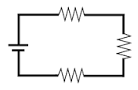
What type of circuit is this?
Series
Parallel
Simple
In a series circuit, how is the brightness of a light globe affected when another globe is connected?
It gets brighter
It stays the same
It gets dimmer
It goes out
Why are Christmas lights wired in parallel?
It is cheaper to make
You can make longer strands
It uses less electricity
If a light breaks, the others keep working

If the current in an electrical circuit is constant, what will happen to the voltage if the resistance is increased?
Voltage will increase
Voltage will decrease
Voltage will stay the same

If you increase the voltage across a resistor, what will happen to the current?
Current will increase
Current will decrease
Current will stay the same

If you increase the size of the resistor and keep the voltage the same, what will happen to the current?
Current will increase
Current will decrease
Current will stay the same


How can it be explained that someone's hair can stick to a balloon?
There is static electricity.
There is too much dust in the air.
The person needs to wash his hair.

Opposite charges _______________.
attract
repel
nothing changes

Like charges _______________.
attract
repel
nothing changes

The flow of electric charge in a circuit is called _______.
Heat
Sound
Electric Current
Magnetic

Identify the part of the circuit that is labeled 1.
battery
wire
switch
bulb

Identify the part of a circuit that is labeled 2.
battery
wire
switch
bulb

Identify the part of a circuit that is labeled 3.
battery
wire
switch
bulb
What supplies the energy or power in an electric circuit?
light bulb
wire
battery

If the light is on, the circuit is _________________.
closed
open
If the light is on, the circuit is _________________.
closed
open

If the light is off, the circuit is ______________.
closed
open

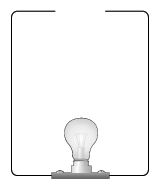
What would best complete this circuit?
A wire
A switch
A battery
A light bulb

What object would best complete this circuit?
A battery
a conductor
an insulator

How could you make this circuit work?
Close the switch
Take out the bulbs
Add another battery
Add another bulb
Which of the following best explains an electric current?
An electric current is the flow of positive charges in a circuit.
An electric current is the flow of atoms in a circuit.
An electric current is the flow of electrons in a circuit.
An electric current is the flow of neutrons in a circuit.
Which of the following statements is correct about electrical insulators?
They do not contain any atoms.
Their protons are not allowed to move about freely.
The electrons are not able to move about freely.
They are good at conducting heat only.
An electric kettle is commonly used to heat up water at home. The heating element used is nichrome wire and not copper. Which of the following reasons best explains why nichrome is used instead of copper?
Nichrome conducts more current than copper, so more heat can be generated.
Nichrome has higher resistance than copper, so more heat can be generated.
Nichrome has higher voltage than copper, so more heat can be generated.
Nichrome are cheaper than copper, so it is more economical.
Which of the following electrical appliances does not make use of a variable resistor?
Volume controls in radio
Dimmers in cinemas
Speed control of a toy car
Electric kettle
The instrument that measures electric current is called ___________.
a resistor
a voltmeter
an ammeter
an electrometer
Which of these is caused by static electricity?
A magnet attracts a paper clip
Glue holds two pieces of paper together
Socks taken from a clothes dryer stick together
Ice sticks to a car’s windshield
Which choice describes the behavior of an electric charge?
Like charges attract. Unlike charges repel.
Like charges repel. Unlike charges attract.
Like charges attract. Unlike charges attract.
Like charges repel. Unlike charges repel.

Which device or devices could be removed without breaking the electric circuit?
Only the bulb
Only the switch
The battery and the switch
The bulb and the switch
Which MUST be included in an electromagnet?
Electric current
Light bulb
Motor
Switch
An electric circuit contains a battery, a switch, and a bulb. Which of the following will MOST LIKELY happen if you add another battery to the circuit?
The bulb will not shine
The bulb will shine brighter than it did with one battery
The bulb will shine the same
The bulb will shine half as bright as it did with one battery
Like or similar poles on two magnets will __________.
Attract each other
Have no effect
Repel each other
All of these
Copper allows electricity to flow through it, therefore it is a ______________________.
conductor
insulator
A thin strip of metal foil has a negative electric charge. You bring a balloon that also has a negative charge near the foil. What will MOST LIKELY happen?
The foil will bend toward the balloon
The foil will bend away from the balloon
The balloon will cause the foil to have a positive charge
The foil will cause the balloon to have a positive charge
Like or similar poles on two magnets will __________.
Attract each other
Have no effect
Repel each other
All of these


AC stands for __________ current.
alternating
Adjusting
Alarmed
Additional
DC stands for __________ current.
deviating
default
diverging
direct
What do electric charges have in common with magnetic poles? Choose all that apply.
These forces can attract and repel without touching.
These forces can only attract.
As the distance of seperation increases the strength of the force decreases.
Electric charges are not similar to magnetic poles.
Why are not all atoms tiny magnets?
Because, the spins must be in the same direction.
Every spinning electron is not a tiny magnet.
Because, the spins must be in opposite direction.
A north pole of the magnet is brought near a south pole
they will repel
they will attract
so? nothing will happen
A magnetic domain is
a cluster of aligned atoms
a singular aligned atom
a cluster of non-aligned atoms
In order to make an electromagnet, you need
a magnet, a nail, some wires
a battery, a nail, and a magnet
a battery, a coil of wire, and a nail
a loop of wire, contacts, and a battery
The shape of the magnetic field in a current carrying wire is?
concentric circles
concentric ovals
concentric squares
if you break a bar magnet in half
the poles will seperate
You will have two complete magnets
it becomes unmagnetized
magnetic fields run from _________ pole to ___________ pole
North, South
South, North
They do not exist
How many poles does a magnet have?
1 pole
3 poles
2 poles
o pole
Which two of these are not magnetic materials? Tick two.
copper
steel
iron
aluminum
Where is the strongest magnetic field around a bar magnet?
above and below
near the poles
in the middle
on the north pole
A magnetic force becomes weaker as magnets ________.
repel
attract
move together
move apart
True or False: An unrubbed nail will be attracted to a magnet.
True
False
The geographic north of the earth is actually close to the Earth's magnetic _____________ pole
north
south
east
west
A magnet that loses all or most of their magnetic strength quickly
permanent magnet
temporary magnet
superconductor
electromagnet
Permanent magnets are made out of the following materials
Copper, Chromium, and Cobalt
Iron, Cobalt, and Silver
Nickel, Cobalt, and Iron
Copper, Nickel, and Iron
The interaction between the solar wind and the earth's magnetic field
produces light in the upper atmosphere.
would not be possible without auroras.
makes the Earth rotate, like a homopolar motor.
occurs at night, producing auroras.

The area around a magnet is called the .....
attraction zone
work area
magnetic field
hot zone

Particles with opposite charges ____________ and particles with same (or like) charges ____________.
attract, repel
repel, repel
attract, attract
repel, attract

What would happen with the magnets in the picture above?
They would repel
Nothing
They would attract
They would repel and then attract
Protons have a ____________ charge.
negative
neutral
positive
Electrons have a ____________ charge.
negative
neutral
positive
A _____________ transforms mechanical energy into electrical energy.
generator
electromagnet
circuit
magnetic field


To make this electromagnet stronger you could:
use less wire
have fewer wire coils around the nail
have more wire coils around the nail
use a plastic core


When running a current through a wire, what do the blue lines represent?
The wire spinning
A magnetic field that was created
Electrons leaving
Electricity

How are electromagnets different from permanent magnets?
magnets can be turned on/off
you can turn an electromagnet on/off
magnets are more powerful
magnets have a North and South pole

What conclusion can you draw from this graph?
As current increases, magnetic strength decreases.
As current increases, magnetic strength increases.
As current decreases, magnetic strength increases.
There is no relationship between current and magnetic strength.

