wayground logo

Free Printable Worksheets

Font size

S
M
L
XL
Worksheets

Physics 9&10 Refresh Quiz

Total questions: 140

Worksheet time: 2hrs 20mins

Name
Class
Date
1.

Which type of force resists motion?

a)

Friction

b)

Gravity

c)

Pull

d)

Push

2.

A student is pushing a book with a force of 10 Newtons to the left. Another student is pushing the book to the right. How many Newtons of force is the second student pushing with if the book is not moving?

a)

10 Newtons

b)

5 Newtons

c)

0 Newtons

d)

1 Newton

3.

Velocity is the speed and _________ of a moving object.

a)

vector

b)

magnitude

c)

direction

d)

motion

4.

What is the net force shown in the free body diagram?

a)

0 Newtons stationary

b)

3 Newtons left

c)

2 Newtons right

d)

8 Newtons right

5.
What speed is the person with the red line going?
a)
20 km per hour
b)
10 km per hour
c)
50 km per hour
d)
30 km per hour
6.
When was the ostrich going at a constant speed?
a)
Between 0 and 30 min.
b)
Between 45 and 60 min.
c)
Between 30 and 45 min.
7.

the gradient of a velocity-time graph

a)

velocity (speed)

b)

aceleration

c)

stationary

d)

constant

8.

a straight horizontal line on a distance time graph

a)

velocity (speed)

b)

aceleration

c)

stationary

d)

constant

9.

a line curving upwards and getting steeper on a distance time graph

a)

velocity (speed)

b)

aceleration

c)

stationary

d)

constant

10.
What is this graph showing?
a)
Constant Speed
b)
Acceleration (speeding up)
c)
Deceleration (slowing down)
d)
No motion
11.
Are forces balanced or unbalanced when a marble speeds up rolling down a ramp?
a)
Balanced
b)
Unbalanced
12.

A mouse traveled 26cm in 4s. What is the average speed of the mouse?

a)

6cm/s

b)

104cm/s

c)

6.5cm/s

13.
Which answer shows three non-contact forces?
a)
magnetism, gravity, friction
b)
gravity, friction, upthrust
c)
gravity, static electricity, magnetism
d)
upthrust, static electricity, friction
14.
The equation to calculate momentum is
a)
p=mv
b)
p=1/2mv2
c)
p=mgh
d)
p=mg
15.
Determine the momentum of 1000-kg car moving northward at 20 m/s......... 
a)
20000 N
b)
20000 Joules
c)
20000 Kg * m/s
d)
20000 kg * m/s north
16.
A runner has a momentum of 720 kg m/s and is traveling at a velocity of 5 m/s. What is his mass?
a)
14.4 kg
b)
1400 kg
c)
144 kg
d)
360 kg
17.
Hooke's Law fails when a material reaches its:
a)
breakdown
b)
elastic limit
c)
end of tether
d)
fracture stress
18.

Spring constant is measured in

a)

N

b)

N/m

c)

m

19.
Newton's Third Law States...
a)
Objects in motion stay in motion and objects at rest stay at rest
b)
Force is equal to mass times acceleration
c)
For each action there is an equal and opposite reaction
20.
Objects falling through the air are slowed by the force of 
a)
velocity 
b)
acceleration 
c)
time 
d)
air resistance 
21.

A dog slides along a waxed floor an initial speed of 7.5 cm/s on a waxed floor. It slides to a stop in 15 seconds. What is the acceleration?

a)

-0.5 m/s

b)

0.5 m/s2

c)

-0.5 cm/s2

d)

7.5 cm/s2

22.

This is a velocity time graph of a skydiver falling. Which point on the graph shows the point where the forces acting on him are equal?

a)

A

b)

B

c)

C

23.

The free body force diagram shows the forces acting on Peter at point (a)   .

24.

Which diagram shows the forces acting on Peter when he is falling at Terminal Velocity?

a)

1

b)

2

c)

3

25.

A skydiver jumps from a plane. The instant she jumps, the force(s) acting on her are

a)

Weight

b)

Weight and air resistance

c)

Weight and Friction

d)

Air resistance

26.

A skydiver jumps from a plane. The air resistance has increased so it is equal in size to her weight. The resultant force acting on her is

a)

decreasing

b)

increasing

c)

constant

d)

zero

27.

The skydiver opens her parachute. The air resistance upwards

a)

increases

b)

decreases

c)

is zero

d)

remains constant

28.

The skydiver opens her parachute. The resultant force acting on her is upwards, so she

a)

accelerates

b)

decelerates

c)

is stationary

d)

moves with a constant velocity

29.

The number of wavelengths that pass a point each per second is:

a)

frequency

b)

period

c)

longitudinal

d)

transverse wave

30.
The lowest point on a wave is the:
a)
Amplitude
b)
Crest
c)
Trough
d)
Wavelength
31.
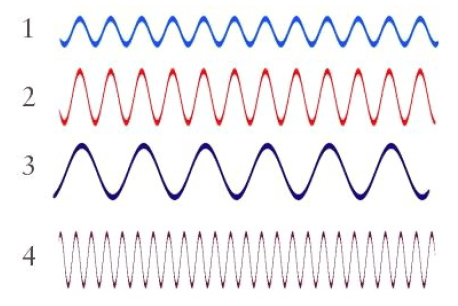
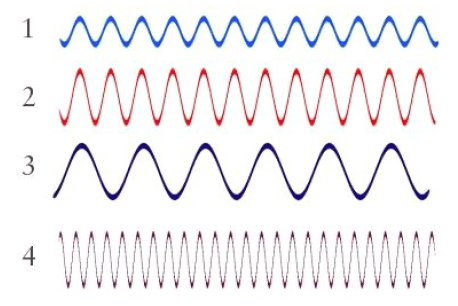
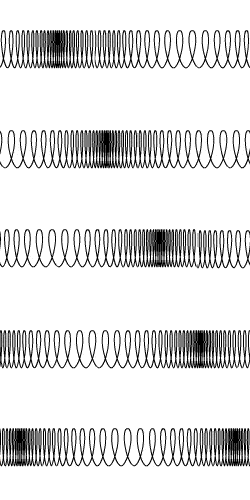
Which wave in the diagram has the greatest frequency?
a)
1
b)
2
c)
3
d)
4
32.
Which wave in the diagram has the greatest wavelength?
a)
1
b)
2
c)
3
d)
4
33.
_____________________ is the distance between a point on one wave and the identical point of the next wave.
a)
Amplitude
b)
Wavelength
c)
Frequency
d)
Crest
34.

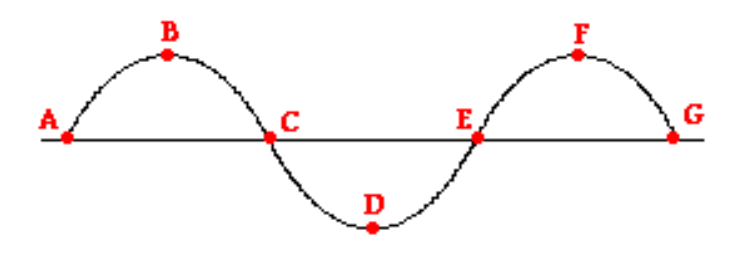
Which letter(s) represent the crest of the wave?

a)

A

b)

B & D

c)

B & F

d)

F

35.

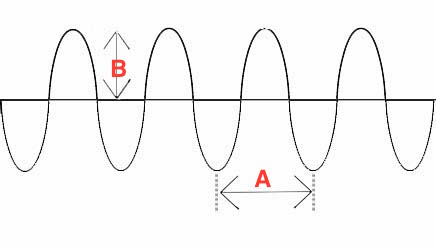
What property of the wave is represented by the letter "B"?

a)

amplitude

b)

crest

c)

trough

d)

wavelength

36.

All waves carry ________ as they travel from one place to another.

a)

matter

b)

space

c)

energy

d)

water

37.
How would a person measure the wavelength on this sound wave?
a)
dense to less dense
b)
trough to crest
c)
compression to compression
d)
beginning of illustration to the end
38.
What kind of wave is pictured below?
a)
compressional wave
b)
transverse wave
c)
sound wave
d)
mechanical wave
39.
A water wave has a wavelength of 0.5 meters and a frequency of 2 Hz. What is the wave's speed?
a)
1 m/s
b)
2.5 m/s
c)
0.25 m/s
d)
4 m/s
40.

What is the wave speed equation?

a)

v= f/λ

b)

v= λ - f

c)

v=λ/f

d)

v=λf

41.
What type of wave is this?
a)
Longitudinal
b)
Transverse
42.
Frequency is measured in 
a)
Pounds
b)
Hertz
c)
Joules
d)
Newtons 
43.
In the wave equation (λ) represents what?
a)
amplitude
b)
wavelength
c)
frequency
d)
wave speed
44.
A wave covers a distance of 68 m during one of its cycles and has a frequency of 700 Hz.  What is its speed?
a)
10.3 m/s
b)
47600 m/s
c)
3600 m/s
d)
830.5 m/s
45.
What is the frequency of a wave equal to?
a)
1/Wavelength
b)

1/Time period

c)
1/Velocity
d)
1/Amplitude 
46.
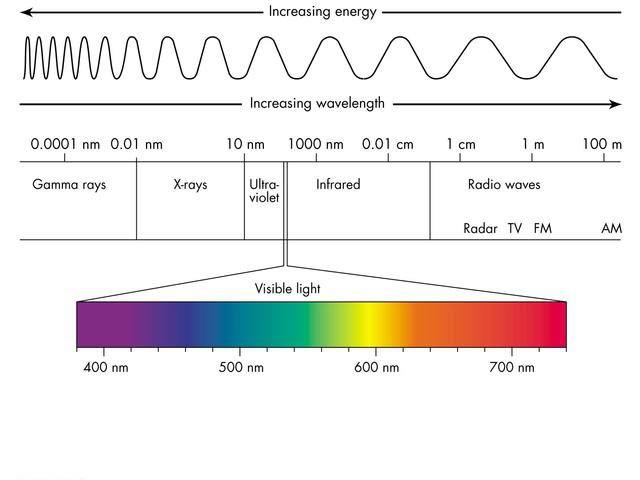
Select the correct order of waves on the EMS from the longest wavelength to the shortest wavelength
a)
Radio, Micro, Infra, Visible, Ultra, X-ray, Gamma
b)
Gamma, X-ray, Ultra, Vis, Infra, Micro, Radio
c)
Vis, Micro, Infra, Ultra, X-ray, Gamma, Radio
d)
Micro, Radio, Vis, Infra, Ultra, X-ray, Gamma
47.
Which electromagnetic waves are used in ovens and cell phone communications?
a)
Infrared rays
b)
ultraviolet rays
c)
microwaves
48.
Which electromagnetic waves allow us to diagnose & treat cancer?
a)
Gamma rays
b)
X-rays
c)
Ultraviolet rays
49.
Which electromagnetic waves help doctors detect broken bones inside your body?
a)
gamma rays
b)
x-rays
c)
ultraviolet rays
50.
Which section of the spectrum is the ONLY one we can see?
a)
X-rays
b)
Visible Light
c)
Gamma Rays
d)
Ultraviolet Rays
51.

Which of the following is not in the electromagnetic spectrum?

a)

Light waves

b)

Sound waves

c)

Radio Waves

d)

X-rays

52.

What is the correct order of the visible light spectrum starting with the longer wavelength?

a)

Red, yellow, orange, blue, violet, indigo

b)

Violet, indigo, blue, green, yellow, orange, red

c)

Green, yellow, blue, indigo, red, orange

d)

Red, orange, yellow, green, blue, indigo, violet

53.

How are electromagnetic waves different from other waves?

a)

They have short wavelengths

b)

they transmit energy instead of matter

c)

they can travel through empty space

d)

they can change direction by reflection

54.

Which of the following has higher frequency than ultraviolet rays?

a)

Visible light

b)

Infrared rays

c)

X-rays

d)

Microwaves

55.

There are many different kinds of waves, but the one thing waves all have in common is they transmit ________ and not matter.

a)

energy

b)

disturbances

c)

motion

d)

medium

56.

Which type of wave vibrates up and down perpendicular to the motion the energy travels.

a)

Transverse

b)

Longitudinal/Compressional

57.

Which type of wave vibrates back and forth parallel to the motion the energy travels.

a)

Transverse

b)

Longitudinal/Compressional

58.
........... – the angle between the normal and the incident ray.
a)
Angle of incidence
b)
Angle of reflection
c)
Angle of coincidence
d)
Angle of direction
59.
The imaginary line perpendicular to a reflecting surface is called _____.
a)
crooked line
b)
parallel line
c)
angular line
d)
normal line
60.

In the diagram, which letter represents the angle of incidence?

a)

A

b)

B

c)

C

d)

D

61.
Law of reflection state that - The angle of incidence is .................. to the angle of reflection.
a)
equal
b)
double
c)
half
62.
When light bends it is ______
a)
Reflection
b)
Absorption
c)
refraction 
d)
optical density
63.
a)
Reflection
b)
Refraction
64.

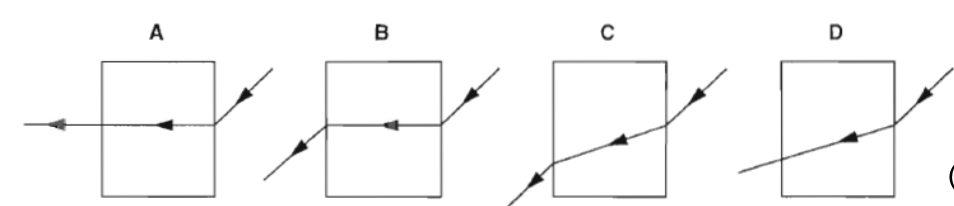
A ray of light travels from air into a glass block.


Which diagram correctly shows the path of the ray through the glass block?

a)

A

b)

B

c)

C

d)

D

65.

The blue is water, the white is air. Light travels slower in water than air. Which of the paths is possible for refraction?

a)

A

b)

B

c)

C

d)

D

e)

E

66.

What letter is used to represent refractive index?

a)

c

b)

n

c)

v

d)

θ

67.

What direction does the ray bend when entering a more optically dense material, where the wave travels more slowly?

a)

Towards the normal.

b)

Away from the normal.

c)

No change.

d)

Answer is not listed above.

68.

Which of the following is true about a wave that has been refracted?

a)

The speed and frequency changes, but the wavelength stays the same.

b)

The speed and wavelength changes, but the frequency stays the same.

c)

The wavelength and frequency changes, but the speed stays the same.

d)

The speed and frequency changes, but the amplitude stays the same.

69.
Which device measures sound waves?
a)
Oscilloscope
b)
Stethoscope 
c)
Radio
d)
I don't know
70.

The volume of a sound is measured in units called ________

a)

decibels

b)

hertz

c)

frequency

d)

amplitude

71.

Sound waves travel the FASTEST through _____________.

a)

Gases

b)

Liquids

c)

Solids

72.

If the distance represented by the letter A (the amplitude) were increased, how would it change the sound?

a)

The sound would be higher.

b)

The sound would be softer.

c)

The sound would be lower.

d)

The sound would be louder.

73.

Which of the following statement is true?

a)

The higher the amplitude, the higher the pitch of sound

b)

The lower the amplitude, the louder the sound

c)

The higher the frequency, the higher the pitch

d)

The lower the frequency, the louder the sound

74.

True or False: Can sound travel though a vacuum (space)

a)

True

b)

False

75.
Which device measures sound waves?
a)
Oscilloscope
b)
Stethoscope 
c)
Radio
d)
I don't know
76.

A cyclist at the top of a hill has...

a)

Kinetic Energy

b)

Chemical Potential Energy

c)

Elastic Potential Energy

d)

Gravitational Potential Energy

77.

Energy stored in objects being stretched or squashed...

a)

Elastic Potential Energy

b)

Kinetic Energy

c)

Chemical Energy

d)

Thermal Energy

78.
What type of energy is stored in food and fuel?
a)
Chemical
b)
Thermal
c)
Potential
d)
Calories
79.
What type of energy transfer is most likely responsible when a plant converts the suns energy into food?
a)
Chemical to Solar
b)
Solar to chemical
c)
Light to electrical
d)
Electrical to chemical
80.

Identify the energy transfer

a)

electrical to chemical to light

b)

kinetic to potential

c)

chemical to electrical to light

d)

light to sound

81.
According to which law of energy, energy can't be created or destroyed?
a)
First law of motion
b)
The law of tacos
c)
Laws of Energy
d)
law of conservation of energy
82.

The picture demonstrates chemical energy transforming into ...(pick 3)

a)

radiant energy

b)

sound energy

c)

thermal energy

d)

kinetic energy

e)

potential energy

83.

What energy changes take place when a car rolls down the hill?

a)

Chemical to thermal

b)

Gravitational to kinetic

c)

Electrical to kinetic

d)

Electrical to sound

84.
The law of conservation of energy states that when one form of energy is converted into another,
a)
energy is destroyed in the process
b)
no energy is destroyed in the process
c)
energy is created in the process
d)
some amount of energy cannot be accounted for
85.
A material that reduces or prevents the transfer of energy.
a)
conductor
b)
conduction
c)
radiation
d)
insulator
86.

A car transfers 100 J of chemical energy in order to gain 50 J of kinetic energy. The efficiency of the car is

a)

20%

b)

0.5%

c)

50%

d)

200%

87.

Which of these equations is correct?

a)

efficiency = useful energy transferredtotal energy transferredefficiency\ =\ \frac{useful\ energy\ transferred}{total\ energy\ transferred}  

b)

efficiency = total energy transferreduseful energy transferredefficiency\ =\ \frac{total\ energy\ transferred}{useful\ energy\ transferred}  

c)

energy = efficiency ×100%energy\ =\ efficiency\ \times100\%  

d)

efficiency = wasted energy transferredtotal energy tranferredefficiency\ =\ \frac{wasted\ energy\ transferred}{total\ energy\ tranferred}  

88.

Total energy = 200J
Useful energy = 20J

Workout the efficiency of this lightbulb.
efficiency = useful enegytotal energy in ×100efficiency\ =\ \frac{useful\ enegy}{total\ energy\ in}\ \times100  

a)

100%

b)

80%

c)

40%

d)

10%

89.

Total energy = 350J
Useful energy = 70J

Workout the efficiency of this iphoneX.
efficiency = useful energytotal energy in ×100%efficiency\ =\ \frac{useful\ energy}{total\ energy\ in}\ \times100\%  

a)

100%

b)

80%

c)

40%

d)

20%

90.
Some power plants pump water down deep holes into hot rock. The hot rock heats the water, which turns the water into steam. The steam rushes back to Earth’s surface and is used to make electricity. This plant is generating which alternative energy resource?
a)
biomass
b)
wind
c)
solar energy
d)
geothermal energy
91.
Nuclear
a)
Renewable
b)
Nonrenewable
92.

Use the diagram to put the steps below in the correct order to describe how electrical energy is generated in an electrical power plant.

  1. Electricity is generated.
  2. Magnet spins between wire coils.
  3. Water is heated and changes to steam.
  4. Steam makes turbine spin.
  5. Fossil fuel is burned.
a)

Steps 1, 3, 4, 2, then 5.

b)

Steps 5, 2, 4, 3, then 1.

c)

Steps 5, 3, 4, 2, then 1.

d)

Steps 1, 2, 4, 3, then 5.

93.

In a power station, what causes the turbine to turn?

a)

Heat

b)

Gas

c)

Air

d)

Steam

94.

You throw a ball into the air as shown in the diagram. At what point does the ball have the most gravitational potential energy?

a)

W

b)

X

c)

Y

d)

Z

95.

How could you increase the object's gravitational potential energy (GPE) without changing its distance from the ground (height) and gravity?

a)

Decrease the object's mass

b)

Increase the object's height

c)

Increase the object's mass

d)

Decrease the object's height

96.

If a falling ball has, at one point in its fall, 20 J of gravitational potential energy and 60 J of kinetic energy, how much kinetic energy will it have when it strikes the Earth?

a)

80 J

b)

60 J

c)

20 J

d)

40 J

97.
As mass increases, KE ...
a)
increases
b)
decreases
c)
stays the same
98.
Rearrange the equation for kinetic energy to make mass the subject of the equation.
a)
m = KE/2v2
b)
m = 2KE/v2
c)
m = v2/2KE
d)
m = 2v2/KE
99.
Rearrange the equation for kinetic energy to make velocity squared the subject of the equation.
a)
v= KE/2m
b)
v2 = 2m/KE
c)
v2 = 1/2 KE m
d)
v2 = 2KE/m
100.
Rearrange the equation for kinetic energy to make velocity the subject of the equation.
a)
v = √(2KE/m)
b)
v2 = 2KE/m
c)
v = √(m/2KE)
d)
v = √(KE/2m)
101.
Calculate the kinetic energy of a moving 4 kg object travelling at a velocity of 3 m/s.
a)
18 J
b)
36 J
c)
12 J
d)
6 J
102.
What is the kinetic energy of a ball with a mass of 5kg rolling at 10m/s
a)
50 J
b)
5 J
c)
250 J
d)
25 J
103.

What is the volume of the nail?

a)

15 mL

b)

16 mL

c)

1 mL

d)

2 mL

104.
At which point should your eyes be when you read a graduated cylinder? (Hint: see the letter next to the eye)
a)
A
b)
B
c)
C
105.

what is the volume of the cube?

a)

123

b)

144

c)

244

d)

150

106.
What is the formula for density?
a)
density = mass x volume
b)
density = mass / volume
c)
density = mass + volume
d)
density = mass - volume
107.
Jack has a rock. The rock has a mass of 14g and a volume of 2cm3. What is the density of the rock?
a)
7 mL
b)
7 g/cm3
c)
28 g/cm3
d)
1/7 g/cm3
108.

An object will float if...

a)

Its density is less than the density of the liquid it floats in

b)

Its density is more than the density of the liquid it floats in

c)

Its density if the same as the density of the liquid it floats in

109.
What is the volume of the fish?
a)
18.0 cm3
b)
6.0 cm
c)
38.0 cm3
110.
You are given the following information: mass = 48 g; volume = 24 cm3. What is the density of this substance? 
a)
2 g/cm3
b)
1,152 g/cm3
c)
0.5 g/cm3
d)
72 g/cm3
111.

A copper wire has a density of 9 g/cm3 and a volume of 36 cm3. What is the mass of the copper wire?

a)

324 g

b)

4 g

c)

0.25 g

d)

25 g

112.

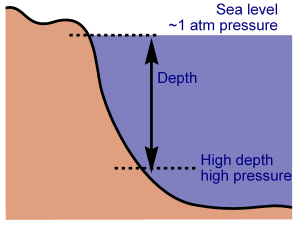
When you increase your depth under water, the water pressure on your body

a)

increases

b)

decreases

c)

stays the same

113.

Which of these is a correct formula?

a)

pressure =force×areapressure\ =force\times area

b)

area=force×pressurearea=force\times pressure

c)

force=pressureareaforce=\frac{pressure}{area}

d)

pressure=forceareapressure=\frac{force}{area}

114.

Find the pressure exerted when a box is placed on a table and exerts a force of 124 newtons on an area of 10.5cm²

a)

11.81 N/cm2

b)

0.085 N/cm2

c)

1.18 N/cm2

d)

0.85 N/cm2

115.
If you have a gold brick that is 2 cm by 3 cm by 4 cm and has a density of 19.3 g/cm3, what is its mass?
a)
463.2 g/cm3
b)
463.2 g
c)
0.804 kg
d)
0.804 g
116.
If the horse reared up on 2 legs what effect would it have on the pressure?
a)
it will exert half the pressure it did before
b)
it will exert the same pressure it did before
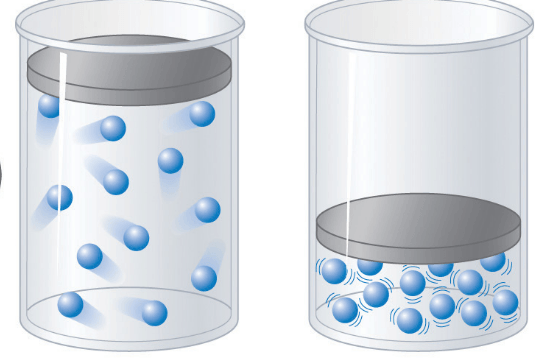
c)
it will exert twice the pressure it did before
d)
it will exert four times the pressure it did before
117.

The reason gases can be compressed is because:

a)

The particles are very close together.

b)

The particles are merely vibrating.

c)

The particles are unable to move.

d)

The particles are very far apart.

118.

The pressure inside the syringe will decrease if we move the plunger in:

a)

Direction A

b)

Direction B

c)

We don't have to move the plunger as the pressure will change on its own.

d)

None of the above answers.

119.

We can increase the pressure of a gas by:

a)

Adding more gas.

b)

Reduce the volume of the container.

c)

Increase the temperature of the gas.

d)

None of the above answers.

120.

A substance's melting point is the same as its

a)

freezing point.

b)

condensation point.

c)

boiling point.

121.
A _____________ is the scientific  instrument used to measure air pressure.
a)
barometer
b)
thermometer
c)
mercury
d)
watch
122.

An ideal gas is one that doesn't follow the gas laws at all conditions of pressure and temperature

a)

True

b)

False

123.

Convert

100oC100^oC  to Kelvin

a)

373 K373\ K  

b)

273 K273\ K  

c)

212 K212\ K  

d)

0 K0\ K  

124.

Convert

300 K300\ K  to Celsius

a)

573oC573^oC  

b)

37oC37^oC  

c)

27oC27^oC  

d)

600oC600^oC  

125.
What is the difference between particles in a gas and a solid?
a)
gas particles are closer together
b)
solid particles move faster than gas particles
c)
solid particles expand on heating
d)
gas particles have more kinetic energy than solid particles
126.
Which container will have a lower pressure?
a)
left
b)
right
c)
they both have the same pressure
d)
I don't know
127.

A gas has a volume of 10cm3 and is at a pressure of 100kPa. The volume is doubled to 20cm3, what is its new pressure?

a)

100kPa

b)

50kPa

c)

200kPa

d)

10kPa

128.

A gas is at room temperature of 293K and is at a pressure of 210 000 Pa. The temperature is decreased to 193K. What is the new pressure? WORK THIS OUT!

a)

138,328 Pa

b)

318,808 Pa

c)

138,000 kPa

d)

138,000 Pa

129.

What is the relationship between the volume of a gas and its pressure according to Boyle's law?

a)

Direct relationship

b)

Inverse relationship

c)

No relationship

d)

Random relationship

130.

The magnetic ____________ around a bar magnet is shown above.

a)

legs

b)

flowers

c)

field

d)

direction

131.

Every magnet has both a _________ pole and a __________ pole.

a)

North, South

b)

East, West

c)

Positive, Negative

d)

Positive, South

132.

If two magnets are close together, the magnetic force will be ________.

a)

smelly

b)

weak

c)

strong

d)

positive

133.

If two magnets are placed so that a north pole and a south pole are facing each other, they will _____________ each other.

a)

date

b)

spin

c)

repel

d)

attract

134.

Although magnetic fields are _____________, one common way that people investigate them is to use ________ filings.

a)

invisible, iron

b)

touchable, iron

c)

invisible, plastic

d)

touchable, plastic

135.
Earth acts like a giant magnet because its center is made up MOSTLY of
a)
granite
b)
limestone
c)
iron
d)
nickel
136.
If the North Pole of a permanent magnet is placed next to a compass as seen in the picture, which direction will the needle move?
a)
Clockwise
b)
Counter-clockwise
c)
It will not move
d)
Need more information
137.
The strongest part of a magnet is...
a)
the bars.
b)
the force field.
c)
the poles. 
d)
the middle.
138.
This is an example of...
a)
attraction
b)
repulsion
139.

Which direction do the arrows point when representing the magnetic field around a magnet?

a)

into N

b)

out of S

c)

into S

d)

out of N

140.

The arrow on magnetic field lines shows them flowing in which direction?

a)

left to right

b)

north to south

c)

south to north

d)

east to west