wayground logo

Free Printable Worksheets

Font size

S
M
L
XL
Worksheets

Magnetism

Total questions: 135

Worksheet time: 7hrs 45mins

Name
Class
Date
1.
Which is not a property of all magnets?
a)
Has a magnetic field
b)
exerts forces
c)
has 2 magnetic poles
d)
has 2 geographic ples
2.
If you drop or heat up a a magnet, what will eventually happen to it?
a)
the magnet will become stronger
b)
the magnet will demagnetize
3.
Inside of magnets there are tiny magnets called _______
a)
atoms
b)
domains
c)
mini magnets
4.
The center of a bar magnet is the strongest
a)
True
b)
False
5.
The lines on this image are called...
a)
magnetic field lines
b)
iron fillings
c)
graphite lines
d)
none of these
6.
This type of magnet is DIFFICULT to magnetize
a)
temporary
b)
permanent
7.
Magnetic poles and electric charges are similar in that...
a)
like poles repel and opposites attract
b)
magnetic force is equal to electric force
8.
Magnetic NORTH is actually geographic _________
a)
SOUTH
b)
NORTH
c)
EAST
d)
WEST
9.
If the end of an unknown magnet sticks to a magnet pole labeled "North" the unknown end must be...
a)
North
b)
South
c)
East 
d)
West
10.
Electricity can be used to create a magnet
a)
True
b)
False
11.
A Magnet can be used to create electricity
a)
True
b)
False
12.
Electricity & Magnetism are interconnected
a)
True
b)
False
13.
A _________ is a device that produces magnetism by spinning a coil of wire around a nail.
a)
Generator
b)
Electromagnet
c)
Battery
d)
Galvonometer
14.
Solenoids and Electromagnets use _________ to create Magnetism
a)
Magnetism
b)
Electricity
c)
Wires
15.
Generators use __________ to create Electricity
a)
Electricity
b)
Magnetism
c)
Wires
16.
You can make an electromagnet stronger by...
a)
increasing the current through the wire
b)
make the iron core bigger
c)
increase the number of loops around the core
d)
All of these
17.
Large buildings typically have ___________ to create Electricity in case the power goes out.
a)
Generators
b)
Electromagnets
c)
Solenoids
18.
Magnets stick to any materials that are made of
a)
Iron, Nickel, Copper
b)
Iron, Nickel, Cobalt
c)
Ions, Nickel, Cobalt
d)
Iron, Lead, Cobalt
19.
Magnetism is generated by moving
a)
protons.
b)
electrons.
c)
neutrons.
d)
elements.
20.
What do the lines around this magnet represent?
a)
North Pole
b)
South Pole
c)
Magnetic Declination
d)
Magnetic Field
21.
If you place the North pole of a magnet next to the South pole of another magnet, they will:
a)
Attract
b)
Repel
c)
Do nothing
d)
Shatter
22.
A paper clip is an example of a:
a)
magnetic material
b)
permanent magnet
c)
bar magnet
d)
insulator
23.
What happens when two north poles of a magnet are placed together?
a)
they repel
b)
they attract
c)
they cancel each other out
d)
the strength of the magnet is doubled
24.
In un-magnetized materials the domains are __________ aligned.
a)
super
b)
slightly
c)
randomly
d)
always
25.
Electric motors are devices that convert _____ energy into  _____ energy.
a)
electrical; mechanical
b)
mechanical; electrical
c)
chemical; potential
d)
mechanical; kinetic
26.
What kind of magnet can be turned on and off?
a)
refridgerator magnet
b)
electromagnet
c)
magnetite
d)
iron
27.
Region around a magnet in which magnetic force can act.
a)
Magnetic field 
b)
Magnetic force
c)
Domain
d)
Perimeter
28.
Two south poles will...
a)
attract
b)
repel 
29.
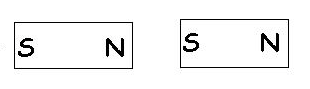
Magnets that are arranged like this will _______. 
a)
move away from each other (repel)
b)
move towards each other (attract)
30.
The strongest part of a magnet is...
a)
the bars.
b)
the force field.
c)
the poles. 
d)
the middle.
31.
Iron and steel can become _____.
a)
magnetized
b)
transformed into plastics
c)
lined up to the poles
d)
part of the equator
32.
A simple electromagnet can be made with which of the following?
a)
an electric current
b)
a turbine and nail
c)
a nail, a wire, and a battery
d)
a compass and a battery
33.
What will happen when these magnets are brought close together?
a)
They will attract each other.
b)
They will repel each other.
c)
Both magnets will turn to the left
d)
Both magnets will turn to the right
34.
Magnetism is generated by moving
a)
protons.
b)
electrons.
c)
neutrons.
d)
elements.
35.
What do the lines around this magnet represent?
a)
North Pole
b)
South Pole
c)
Magnetic Declination
d)
Magnetic Field
36.
As the distance between two magnets increases (they get farther apart), the force between them:
a)
Increases
b)
Decreases
c)
Stays the Same
37.
If you cut a magnet in half, what happens to the poles?
a)
One half gets the North Pole, the other half gets the South Pole
b)
Both halves get only a North Pole
c)
Both halves get only a South Pole
d)
Both halves get a North pole and a South Pole
38.
What is responsible for the Magnetic Field around Earth?
a)
The Earth's crust
b)
The Earth's molton iron core
c)
The Earth's mantel
d)
The Sun
39.
If the North Pole of a permanent magnet is placed next to a compass as seen in the picture, which direction will the needle move?
a)
Clockwise
b)
Counter-clockwise
c)
It will not move
d)
Need more information
40.
An electromagnet's poles may be reversed by:
a)
decreasing the voltage of the coil
b)
increasing the number of coils
c)
changing the direction of current flow
d)
altering the material used to make the coils
41.
Which direction is the North Pole of this electromagnet?
a)
Right
b)
Left
c)
Up
d)
Down
42.
In un-magnetized materials the domains are __________ aligned.
a)
super
b)
slightly
c)
randomly
d)
always
43.
Electric motors are devices that convert _____ energy into  _____ energy.
a)
electrical; mechanical
b)
mechanical; electrical
c)
chemical; potential
d)
mechanical; kinetic
44.
What kind of magnet can be turned on and off?
a)
refridgerator magnet
b)
electromagnet
c)
magnetite
d)
iron
45.
The strongest part of a magnet is...
a)
the bars.
b)
the force field.
c)
the poles. 
d)
the middle.
46.

If a glass plate is placed over a magnet and iron filings are sprinkled over the glass, a pattern will be visible. What does this pattern indicate?

a)

The magnetic field

b)

The electrostatic field

c)

The piezoelectric effect

d)

The chemical reaction of the magnet and the filings

47.

What causes magnetism?

a)

the sun

b)

moving neutrons

c)

moving charges

d)

friction

48.

How can a wire become magnetic?

a)

point it north

b)

add a resistor

c)

heat it up

d)

run a current through it

49.

What device takes in mechanical energy and produces electricity?

a)

motor

b)

generator

c)

electromagnet

d)

battery

50.
Magnetism is a type of ____________
a)
force
b)
book
c)
plant
d)
animal
51.
When two magnets attract, they ______________
a)
push apart
b)
change color
c)
get colder
d)
pull together
52.
When two magnets repel, they ________________
a)
change color
b)
pull together
c)
push apart
d)
get colder
53.
Magnets have a north and a south ___________
a)
shape
b)
color
c)
pole
d)
region
54.
Two north poles will attract.
a)
True
b)
False
55.
A north pole and a south pole will attract.
a)
True
b)
False
56.
What would we call a nail that can pick up a paperclip because it is touching a magnet?
a)
temporary magnet
b)
poles
c)
force
d)
detector
57.
The force of magnetism is stronger when magnets are ________________
a)
cold
b)
round
c)
closer together
d)
farther apart
58.
What kind of magnet can be turned on and off?
a)
refridgerator magnet
b)
electromagnet
c)
magnetite
d)
iron
59.
Surrounding every magnet is a __________  __________.
a)
magnetic field
b)
electrical current
c)
another magnet
60.
How many poles does a magnet have?
a)
1
b)
2
c)
3
d)
4
61.
Magnets that are arranged like this will _______. 
a)
move away from each other (repel)
b)
move towards each other (attract)
62.
These magnets will _______.
a)
move away from each other (repel)
b)
move toward each other (attract)
63.
What happens if you cut a bar magnet in half?
a)
You get two North pole magnets
b)
You get two South pole magnets
c)
You get a North pole magnet and a South pole magnet
d)
You get two smaller magnets, each with a North and South pole
64.
What is an electromagnet?
a)
a magnet that creates an electric current
b)
a magnet created by an electric current
c)
a magnet that has an electric charge
d)
an electric charge that is magnetic
65.
The strongest point on a magnet is located
a)
In the magnetic field
b)
Center of the magnet
c)
At the Poles (close)
d)
At the Poles (further away) 
66.
2 ways to increase the magnetic force of an electro-magnet
a)
Increase the current flow, reduce the number of coils
b)
Increase the voltage, decrease the number of coils
c)
Increase the number of coils and the current flow
d)
Spread out the coils, replace iron core with rubber.
67.
Electric current passing through a wire produces ________.
a)
permanent magnet
b)
magnetic field around wire
c)
compass
d)
geographic poles
68.
The groups of atoms which can align to create a magnet are called ________.
a)
domains
b)
magnetic units
c)
molecules
d)
electrons
69.
GLASS
Magnetic or Non-Magnetic?
a)
magnetic
b)
non-magnetic
70.
NICKEL
Magnetic or
Non-Magnetic?
a)
magnetic
b)
non-magnetic
71.
How is a permanent magnet DIFFERENT from a temporary magnet?
a)
A permanent magnet attracts materials made of iron.
b)
A permanent magnet has poles.
c)
A permanent magnet has a magnetic field.
d)
A permanent magnet keeps its magnetism for a long time.
72.

What type of a system is this?

a)

Attracting

b)

Repelling

73.

What type of a system is this?

a)

Attracting

b)

Repelling

74.

What type of a system is this?

a)

Attracting

b)

Repelling

75.

Are like poles or opposite poles facing each other?

a)

like

b)

opposite

76.

Are like poles or opposite poles facing each other?

a)

like

b)

opposite

77.

Which image has the most potential energy in the system of magnets?

a)

A

b)

B

c)

C

d)

D

78.

Which image has the most potential energy in the system of magnets?

a)

A

b)

B

c)

C

d)

D

79.

What type of a system is this?

a)

Attracting

b)

Repelling

80.

What type of a system is this?

a)

Attracting

b)

Repelling

81.

What will happen if you bring these two electric charges near each other?

a)

They will attract.

b)

They will repel.

82.

What will happen if you bring these two electric charges near each other?

a)

They will attract.

b)

They will repel.

83.

Where is magnetic force the strongest?

a)

the center of the magnet

b)

the poles of the magnet

c)

farther away from the magnet

d)

around all the edges of the magnet

84.

What is the identify of the pole in question?

a)

N

b)

S

85.

What best describes the relationship between the balloon and block?

a)

The balloon is attracted to the block.

b)

The balloon is repelled by the block.

c)

The balloon is neither repelled nor attracted.

86.
The diagram below shows a bar magnet. Which direction best represents the direction of the needle of a compass placed at point A?
a)
left
b)
right
c)
up
d)
down
87.
The diagram below represents the magnetic lines of force around a bar magnet. At which point is the magnitude of the magnetic field strength of the bar magnet the weakest
a)
A
b)
B
c)
C
d)
D
88.
A student sprinkled iron filings around a bar magnet and observed that the filings formed the pattern shown below. The magnetic field is strongest at point
a)
A
b)
B
c)
C
d)
D
89.
The field around a permanent magnet is caused by the motions of
a)
protons
b)
neutrons
c)
electrons
d)
nuc
90.
Two bar magnets are placed parallel to each other, North to North and South to South. Which statement best describes the forces between the bar magnets?
a)
 Gravitational force and magnetic force are both repulsive
b)
 Gravitational force and magnetic force are both attractive
c)
Gravitational force is attractive and magnetic force is repulsive
d)
Gravitational force is repulsive and magnetic force is attractive
91.
A magnetic compass points towards the north geographic pole of the Earth because
a)
all magnetic poles, north or south, point that way due to the spin of the Earth.
b)
there is a north magnetic pole near the north geographic pole.
c)
there is a south magnetic pole near the north geographic pole.  
d)
the static electricity in the atmosphere causes the alignment of the compass.  
92.
Which of the following shows the magnetic field correctly around a bar magnet?
a)
A
b)
B
c)
C
d)
D
93.
The diagram below shows an electron, e, located in a magnetic field. If a compass was placed at the point of the electron, it would point
a)
left
b)
right
c)
up
d)
down
94.
A compass points to the left. Where was this compass placed?
a)
A
b)
B
c)
C
d)
D
95.
A student sprinkled iron filings around a bar magnet and observed that the filings formed the pattern shown below. What is false about the iron filings experiment
a)
it can show you the direction of the magnetic field
b)
it can show you repulsion or attraction
c)
it can show you where the field is weakest
d)
it can show you where the field is strongest
96.
Which of the following is incorrect about this magnetic field
a)
it points towards north and south
b)
it does not show the attraction between north and south
c)
it should point away from north
d)
all of the above
97.
Two students drew the magnetic field around a horseshoe magnet. Who was incorrect and why?
a)
Student B because magnetic fields start on North and end on South
b)
Student B because magnetic field lines do not cross
c)
Student C because magnetic fields start on North and end on South
d)
Student C because magnetic field lines cross
98.
Which of the following is true if you were to break a magnet in two?
a)
The magnet would no longer be magnetic
b)
It would still be magnetic and just as strong
c)
It would still be magnetic and each piece would be half the strength
d)
there would be a North and a South magnet
99.
As you bring two magnets closer together, the magnetic force between them 
a)
increases regardless of whether they are repelling or attracting
b)
decreases regardless of whether they are repelling or attracting
c)
increases but only if they are attracting
d)
increases but only if they are repelling
100.

If you break a bar magnet in half, each half:

a)

contains one magnetic pole

b)

becomes unmagnetized

c)

becomes a bar magnet with 2 poles

101.

Magnetic field strength is:

a)

strongest away from the poles

b)

strongest closest to the poles

c)

the same along the entire magnet

102.

The magnitude of the force acting on a moving charge through a magnetic field is not dependent on

a)

The amount of charge

b)

The strength of the magnetic field

c)

The direction of the magnetic field

103.

In the picture, what direction is the current flowing in?

a)

a. In the direction of the fingers

b)

a. In the direction of the thumb

c)

a. Opposite the direction of the fingers

d)

a. Opposite the direction of the thumb

104.

Where is field strength the strongest in a current carrying wire?

a)

closest to the wire

b)

further from the wire

c)

The same no matter the distance

105.

What does Earth’s magnet field do

a)

Protect us from the Sun’s radiation

b)

Causes the Aurora Borealis

c)

both

d)

neither

106.

Magnetic poles are similar to electric charges in that they both can repel and attract one another

a)

True

b)

False

107.

1. Just as it is easy to separate electric charges, it is easy to isolate one pole of a magnet

a)

True

b)

False

108.

The magnetic field lines around a wire carrying a current form a series of concentric circles around the wire

a)

True

b)

False

109.

We can begin with electricity and get magnetism. If we start with magnetism cannot get electricity

a)

True

b)

False

110.

A magnetic field is produced by a static electron

a)

True

b)

False

111.

Which of the following is not true about magnetic field lines?

a)

They go away from the north pole

b)

They go away from the south pole

c)

They are a vector quantity

d)

They are 3D

112.

The magnetic north pole is located in the same place as the geographic north pole

a)

True

b)

False

113.

Certain objects can become temporary magnets due to:

a)

The stars aligning

b)

The domains aligning

c)

The fields being disrupted

d)

Being exposed to a static charge

114.

Which of the following is not necessary to make an electromagnet?

a)

A power source

b)

A conductor

c)

A metal, rod shaped object

d)

A lightbulb

115.

Which of these is not a magnetic material?

a)

aluminium

b)

steel

c)

nickel

d)

iron

116.

Which of the above diagrams shows the magnetic field lines around the north pole of a magnet?

a)

A

b)

B

c)

C

d)

D

117.

Which one of these could not have a magnetic field around it?

a)

Horseshoe magnet

b)

electric cable

c)

glass rod

d)

compass

118.

When magnets and metal bars are close together they experience forces.


Which row gives the correct description of the effect between these materials?

a)

A

b)

B

c)

C

d)

D

119.

A magnetic compass points North. This shows that...

a)

the Earth is tilted on its axis

b)

the Earth is spinning

c)

the Earth has a magnetic field

d)

the Earth has gravity

120.

A magnetic field line shows the direction of force acting on

a)

a magnetic north pole

b)

a magnetic south pole

c)

a bar magnet

d)

a current carrying wire

121.

A uniform magnetic field can be produced between 2 permanent magnets. Which of the following arrangements of magnets will produce the field shown?

a)

A

b)

B

c)

C

d)

D

122.

Some magnets are easily magnetised when placed in a magnetic field, and then quickly lose their magnetism once the field is removed. These materials are used in electromagnets, and are called...

a)

soft magnetic materials

b)

hard magnetic materials

c)

temporary magnets

d)

partial magnets

123.

Fleming's Left Hand Rule can be used to predict the direction of the force on a wire carrying a current, when placed in a magnetic field. Which of the above correctly identifies the fingers/thumb?

a)

A

b)

B

c)

C

d)

D

124.

The diagram shows a coil of wire with a current flowing through it in the direction shown by the arrows. The coil is between 2 magnets as shown.


Using Fleming's Left hand Rule, which way will the coil move?

a)

upwards

b)

downwards

c)

rotate clockwise

d)

rotate anticlockwise

125.

Which of these appliances does not use the effect of force on a current in a magnetic field?

a)

loudspeaker

b)

motor

c)

lightbulb

d)

electric fan

126.

The force on a wire can be made stronger in several ways. Which one of these will not work?

a)

Increase the current

b)

Use stronger magnets

c)

Use a coil with many turns

d)

Make the wire thicker

127.

If you push a metal bar quickly between 2 magnets it produces a voltage in the bar. What is this effect called?

a)

Induction

b)

Reduction

c)

Generation

d)

Production

128.

In an a.c. generator a coil is turning in between two magnets to produce a voltage to heat a resistor.


Which of the above describes the changes to the voltage produced by making the magnets stronger, and rotating the coil faster?

a)

A

b)

B

c)

C

d)

D

129.

Which of these methods will not generate a voltage?

a)

Rotate a coil in a magnetic field

b)

Rotate a magnet inside a coil

c)

Move a magnet past a wire

d)

Move a wire past a coil

130.

What does 'induction' mean?

a)

The production of a force on a conductor due to a magnetic field

b)

The production of a force on a conductor due to friction

c)

The production of a voltage in a conductor due to a magnetic field

d)

The production of a voltage in a conductor due to friction

131.

The image shows an aluminium rod placed between 2 magnets.


How can a voltage be induced in this rod between the ends labelled A and B?

a)

Replace the north pole with another south pole

b)

Change the aluminium rod for a copper rod

c)

Move the rod upwards or downwards

d)

Heat the rod

132.

A magnet is dropped through a coil connected to a millivoltmeter as shown. The voltmeter needle moves to the right showing a positive reading.


Which of these will make the voltmeter reading smaller but still positive?

a)

Drop the south pole through first

b)

Add more turns to the coil

c)

Move the magnet slowly through the coil

d)

Use a stronger magnet

133.

A magnet is dropped through a coil connected to a millivoltmeter as shown. The voltmeter needle moves to the right showing a positive reading.


Which of these will make the voltmeter move to the left?

a)

Drop the south pole through first

b)

Add more turns to the coil

c)

Move the magnet slowly through the coil

d)

Use a stronger magnet

134.

A device that uses sound waves to move a coil can induce a small voltage signal in an external circuit that represents the sound. It is converting the energy in sound waves into electrical energy.


What is the name given to this device?

a)

A loudspeaker

b)

A dynamo

c)

A generator

d)

A microphone

135.

The national grid uses step-up transformers to produce very high voltages in long cables that link towns and cities. Why is this?

a)

People are less likely to steal the electrical energy because it is dangerously high voltage.

b)

The transformers step up the power delivered by the same ratio as the step up in voltage.

c)

Houses and offices need this very high voltage to operate

d)

Less current is needed, and therefore there is less power loss in the cables.