wayground logo

Free Printable Worksheets

Font size

S
M
L
XL
Worksheets

EMSPEC

Total questions: 138

Worksheet time: 2hrs 58mins

Name
Class
Date
1.
Which electromagnetic waves have the highest frequencies and the shortest wavelengths?
a)
microwaves
b)
visible light
c)
gamma rays
2.
For waves in any medium, as the wavelength decreases, what happens to the frequency?
a)
It also decrease
b)
It stays the same
c)
It increases
3.
Which of the following has wavelengths longer than microwaves?
a)
Infrared waves
b)
Radio waves
c)
Visible light
4.
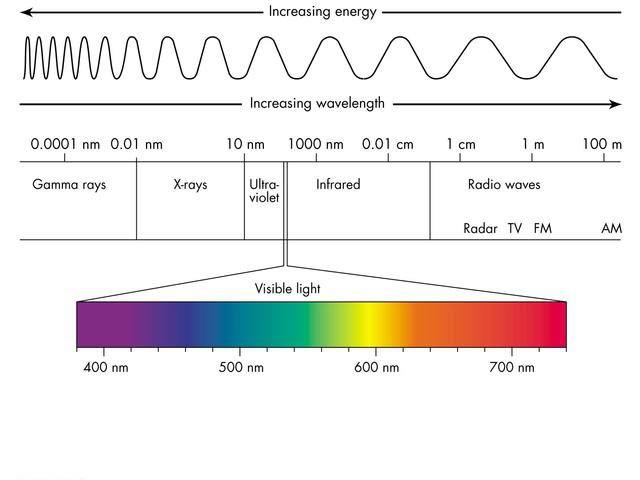
The electromagnetic spectrum includes the complete range of electromagnetic waves placed in order of:
a)
increasing amplitutde
b)
increasing wavelength
c)
increasing frequency
5.
Which of the following has frequencies higher than ultraviolet rays?
a)
visible light
b)
infrared rays
c)
x-rays
6.
Which of the following lists the electromagnetic waves in order of increasing wavelength?
a)
X-rays, visible light, radio waves
b)
gamma rays, microwaves, UV rays
c)
infrared rays, radio waves, x-rays
7.
Which of the following lists the electromagnetic waves in order of decreasing frequency?
a)
X-rays, microwaves, infrared rays
b)
UV rays, visible light, x-rays
c)
infrared rays, microwaves, radio waves
8.
A wave with a large wavelength will have a ______ frequency and _____ energy
a)
high, low
b)
high, high
c)
low, high
d)
low, low
9.
Select the correct order of waves on the EMS from the longest wavelength to the shortest wavelength
a)
Radio, Micro, Infra, Visible, Ultra, X-ray, Gamma
b)
Gamma, X-ray, Ultra, Vis, Infra, Micro, Radio
c)
Vis, Micro, Infra, Ultra, X-ray, Gamma, Radio
d)
Micro, Radio, Vis, Infra, Ultra, X-ray, Gamma
10.
Which has the LONGEST wavelength and, therefore, the lowest frequency/energy
a)
Gamma Rays
b)
Radio Waves
c)
Visible Light
d)
Infrared rays
11.
Which has the SHORTEST wavelength and, therefore, the highest frequency/most energy
a)
Radio waves
b)
Ultraviolet Rays
c)
Gamma Rays
d)
X-rays
12.
Which section of the spectrum is the ONLY one we can see?
a)
X-rays
b)
Visible Light
c)
Gamma Rays
d)
Ultraviolet Rays
13.
Which of the following electromagnetic waves has the lowest energy?
a)
gamma ray
b)
infrared wave
c)
visible light wave
d)
microwave
14.
As the frequency of an electromagnetic wave increases, the amount of energy in that wave...
a)
increases.
b)
decreases.
c)
stays the same.
15.

Which color has the longest wavelength?

a)

Yellow

b)

Red

c)

Green

d)

Purple

16.
A disturbance that transfers energy from place to place is called a __________. 
a)
Wave
b)
Medium
c)
Vibration
d)
Compression 
17.
The highest parts of a transverse wave are called ____________. 
a)
Troughs
b)
Crests
c)
Nodes
d)
Wavelengths 
18.
Waves that move particles of the medium parallel to the direction in which the waves are traveling are called ___________. 
a)
Compressional Waves
b)
Transverse Waves
c)
Surface Waves
d)
Combination Waves 
19.
The distance between two corresponding parts of a wave is the wave's ___________. 
a)
Amplitude
b)
Wavelength
c)
Frequency
d)
Speed 
20.
The bending of waves due to change in speed is called ______________. 
a)
Reflection
b)
Refraction
c)
Diffraction
d)
Interference 
21.
The interaction between two waves that meet is called _____________. 
a)
Reflection
b)
Refraction
c)
Diffraction
d)
Interference 
22.
Frequency is measure in units called __________. 
a)
Amps
b)
Hertz
c)
Nodes
d)
Antinodes 
23.
Electromagnetic waves can transfer energy without a(an) _________. 
a)
Medium
b)
Electric Field 
c)
Magnetic Field 
d)
Change in either a magnetic or an electric field 
24.
When a police officer uses a radar for speed control, the officer is using what kind of electromagnetic waves? 
a)
Radio Waves
b)
Gamma Rays
c)
Ultraviolet Rays
d)
X-Rays 
25.
Visible light can be separated into various colors to form a (an) __________. 
a)
Spectrum
b)
Thermogram
c)
MRI
d)
X-Ray Picture 
26.
FM signals travel as changes in ___________. 
a)
the speed of  the wave
b)
the amplitude of the wave
c)
the frequency of the wave
d)
the loudness of the wave 
27.
What kind of waves do cellular telephones use to transmit and receive signals? 
a)
Gamma Rays
b)
Microwaves
c)
Ultraviolet Rays
d)
Infrared Rays 
28.
Global Positioning System signals can tell you ____________. 
a)
What television station you are tuned to 
b)
Your exact location on Earth
c)
How many satellites are in orbit
d)
Who is sending a message to your phone 
29.
For each cell, or geographical area, a cellular phone system requires ___________. 
a)
A hub
b)
A specific frequency
c)
A tower
d)
A satellite dish 
30.
Cell phone signals are transmitted by ____________. 
a)
Radio Waves
b)
Infrared Rays
c)
Ultraviolet Rays
d)
X-Rays 
31.

Match the following

a)

Radio waves

1.

Has the longest wavelengths and the lowest frequency

b)

Microwaves

2.

Used in cell phone communication and police radar systems

c)

Infrared rays

3.

It is used in thermal imaging

d)

UV rays

4.

Overexposure to this can result in sunburns and skin cancer

e)

Gamma Rays

5.

Has the highest energy of all electromagnetic radiation and is the most damaging to human tissue

32.

Radiant energy spreads out from its source in all directions.

a)

True

b)

False

33.

Both X-rays and gamma rays have higher frequencies than ultraviolet rays.

a)

True

b)

False

34.

Communicating with satellites is an application of gamma rays.

a)

True

b)

False

35.

Reorder the following according to the spectrum

a)

red

b)

orange

c)

yellow

d)

green

e)

blue

1)
2)
3)
4)
5)
36.

Reorder the following from shortest wavelength to the longest wavelength.

a)

gamma waves

b)

x-rays

c)

ultraviolet waves

d)

visible light

e)

infrared rays

1)
2)
3)
4)
5)
37.

Reorder the following from shortest wavelength to the longest wavelength.

a)

radio waves

b)

microwaves

c)

infrared

d)

x-rays

e)

gamma waves

1)
2)
3)
4)
5)
38.

The electromagnetic spectrum is a continuous range of ______ for electromagnetic radiation.

a)

light

b)

frequencies

c)

particles

d)

magnestism

39.

Which has more energy?

a)

radio/tv waves

b)

infrared

40.

Which has a higher frequency?

a)

visible light

b)

ultraviolet rays

41.

What is the difference between frequency and wavelength?

a)

The shorter wavelength, the less frequency.

b)

The longer the wavelength, the frequency is greater.

c)

The longer the wavelength, the frequency is less.

42.

Electromagnetic waves that you can see

a)

radio waves

b)

visible light

c)

x-rays

d)

ultraviolet rays

43.

Used for medical imaging to diagnose health issues in bones and teeth

a)

visible light

b)

ultraviolet rays

c)

x-rays

d)

gamma rays

44.

Reorder the following according to the spectrum

a)

yellow

b)

green

c)

blue

d)

indigo

e)

violet

1)
2)
3)
4)
5)
45.
Which electromagnetic waves have the highest frequencies and the shortest wavelengths?
a)
microwaves
b)
visible light
c)
gamma rays
46.
Which electromagnetic waves are used in ovens and cell phone communications?
a)
Infrared rays
b)
ultraviolet rays
c)
microwaves
47.
Electromagnetic waves that help your body produce vitamin D are called?
a)
ultraviolet rays
b)
x-rays
c)
gamma rays
48.
For waves in any medium, as the wavelength decreases, what happens to the frequency?
a)
It also decrease
b)
It stays the same
c)
It increases
49.
Which of the following has wavelengths longer than microwaves?
a)
Infrared waves
b)
Radio waves
c)
Visible light
50.
Which electromagnetic waves allow us to diagnose & treat cancer?
a)
Gamma rays
b)
X-rays
c)
Ultraviolet rays
51.
Which of the following has frequencies higher than ultraviolet rays?
a)
visible light
b)
infrared rays
c)
x-rays
52.
Which electromagnetic waves help doctors detect broken bones inside your body?
a)
gamma rays
b)
x-rays
c)
ultraviolet rays
53.
Which of the following lists the electromagnetic waves in order of increasing wavelength?
a)
X-rays, visible light, radio waves
b)
gamma rays, microwaves, UV rays
c)
infrared rays, radio waves, x-rays
54.
Which electromagnetic waves are used in devices such as heat lamps & TV remote controls?
a)
ultraviolet rays
b)
microwaves
c)
infrared rays
55.
A wave with a large wavelength will have a ______ frequency and _____ energy
a)
high, low
b)
high, high
c)
low, high
d)
low, low
56.
Which has the LONGEST wavelength and, therefore, the lowest frequency/energy
a)
Gamma Rays
b)
Radio Waves
c)
Visible Light
d)
Infrared rays
57.
Which has the SHORTEST wavelength and, therefore, the highest frequency/most energy
a)
Radio waves
b)
Ultraviolet Rays
c)
Gamma Rays
d)
X-rays
58.
How are electromagnetic waves different from other waves? 
a)
They have very short wavelengths 
b)
They transmit energy instead of matter 
c)
They can travel through empty space
d)
They can change direction by reflection 
59.
Which section of the spectrum is the ONLY one we can see?
a)
X-rays
b)
Visible Light
c)
Gamma Rays
d)
Ultraviolet Rays
60.

Which of the following has the shortest wavelength?

a)

microwaves

b)

UV rays

c)

Infrared

d)

the color blue

61.

Which of the following has the most energy?

a)

Red

b)

Blue

c)

Green

d)

Violet

62.

Which of the following has the shortest wavelength?

a)

Gamma rays

b)

The color blue

c)

AM radio

d)

Infrared

63.
Select the correct order of waves on the EMS from the longest wavelength to the shortest wavelength
a)
Radio, Micro, Infra, Visible, Ultra, X-ray, Gamma
b)
Gamma, X-ray, Ultra, Vis, Infra, Micro, Radio
c)
Vis, Micro, Infra, Ultra, X-ray, Gamma, Radio
d)
Micro, Radio, Vis, Infra, Ultra, X-ray, Gamma
64.
Which has the LONGEST wavelength and, therefore, the lowest frequency/energy
a)
Gamma Rays
b)
Radio Waves
c)
Visible Light
d)
Infrared rays
65.
Which has the SHORTEST wavelength and, therefore, the highest frequency/most energy
a)
Radio waves
b)
Ultraviolet Rays
c)
Gamma Rays
d)
X-rays
66.
Which of the following electromagnetic waves has the lowest energy?
a)
gamma ray
b)
infrared wave
c)
visible light wave
d)
microwave
67.
The distance between two crests or two troughs of a wave is called:
a)
frequency
b)
amplitud
c)
wavelength
d)
hertz
68.
How much of the electromagnetic spectrum is visible?
a)
All of it
b)
None of it
c)
Most of it
d)
Only a small part
69.
Which electromagnetic waves are used in ovens and cell phone communications?
a)
Infrared rays
b)
ultraviolet rays
c)
microwaves
70.
Electromagnetic waves that help your body produce vitamin D are called?
a)
ultraviolet rays
b)
x-rays
c)
gamma rays
71.
Which electromagnetic waves allow us to diagnose & treat cancer?
a)
Gamma rays
b)
X-rays
c)
Ultraviolet rays
72.
Which electromagnetic waves help doctors detect broken bones inside your body?
a)
gamma rays
b)
x-rays
c)
ultraviolet rays
73.
Which section of the spectrum is the ONLY one we can see?
a)
X-rays
b)
Visible Light
c)
Gamma Rays
d)
Ultraviolet Rays
74.

What is not a field that makes up an electromagnetic wave?

a)

electric

b)

magnetic

c)

digitial

d)

none of the above

75.

Which of the following is not in the electromagnetic spectrum?

a)

Light waves

b)

Sound waves

c)

Radio Waves

d)

X-rays

76.

What is the correct order of the visible light spectrum starting with the longer wavelength?

a)

Red, yellow, orange, blue, violet, indigo

b)

Violet, indigo, blue, green, yellow, orange, red

c)

Green, yellow, blue, indigo, red, orange

d)

Red, orange, yellow, green, blue, indigo, violet

77.

Which of the following does not use microwaves?

a)

A mobile phone

b)

Wifi

c)

A speed Camera

d)

A TV remote control

78.

Identify the part of the electromagnetic spectrum from the following description. Used in cooking, used in short-range communication and has a typical wavelength of 900nm.

a)

infrared

b)

microwave

c)

radio wave

d)

gamma wave

79.

Identify the part of the electromagnetic spectrum from the following description. Used in cooking, used in communication and has a typical wavelength of 150nm.

a)

Infrared

b)

Microwave

c)

radiowaves

d)

gamma wave

80.
Which has the LONGEST wavelength and, therefore, the lowest frequency/energy
a)
Gamma Rays
b)
Radio Waves
c)
Visible Light
d)
Infrared rays
81.
Which has the SHORTEST wavelength and, therefore, the highest frequency/most energy
a)
Radio waves
b)
Ultraviolet Rays
c)
Gamma Rays
d)
X-rays
82.
Which section of the spectrum is the ONLY one we can see?
a)
X-rays
b)
Visible Light
c)
Gamma Rays
d)
Ultraviolet Rays
83.
As the frequency of an electromagnetic wave increases, the amount of energy in that wave...
a)
increases.
b)
decreases.
c)
stays the same.
84.
Which color has the least amount of energy?
a)
red
b)
orange
c)
green
d)
blue
85.
Which of the following has the longest wavelength?
a)
microwaves
b)
visible light
c)
x-rays
d)
infrared waves
86.

The distance between two crests or two troughs of a wave is called:

a)

frequency

b)

amplitude

c)

wavelength

d)

hertz

87.
The height of the wave is known as the _____________.
a)
amplitude
b)
crest
c)
trough
d)
wavelength
88.

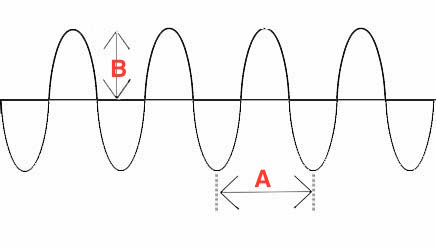
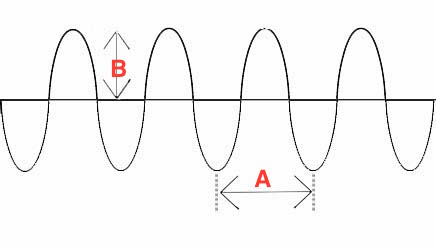
What property of this wave is represented by the letter "A"

a)

amplitude

b)

crest

c)

trough

d)

wavelength

89.
What property of the wave is represented by the letter "B"?
a)
amplitude
b)
crest
c)
trough
d)
wavelength
90.
The highest point on a wave is:
a)
the crest
b)
the trough
c)
the top
d)
the coast 
91.
The number of wavelengths that pass a point each per second is:
a)
frequency
b)
period
c)
longitudinal 
d)
transverse wave 
92.
When the frequency of a wave increases, what happens to the wavelength?
a)
The wavelength is not directly affected by the frequency of a wave.
b)
The wavelength increases.
c)
The wavelength decreases.
d)
More specific information is needed to form a conclusion about the wavelength.
93.
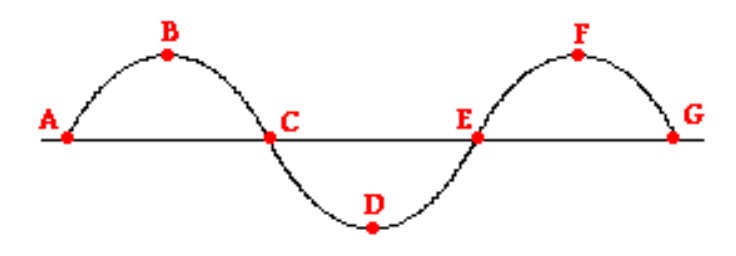
Which letter(s) represent the trough of the wave?
a)
A
b)
B & D
c)
D
d)
C & G
94.
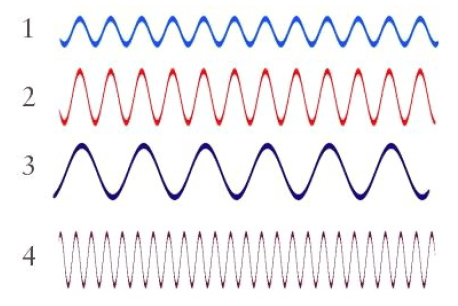
Which wave in the diagram has the greatest frequency?
a)
1
b)
2
c)
3
d)
4
95.

Which wave in the diagram has the longest wavelength?

a)

1

b)

2

c)

3

d)

4

96.
Electromagnetic waves include the following except
a)
radio waves
b)
X-rays
c)
doing the wave at a football game
d)
microwaves
97.
The units for frequency are measured in _____________.
a)
hertz
b)
seconds
c)
m/s
d)
grams
98.
EM waves ________ a medium.
a)
require
b)
don't require
c)
can have
d)
sometimes have
99.
Wavelengths on the right side of the EM spectrum are ______________.
a)
short
b)
long
c)
average
100.

Wavelengths on the left side of the EM spectrum are __________.

a)

long

b)

short

c)

average

101.
_____ have the longest wavelengths and lowest frequencies of all electromagnetic waves.
a)
microwaves
b)
radio waves
c)
gamma rays
d)
ultraviolet
102.
This type of EM wave can cause skin cancer. 
a)
microwaves
b)
ultraviolet ray
c)
radio
d)
infrared
103.
EM waves with wavelengths between those of infrared and ultraviolet waves are _______.
a)
microwaves
b)
visible light
c)
x-rays
d)
gamma rays
104.

This type of EM wave shows a break in bones.

a)

gamma ray

b)

x-ray

c)

infrared

d)

radio wave

105.

________ is an EM wave used to cook Ms. Fulmer's hot pocket.

a)

radio

b)

microwave

c)

visible light

d)

ultraviolet

106.
True or false: as you move along the spectrum, left to right, the wavelengths decrease in size (get smaller)
a)
true
b)
false
107.
Select the correct order of waves on the EMS 
a)
Radio, Micro, Infra, Visible, Ultra, X-ray, Gamma
b)
Gamma, X-ray, Ultra, Vis, Infra, Micro, Radio
c)
Vis, Micro, Infra, Ultra, X-ray, Gamma, Radio
d)
Micro, Radio, Vis, Infra, Ultra, X-ray, Gamma
108.

Put the visible light colors in order from least energy to most energy

a)

Violet, Indigo, Blue, Green, Orange, Yellow, Red

b)

Red, Yellow, Green, Orange, Violet, Blue, Indigo

c)

Red, Orange, Yellow, Green, Blue, Indigo, Violet

109.
How much of the electromagnetic spectrum is visible?
a)
All of it
b)
None of it
c)
Most of it
d)
Only a small part
110.
EM waves used to broadcast television signals
a)
radio waves
b)
infrared
c)
gamma rays
d)
x rays
111.
The electromagnetic spectrum is the entire range of
a)
colors of visible light
b)
ultraviolet light.
c)
gamma rays and X rays.
d)
EM waves.
112.
The entire electromagnetic spectrum is divided into regions by
a)
color
b)
speed
c)
wavelength
d)
the way they are used
113.
EM waves used to treat some forms of cancer
a)
microwaves
b)
gamma waves
c)
ultraviolet
d)
infrared
114.
White light is the entire range of
a)
colors of visible light combined.
b)
ultraviolet light.
c)
gamma rays and X rays.
d)
EM waves.
115.
EM waves used in security scanning devices in airports
a)
ultraviolet
b)
x rays
c)
radio waves
d)
infrared
116.
EM waves that make an object feel warmer
a)
visible light
b)
red light
c)
infrared waves
d)
ultraviolet
117.
Ultraviolet light is associated with
a)
human vision
b)
communication
c)
lung cancer
d)
producing vitamin D
118.
Which color of light has the longest wavelength?
a)
orange
b)
red
c)
blue
d)
green
119.

Electromagnetic waves vary in

a)

the speed they travel in a vacuum

b)

wavelength and frequency

c)

the way they reflect

d)

the orientation of their electric and magnetic fields

120.

To calculate the frequency of an electromagnetic wave, you need to know the speed of the wave and its

a)

wavelength

b)

refraction

c)

intensity

d)

amplitude

121.

Infrared rays have a shorter wavelength than

a)

Ultraviolet ray

b)

X-rays

c)

gamma rays

d)

radio waves

122.

The full range of frequencies of electromagnetic radiation is called

a)

visible light

b)

the electromagnetic spectrum

c)

radio waves

d)

invisible radiation

123.

The waves with the longest wavelengths in the electromagnetic spectrum

a)

Infrared rays

b)

gamma rays

c)

radio waves

d)

X-rays

124.

The visible light spectrum ranges between

a)

radio waves and X-rays

b)

infrared rays and ultraviolet rays

c)

television waves and infrared rays

d)

ultraviolet rays and gamma rays

125.

What happens to frequency when the energy increases?

a)

it increases

b)

it stays the same

c)

it decreases

126.

What part of the wave is shown at letter A?

a)

crest

b)

wavelength

c)

trough

d)

frequency

127.

Which part of the wave is shown at letter B?

a)

crest

b)

wavelength resting point

c)

trough

128.

Which part of the wave is shown at letter C?

a)

crest

b)

resting point

c)

wavelength

d)

amplitude

129.

What does a wave carry?

a)

boats

b)

energy

c)

matter

d)

water

130.

Which wave has a longer wavelength?

a)

wave C

b)

wave D

131.

Which wave has a greater frequency?

a)

wave B

b)

wave C

132.

a form of electromagnetic radiation that doesn't require a medium to pass through

a)

sound wave

b)

transverse wave

c)

light wave

d)

compressional wave

133.

Select the correct order of waves on the EMS from low to high energy

a)

Radio wave, Microwave, Infrared, Visible, Ultraviolet, X-ray, Gamma

b)

Visible, Microwave, Infrared, Ultraviolet, X-ray, Gamma, Radio wave

c)

Gamma, X-ray, Ultraviolet, Visible, Infrared, Microwave, Radio wave

d)

Microwave, Radio wave, Visible, Infrared, Ultraviolet, X-ray, Gamma

134.

Which has the LONGEST wavelength and, therefore, the LOWEST frequency/energy

a)

Gamma Rays

b)

Visible Light

c)

Ultraviolet

d)

Infrared rays

135.

Which of the following electromagnetic waves has the lowest frequency?

a)

gamma ray

b)

visible light wave

c)

infrared wave

d)

microwave

136.

High frequency in EM waves equals

a)

high energy and short wavelength

b)

low energy and short wavelength

c)

high energy and long wavelength

d)

low energy and long wavelength

137.

Which section of the spectrum is the ONLY one we can see?

a)

X-rays

b)

Gamma Rays

c)

Visible Light

d)

Ultraviolet Rays

138.

As the frequency of an electromagnetic wave increases, the amount of energy in that wave

a)

increases

b)

stays the same

c)

decreases