wayground logo

Free Printable Worksheets

Font size

S
M
L
XL
Worksheets

Brain and Neuron

Total questions: 73

Worksheet time: 47mins

Name
Class
Date
1.
Label the Neuron-What does the letter "H" represent?
a)
Schwann Cell
b)
Axon
c)
Axon Terminal
d)
Dendrite
2.
Label the Neuron-What does the letter "C" represent?
a)
Cell Body
b)
Dendrite
c)
Axon Terminal
d)
Myelin Sheath
3.
Label the Neuron-What does the letter "A" represent?
a)
Axon
b)
Dendrite
c)
Axon Terminal
d)
Cell Body
4.
What is the chemical used by a neuron to transmit an impulse across a synapse to another nerve cell?
a)
Neurotransmitters
b)
Synapse
c)
Threshold
d)
Impulse
5.
What is the insulating membrane that surrounds parts of the axon that helps the impulses travel faster called?
a)
Axon
b)
Dendrites
c)
Node of Ranvier
d)
Myelin Sheath
6.
These receive messages and conduct impulses to the Cell Body
a)
Axon
b)
End Bulbs
c)
Dendrites
d)
Myelin Sheath
7.
The part of the neuron that insulates the axon and increases the speed of the neural message within the neuron.
a)
Synapse
b)
Dendrite
c)
Myelin Sheath
d)
Axon Terminal Button
8.
A nerve cell that is the basic working unit of the brain and nervous system which processes and transmits information
a)
axon
b)
neuron
c)
dendrite
d)
neurotransmitter
9.
This lobe controls responses to complex problems through reasoning, judgment, decision making and planning.
a)
Occipital Lobe
b)
Parietal Lobe
c)
Temporal Lobe
d)
Frontal Lobe
10.
This lobe receives and processes pain, pressure and touch from the body to create a map of the body's position in space and a map of body parts in relation to other body parts.
a)
Occipital Lobe
b)
Parietal Lobe
c)
Temporal Lobe
d)
Frontal Lobe
11.
This lobe evolved most recently and is the last to fully develop in young adulthood.
a)
Occipital Lobe
b)
Parietal Lobe
c)
Temporal Lobe
d)
Frontal Lobe
12.
This lobe receives and processes visual information and then sends it to other parts of the brain for further processing and storage.
a)
Occipital Lobe
b)
Parietal Lobe
c)
Temporal Lobe
d)
Frontal Lobe
13.
The left side of this lobe regulates hearing.
a)
Occipital Lobe
b)
Parietal Lobe
c)
Temporal Lobe
d)
Frontal Lobe
14.
Each hemisphere (half) of the brain has specific functions, but both sides of the brain must communicate and work together. 
a)
True
b)
False
15.
Which is the following is represented by the letter A?
a)
Dendrite
b)
Cell Body 
c)
Nucleus
d)
Myelin Sheath
16.
The lobe responsible for making plans and evaluating consequences
a)
Frontal Lobe
b)
Temporal Lobe
c)
Parietal Lobe
d)
Occipital Lobe
17.

What controls your balance?

a)

thalamus

b)

cerebellum

c)

cerebrum

d)

frontal lobes

18.
If a head injury results in someone no longer being able to hear, which part of the brain may have been damaged?
a)
temporal lobe
b)
occipital lobe
c)
parietal lobe
d)
frontal lobe
19.

Which lobe is responsible for interpreting vision?

a)

Frontal Lobe

b)

Temporal Lobe

c)

Parietal Lobe

d)

Occipital Lobe

20.
a)
Cerebellum
b)
Brain Stem
c)
Occipital Lobe
d)
Temporal Lobe
21.

The brain and spinal cord are part of

a)

The Nervous System

b)

The Digestive System

c)

The Circulatory System

d)

The Muscular System

22.

Posture and balance of the body is controlled by

a)

Cerebrum

b)

Cerebellum

c)

Medulla

d)

Pons

23.

Spinal cord originates from

a)

Cerebrum

b)

Medulla

c)

Cerebellum

d)

Pons

24.

Part of the brain that controls respiration, heart beat and peristalsis is

a)

Cerebrum

b)

Cerebellum

c)

Hypothalamus

d)

Medulla

25.

Most highly developed part of human brain is

a)

Pons

b)

Medulla

c)

Cerebrum

d)

Cerebellum

26.
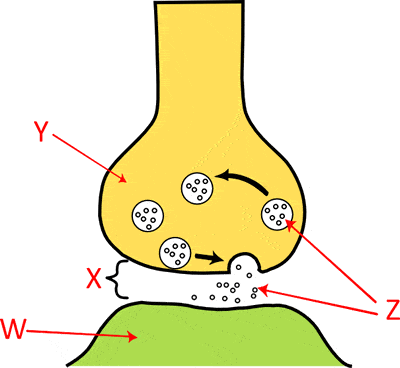
W
a)
Axon Terminal Button
b)
Neurotransmitters
c)
Dendrite
d)
Synapse
27.
Y
a)
Axon Terminal Button
b)
Neurotransmitters
c)
Dendrite
d)
Synapse
28.
What generates a nerve impulse on the post-synaptic membrane? 
a)
Calcium binding with a receptor site
b)
Potassium leaking into the post-synaptic membrane 
c)
Neurotransmitter binding with receptor sites
d)
Neurotransmitter being removed from the synapse
29.

The location of neurotransmitters

a)

axon terminals

b)

dendrites

c)

Schwann cells

d)

cell body

30.

X

a)

Axon Terminal Button

b)

Neurotransmitters

c)

Dendrite

d)

Synapse

31.

Z

a)

Axon Terminal Button

b)

Neurotransmitters

c)

Dendrite

d)

Synapse

32.

X

a)

Axon Terminal Button

b)

Neurotransmitters

c)

Dendrite

d)

Synapse

33.

Which type of neuron is found in the brain and spinal cord?

a)

Sensory

b)

Interneuron

c)

Motor

34.

Which neurons carry nerve impulses from the senses organs to the spinal cord or brain

a)

Sensory

b)

Interneuron

c)

Motor

35.

Which neurons carry nerve impulses from the senses organs to the spinal cord or brain

a)

Sensory

b)

Interneuron

c)

Motor

36.

____________neurons carry impulses from the brain or spinal cord to the muscles, tissues and organs.

a)

Sensory

b)

Motor

c)

Interneuron

37.

What is the name of the neuron shown in the diagram?

a)

Interneuron

b)

Sensory

c)

Motor

38.

What is the name of the neuron shown in the diagram?

a)

Interneuron

b)

Motor

c)

Sensory

39.

What is the name of the neuron shown in the diagram?

a)

Interneuron

b)

Sensory

c)

Motor

40.

The part of the neuron that receives messages from other neurons

a)

axon

b)

dendrite

c)

cell body

d)

Schwann cell

41.

The location of neurotransmitters

a)

axon terminals

b)

dendrites

c)

Schwann cells

d)

cell body

42.
Identify the part of the neuron
a)
axon
b)
axon terminal
c)
dendrite
d)
Node of Ranvier
43.
Identify the part of the neuron
a)
axon
b)
axon terminal
c)
cell body 
d)
dendrite
44.

The tiny gap between neurons where nerve impulses are sent from one neuron to another.

a)

synapse

b)

axon terminal

c)

impulse

d)

myelin

45.

The part of the neuron that insulates the axon and increases the speed of the neural message within the neuron.

a)

Cell Body

b)

Dendrite

c)

Myelin Sheath

d)

Axon Terminal

46.
What two things are found in the central nervous system?
a)
brain/spinal cord
b)
spinal cord/motor neurons
c)
motor/sensory neurons
d)
only brain
47.

If I step on a nail...what type of neuron take that signal TO the CENTRAL NERVOUS SYSTEM?

a)

interneurons

b)

motor

c)

sensory

d)

receptors

48.

If I step on a nail...what type of neurons send the response from the brain to my muscles?

a)

motor

b)

interneurons

c)

sensory

d)

not neurons, muscle tissue sends the response

49.

something that causes a response is called a

a)

response

b)

stimulus

c)

touch

d)

survival

50.

What type of stimuli originate in the environment around an organism?

a)

external

b)

internal

51.

Hunger, thirst, fever or vomiting are what type of stimuli?

a)

external

b)

internal

52.

The dog sees his owner get a doggie treat out of the cupboard. The dog jumps and wags his tail.


What is the stimulus?

a)

The dog see his owner get a doggie treat out of the cupboard.

b)

The dog jumps and wags his tail.

53.

After a ride on the Merry-Go-Round, Mary felt dizzy.


What is the response?

a)

Mary riding on the Merry-Go-Round.

b)

Mary gets dizzy.

54.

When Grace told Jacob he looked nice today, he blushed.


What is the response?

a)

Jacob blushing.

b)

Grace telling Jacob he looked nice today.

55.

When Katie is fishing, she feels her rod start to bend. She immediately yanks the rod and reels the line in.


What is the stimulus?

a)

Katie yanks the rod and reels the line in.

b)

Katie feels her fishing rod start to bend.

56.

(a)   is a change in an organism’s surroundings that causes the organism to react.

57.

Jackson went outside and ran 5 miles. When he gets home, he is thirsty.


What is the stimulus?

a)

Jackson ran 5 miles.

b)

Jackson is thirsty.

58.
What is the central nervous system (CNS) made of?
a)
brain and spinal cord
b)
brain and cranial nerves
c)
spinal cord and spinal nerves
d)
cranial nerves and spinal nerves
59.
What is NOT part of the peripheral nervous system (PNS)?
a)
axons
b)
sensory receptors
c)
spinal cord
d)
motor neurons
60.
a signal molecule that transmits nerve impulses across synapses
a)
neuron
b)
neurotransmitter
c)
nerve
d)
action potential
61.
Location at which a neuron can transfer an impulse to another cell with the use of neurotransmitters is called __________.
a)
myelin sheath
b)
axon
c)
threshold
d)
synapse
62.
The part of the neuron that takes information away from the cell body is called a(n) _____________.
a)
dendrite
b)
axon
c)
cell body
d)
Schwann cell
63.

What is the biggest part of the brain?

a)

Adrenaline

b)

Glucagon

c)

Cerebrum

d)

Cortisol

64.

The part of the neuron that insulates the axon and increases the speed of the neural message within the neuron.

a)

Cell Body

b)

Dendrite

c)

Myelin Sheath

d)

Axon Terminal

65.
The nerve cell that transmits impulses from the brain or spinal cord to a muscle or gland.
a)
Motor Neuron
b)
Relay Neuron
c)
Sensory Neuron
66.

The __________ is a two-hemisphere structure located just below the rear part of the cerebrum, right behind the brain stem. This area coordinates movement. (Sousa, p.21)

a)

Amygdala

b)

Cerebellum

c)

Frontal Lobe

d)

Hippocampus

67.

Often called the executive control center, these lobes deal with planning and thinking. (Sousa, pp. 16-17)

a)

Frontal Lobes

b)

Temporal Lobes

c)

Occipital Lobes

d)

Parietal Lobes

68.

What is the function of the highlighted area of the brain, shown above? (Image retrieved from Kenhub.com)

a)

planning and thinking

b)

dealing with sound, music, face and recognizing object

c)

visual processing

d)

integrating sensory information

69.

What is the function of the above highlighted brain area?

(Image retrieved from Kenhub.com)

a)

coordinating movement

b)

controlling the release of various hormones

c)

regulating individual's interaction with the environment

d)

monitoring and controlling vital body functions

70.

Which color represents the temporal lobe?

a)

Blue

b)

Yellow

c)

Pink

d)

Green

71.

Which color represents the parietal lobe?

a)

Blue

b)

Pink

c)

Yellow

d)

Green

72.

Which color represents the occipital lobe?

a)

Yellow

b)

Blue

c)

Pink

d)

Green

73.

Which color represents the frontal lobe?

a)

Yellow

b)

Pink

c)

Red

d)

Blue