wayground logo

Free Printable Worksheets

NEW

Font size

S
M
L
XL
Worksheets

STAAR Bio RC 4 (Animal/Plant Systems)

Total questions: 69

Worksheet time: 54mins

Name
Class
Date
1.
Flower: What is label B (the head of the male part of a flower)?
a)
Anther
b)
Filament
c)
Petal
d)
Pistil
2.
Flower: What is label E?
a)
Ovary
b)
Filament
c)
Petal
d)
Pistil
3.
Flower: What is label A?
a)
Anther
b)
Filament
c)
Petal
d)
Pistil
4.
Flower: What is label G (where the seeds are made)?
a)
Anther
b)
Ovule
c)
Petal
d)
Pistil
5.
Flower: What is label D?
a)
Sepal
b)
Ovule
c)
Petal
d)
Pistil
6.
Flower: What is label H (the body of the male part of the flower)?
a)
Sepal
b)
Ovule
c)
Filament
d)
Pistil
7.
What part of a plant takes up nutrients and water from the soil and stabilizes the plant? 
a)
Shoot System
b)
Leaf
c)
Roots
d)
Flower
8.
What is the female part of a flower called?
a)
Stamen
b)
Pistil
c)
Flower
d)
Petal
9.
What part of a plant moves water throughout the plant and gives structure to the plant?
a)
Stem
b)
Flower
c)
Leaves
d)
Pistil
10.
What is the food making process of a plant?
a)
Photosynthesis
b)
Chloroplast
c)
Mitosis
d)
Sugar
11.
Is this a monocot or dicot?
a)
Monocot
b)
Dicot
12.
Is this a monocot or dicot?
a)
Dicot
b)
Monocot
13.
Is this a monocot or dicot?
a)
Monocot
b)
Dicot
14.
Tiny openings in the leaves called _______________ allow the plant to take in carbon dioxide and release oxygen.
a)
Chlorophyll
b)
Glucose
c)
Stomata
d)
Xylem
15.
____________ is a gas needed by plants in order to perform photosynthesis.
a)
Oxygen
b)
Carbon Dioxide
c)
Stomata
d)
Sunlight
16.
What is the function of the Xylem?
a)
Transport sugar
b)
Transport water
c)
Transport salt
d)
Turgor Pressure
17.
Everything above the ground in plants is called...
a)
Photosynthesis
b)
Xylem
c)
Root
d)
Shoot
18.
Photosynthesis  takes place inside the ________ of the plants.
a)
Root
b)
Leaf
c)
Shoot
d)
Taproot
19.
A plant moving away from a stimulus is showing __________ tropism.
a)
Positive
b)
Negative 
c)
Taproot
d)
Auxin
20.
Phloem is a vascular tissue that transports....
a)
Sugar
b)
Auxin
c)
Water
d)
Shoot
21.
A plant that is moving towards a stimulus is showing______ tropism.
a)
Positive
b)
Negative
c)
Root
d)
Shoot
22.
This organ is responsible for for absorbing water.
a)
Root
b)
Stem
c)
Leaf
d)
Stomata
23.
This organ is covered in stomata for gas transfers.
a)
Leaf
b)
Tree
c)
Root
d)
Stem
24.
To prevent water from evaporating from its leaves, a plant will keep its stomata closed during the heat of the day. What cells regulate this process by controlling the size of the stomata?
a)
Gamete Cells
b)
Guard Cells
c)
Root Cells
d)
Vascular Cells 
25.
Which of the following sets of plant organs would be used during plant reproduction?
a)
Flowers and Cones
b)
Stems and Cones
c)
Roots and Flowers
d)
Leaves and Stems
26.
Which tropism does this represent?
a)
Phototropism
b)
Thigmotropism
c)
Hydrotropism
d)
Geotropism
27.
Which tropism does this represent?
a)
Phototropism
b)
Hydrotropism
c)
Thigmotropism
d)
Geotropism
28.
Which tropism does this represent?
a)
Phototropism
b)
Thigmotropism
c)
Hydrotropism
d)
Geotropism (Gravitropism)
29.
What is another word for Geotropism?
a)
Gravitropism
b)
Hydrotropism
c)
Thigmotropism
d)
Earth
30.
Which tropism does this represent?
a)
Thigmotropism
b)
Hydrotropism
c)
Geotropism
d)
Phototropism
31.
The only way plants respond to stimulus is by the use of a plant hormone called_______.
a)
Phototropism
b)
Xylem
c)
Phloem
d)
Auxin
32.

In plants the vascular tissues xylem and phloem are responsible for transporting materials to the cells of the plant. The vascular tissues of a plant are most like which human body system?

a)

Circulatory

b)

Respiratory

c)

Digestive

d)

Immune

33.
A student reads this advertisement for a product containing a plant micronutrient that can be added to soil.
Based on this information, the student can conclude that boron is absorbed by plant roots from soil and then —
a)
transported to reproductive tissues by the plant’s shoot system
b)
stored in plant stems until the flowers are pollinated
c)
concentrated in the roots until the plant’s reproductive tissues mature
d)
transported by the phloem to the stomata in leaves, where it attracts pollinators
34.
Several structures work together to allow flowering plants to reproduce. The diagram shows a typical flower.
Which table correctly identifies the function of each structure or group of structures in the reproduction of the plant?
a)
X Pollen production
Y Pollen transfer
Z Production of eggs
b)
X Attraction of pollinators
Y Production of male sex cells
Z Egg production and embryo development
c)
X Protection for embryo
Y Supply nourishment to embryo
Z Place of embryonic development
d)
X Photosynthesis
Y Production of cells that protect internal organs
Z Production of egg and sperm
35.
These two systems interact to allow our bodies respond to the environment and to maintain homeostasis.  (Hint - they both send messages and one is fast, one is slow)
a)
nervous and endocrine
b)
nervous and digestive
c)
endocrine and excretory
d)
respiratory and digestive
36.
Organs of this system include the kidneys and bladder
a)
Digestive
b)
Excretory
c)
Immune
d)
Skeletal
37.
Functions of this system include production of red blood cells, storage of minerals, support of the body, and protection of organs.
a)
Muscular
b)
Excretory
c)
Skeletal
d)
Nervous
38.
Which human body systems interact to produce movement of the body?
a)
Nervous and endocrine
b)
Skeletal and muscular
c)
Circulatory and digestive
d)
Excretory and nervous
39.
Which body systems work together to supply the body's cells with oxygen?
a)
Respiratory and immune
b)
Nervous and reproductive
c)
Circulatory and respiratory
d)
Endocrine and muscular
40.
Which two body systems work together to break down food into energy and rid the body of the waste produced during this process?
a)
Skeletal and endocrine
b)
Digestive and excretory
c)
Nervous and immune
d)
Muscular and skeletal
41.
The two body systems that work together to protect you from foreign pathogens are...
a)
Integumentary and immune
b)
Reproductive and muscular
c)
Endocrine and digestive
d)
Respiratory and circulatory
42.
Which body system is the 'slow response' system and uses hormones to bring about a response?
a)
Endocrine
b)
Immune
c)
Muscular
d)
Excretory
43.
What is the Circulatory System's main functions?
a)
Produces Oxygen
b)
expelling waste
c)
Transportation of nutrients and oxygen to cells and waste from cells
d)
Converting energy out of food
44.
What three systems work together to move the body?
a)
Skeletal, Muscular, Nervous
b)
Skeletal, Respiratory, Digestive
c)
Nervous, Circulatory, Skeletal
d)
Circulatory, Respiratory, Digestive
45.
How does the Circulatory System help the Muscular System?
a)
Protects muscles
b)
Sends messages to the muscles to contract
c)
Brings oxygen into the body
d)
Delivers nutrients and oxygen to muscle tissue
46.
The diaphragm is a muscle that interacts with the _____ system because it expands and relaxes your chest which pull air in and out of your lungs. 
a)
nervous
b)
respiratory
c)
digestive
d)
endocrine
47.
The skeletal system interacts with the _____ system when it produces red blood cells.  
a)
circulatory
b)
excretory
c)
digestive
d)
nervous
48.
The muscular system interacts with the ____ system as it helps break down and move the food we eat through our bodies.
a)
nervous
b)
digestive
c)
excretory
d)
endocrine
49.
The circulatory system interacts with the ____ system when as it surrounds the small intestine. Broken down food (nutrients) is delivered in the blood to all the cells.  
a)
digestive
b)
excretory
c)
nervous
d)
skeletal
50.
In humans, the gases oxygen and carbon dioxide must be exchanged between the environment and cells. During this exchange, oxygen is delivered to the red blood cells so that they can function properly in the blood stream. Which two body systems are working together to achieve this goal?
a)
Endocrine and Reproductive
b)
Skeletal and Muscular
c)
Respiratory and Circulatory
d)
Digestive and Excretory
51.
David has diabetes. His sugar level is often rising and lowering. Which body system is in charge of regulating his sugar levels?
a)
Excretory
b)
Endocrine
c)
Circulatory
d)
Nervous
52.

When your body comes in contact with a sharp object, an impulse sent you your brain triggers a reflex that causes you to move away from the object. What body systems are interacting to cause this response?

a)

Nervous, Respiratory,

b)

Nervous, Muscular

c)

Nervous, Skeletal

d)

Nervous, Digestive

53.

What is an example of a positive feedback mechanism?

a)
b)
54.

What is an example of a negative feedback mechanism?

a)
b)
55.
Pathogens are dangerous bacteria. What body systems are most important when dealing with pathogens that might be in your blood?
a)
immune, circulatory
b)
nervous, skeletal
c)
muscular, endocrine
d)
reproductive
56.
The skin is the major organ in which system?
a)
Integumentary
b)
Muscular
c)
Endocrine
d)
Immune
57.

How does the skeletal system help defend an organism?

a)

White blood cells are produced in the bone marrow

b)

Protects organs

c)

Works with the muscular system to helps= the organism move away from danger

d)

All of the above are ways that the skeletal system helps protect the organism

58.

A man was walking through the desert and he became lost. The temperature outside rose to 110 degrees Fahrenheit and the man’s body temperature increased with it. His skin began to excrete sweat in an effort to cool his body back down. Which two body systems are working to help him maintain homeostasis?

a)

Endocrine and Excretory

b)

Excretory and Integumentary

c)

Integumentary and Skeletal

d)

Skeletal and Respiratory

59.

A horror frog breaks the bones of his hand/foot when he is in danger. After the bones are broken, he presses the bones through his skin and forms a wolverine-like weapon that he can use to fight off predators. Which three systems are working together here to help him defend himself?

a)

Nervous, Immune, and Muscular

b)

Nervous, Endocrine, and Integumentary

c)

Nervous, Skeletal, and Integumentary

d)

Nervous, Skeletal, and Immune

60.
If the environment gets cold, we will often shiver in order to:
a)
keep body temperature the same as the external temperature
b)
decrease body temperature
c)
increase body temperature
d)
regulate blood pressure
61.

When you get cut, your skin cells release hormones that signal platelets to come and stop the bleeding. Platelets then release more hormones that signal even more platelets to help stop bleeding. The hormone signals continue growing until the cut is closed.

a)

Positive Feedback Response

b)

Negative Feedback Loop

62.
When glucose levels in the blood rise, your brain sends a signal to your pancreas. The pancreas releases insulin, which opens channels in cell membranes to allow glucose to enter the cell, lowering blood sugar levels. 
a)
Positive Feedback Response
b)
Negative Feedback Loop 
63.
Rapid growth during puberty causes your body to release more and more growth hormones. As you grow, more and more growth hormones are released until puberty is reached, and then the hormones stop.
a)
Positive Feedback Response
b)
Negative Feedback Loop 
64.
The "cause" for something to happen is the
a)
response
b)
effect
c)
stimulus
d)
homeostasis
65.
Maintaining body temperature is an example of a:
a)
negative feedback loop
b)
positive feedback loop
66.
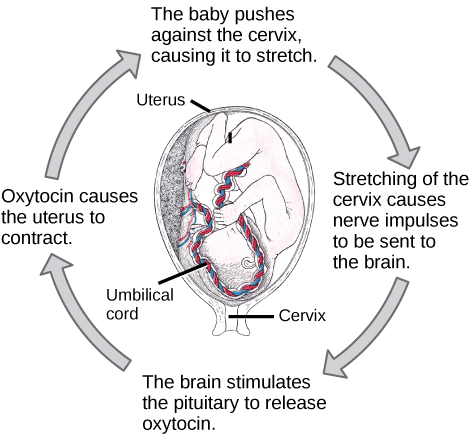
The process of childbirth is an example of:
a)
negative feedback loop
b)
positive feedback loop
67.
Homeostasis
a)
allows for a wildly fluctuating internal environment
b)
is impossible in vertebrates
c)
is the maintenance of a relatively stable internal environment and often incorporates a form of feedback regulation
d)
is the maintenance of a relatively stable external environment and often incorporates a form of feedback regulation
68.
Homeostasis in the human body is often maintained by a: 
a)
neutral feedback loop 
b)
solar feedback loop
c)
positive feedback loop
d)
negative feedback loop
69.
What type of feedback loop is shown?
a)
negative
b)
neutral 
c)
positive