Wayground logo

Free Printable Worksheets

Font size

S
M
L
XL
Worksheets

Change Over Time Review - Clark

Total questions: 70

Worksheet time: 1hrs 3mins

Name
Class
Date
1.
The diagram illustrates an embryonic stage of two organisms.Which of the following can be determined by observing the embryos shown in the diagram? 
a)
The organisms share a common ancestry.
b)
The organisms belong to the same genus.
c)
The organisms are native to the same geographic areas.
d)
The organisms will grow into anatomically similar adults.
2.
Scientists are studying the evolutionary history of a group of plants in the United States, and they developed an evolutionary tree, as shown below.Which statement can be inferred from the evolutionary tree?
a)
Species 1 is most closely related to Species 8.
b)
Species 2 is most closely related to Species 3.
c)
Species 3 is most closely related to Species 7.
d)
Species 5 is most closely related to Species 6.
3.
Scientists are studying the evolutionary history of a group of plants in the United States, and they developed an evolutionary tree, as shown below.What information about the organisms best helps the scientists to determine the evolutionary relationships among them?
a)
DNA sequences
b)
 Anatomical features
c)
Habitat types
d)
Reproductive Strategies
4.

Natural selection results in change in a population's _____________ traits over time.

a)

inherited

b)

acquired

5.

Over generations of time apart on different islands with different food sources, the separated populations of Galapagos finches accumulated genetic differences until each group had different beaks. This is an example of _____.

a)

natural selection

b)

genetic drift

c)

adaptation

d)

speciation

6.

Populations undergo evolution NOT individuals! (an individual organism cannot cause change over time in an entire group of organisms)

a)

True

b)

False

7.

What is speciation?

a)

combining of two species to form one with different traits

b)

Intentional breeding designed to maintain a desired trait

c)

timing of mating that prevents normal sexual selection

d)

A population splits and accumulates different genes in the new groups

8.

How does a species change over time?

a)

by adapting to the environment

b)

changes in the gene frequencies in a population

c)

acquiring new traits

d)

they do not change

9.

The pelvic bone of whales is not needed for movement within the water. This is an example of a(n) ______________ structure.

a)

vestigial

b)

analogous

c)

homologous

10.

The forelimbs of mammals have similar anatomy because these groups descended from a recent common ancestor. Their bone structure is an example of a(n) ______________ structure.

a)

vestigial

b)

analogous

c)

homologous

11.

Many different groups of organisms have wings, even though they do not share a recent common ancestor. This is because they evolved in environments with similar selective pressures. Wings are an example of a(n) ______________ structure.

a)

vestigial

b)

analogous

c)

homologous

12.

What type of speciation would involve mating during different seasons?

a)

geographic isolation

b)

reproductive isolation

c)

habitat isolation

d)

gametic isolation

13.

A flood drowns a large portion of an insect population, with only a few random individuals surviving. This is an example of ______.

a)

genetic drift

b)

adaptation

c)

natural selection

14.

How do species change over time?

a)

frequency (amount) of certain alleles in a population

b)

towards perfection

c)

through individual evolution

d)

through acquired traits

15.

Which does NOT cause genetic variation?

a)

crossing over in meiosis

b)

mutations

c)

acquired traits

16.

Where the better adapted organisms survive to pass traits along to offspring is an example of -

a)
Evolution
b)
Natural Selection
c)
Extinction
d)
Artifical Selection
17.

What changes to cause a mutation?

a)
DNA
b)
tRNA
c)
genotype
d)
phenotype
18.
Two organisms that are closely related would have
a)
very similar DNA sequence
b)
exactly the same DNA sequences
c)
no proteins in common
d)
completely different DNA sequence
19.
European rabbits were introduced to Australia in 1859. The rabbits reproduced rapidly in their new habitat, displaced other animals, and overgrazed vegetation. In an attempt to reduce the rabbit population, a virus was introduced in 1951. This virus is usually deadly to European rabbits. When the virus was first introduced, the rabbits died in large numbers, but the death rate decreased over time. Which of the following best explains the decrease in the rabbit death rate? 
a)
Young rabbits learned to avoid being infected with the virus.
b)
The lifespan of the virus was too short to affect rabbits over a long period of time.
c)
Natural selection favored rabbits that were resistant to the virus. 
d)
No correct choices.
20.
Which of the following statements gives the most likely explanation for the presence of two very similar species of squirrels living on opposite sides of the Grand Canyon?
a)
One squirrel traveled across the canyon and started a new population on the other side.
b)
One squirrel traveled across the canyon and interbred with a different population on the other side.
c)
Members of one single squirrel species were geographically separated by the formation of the canyon.
d)
Members of two different squirrel species migrated from two different places to opposite sides of the canyon. 
21.
The Asian shore crab invaded parts of the eastern coast of the United States about 15 years ago. The Asian shore crab preys on blue mussels. In the time since the Asian shore crab arrived, the average shell thickness of the blue mussel population has increased. Which of the following is the most likely reason that this increase in shell thickness has occurred? 
a)
Blue mussels with thick shells attract more crabs that mussels without thick shells.
b)
Blue mussels with thick shells grow in larger colonies than mussels without thick shells.
c)
Blue mussels with thick shells catch more food per day than mussels without thick shells.
d)
Blue mussels with thick shells survive and reproduce more successfully than mussels without thick shells.
22.
All the individuals of a species that live in a particular area are called a
a)
variation
b)
population
c)
fossil
d)
group
23.

When looking at two birds of the same species, you notice that one has darker feathers than the other one. You also notice that one has a beak that is just a little longer. These slight differences within members of the same species are called.....

a)

Analogous Structures

b)

Homologous Structures

c)

Speciation

d)

Variations

24.

What is the study of organisms at the early stages of development?

a)

DNA studies

b)

Comparative Embryology

c)

Extinction

d)

Fossil Record

25.

Which of the following is a term for a group of similar organisms that can reproduce fertile offspring (meaning that their offspring can also have kids) ?

a)
individual
b)
population
c)
species
d)
fossil
26.
If an organism has a vestigial structure, that structure likely once had a function in a(n)
a)
close relative
b)
early ancestor
c)
unrelated organism
d)
embryological stage
27.
Mutations are important because they bring about
a)
death of the organism in which they develop
b)
genetic variation needed for a population to evolve
c)
benefits for the individual, not for the population
d)
Hardey-Weinberg equilibrium within a population
28.
Magda is a tall, 11 year old drummer. She has a scar on her right cheek. She is good at swimming. Which of her traits did Magda most likely inherit?
a)
height
b)
the scar
c)
ability to swim
d)
ability to play drums
29.
According to the diagram, which organism is older?
a)
ammonite
b)
coral
c)
gastropod
d)
trilobite
30.
The diagram shows fossils in different rock layers. Which of these statements about the age of these fossils is most likely correct?
a)
Fossil A and C are the same age
b)
Fossil B is older than fossil C
c)
Fossils A is older than fossil B
d)
Fossil D is older than fossil C
31.
If species A and B have very similar genes and proteins, what is probably TRUE?
a)
species A and B share a relatively recent common ancestor
b)
species A evolved independently of species B for a long period
c)
species A is younger than species B
d)
species A is older than species B
32.

The ability of an organism to survive and reproduce in its specific environment is called -  

a)
diversity.
b)
evolution
c)
adaptation
d)
 fitness
33.

What increases genetic variation when animals move from one population to another (migrate)?

a)
genetic drift
b)
sexual selection
c)
bottleneck effect
d)
gene flow
34.
What does Darwin's theory of evolution suggest?
a)
species change over time
b)
extinct species are not related to living species
c)
different species can interbreed
d)
animals that look alike are most closely related
35.
Genetic drift happens when
a)

random survival occur (usually due to a natural event)

b)

natural selection occurs

c)

adaptions occur

d)

species die randomly

36.
A virus killed most of the seals in the North Sea (e.g. dropped the population from 8000 to 800).  In an effort to help preserve the species, scientists caught 20 of the remaining seals and used them to start a new population in the northwest Pacific Ocean.  Which of the following statements would accurately describe the new   population?  
a)
The new seal population is genetically less diverse than the original population 
b)
The new seal population is genetically more diverse than the original population
c)
There is equal genetic variety compared  to the original population 
d)
None of the answers
37.
If species A and B have very similar genes and proteins, what is probably TRUE?
a)
species A and B share a relatively recent common ancestor
b)
species A evolved independently of species B for a long period
c)
species A is younger than species B
d)
species A is older than species B
38.

Scientists believe that the species Homo sapiens originated in Africa and migrated out of Africa to compete with existing hominid species in other territories. Which field of study would provide us with evidence that Homo sapiens came to what is now the Americas using a land bridge between Russia and Alaska that became covered with water when the Ice Age thawed?

a)

Biogeography

b)

Comparative Anatomy

c)

Embryology

d)

Molecular Biology

39.

The picture is showing an example of...

a)

Natural Selection

b)

Genetic drift

c)

Mutations

d)

Homologous structures

40.

This random change in allele frequency has caused the small population to change. This is an example of

a)

artificial selection

b)

reproductive isolation

c)

genetic drift

d)

mutations

41.

The animals in the picture do not live in the same population. They are found in different parts of the world, but are all still part of the camel family. What can be said about these animals?

a)

They belong to the same species

b)

It is difficult for them to find food to eat

c)

They have a very similar skeletal structure

d)

They descended from a common ancestor

42.
Suppose a family of black wolves migrates across a land bridge to a region supporting a large population of gray wolves. A few generations later, the population consists entirely of wolves with black and gray markings. Which of the following best describes the mechanism that caused this change in the population of the wolves in the region?
a)
Genetic mutations naturally occurred in the black and gray wolf populations, resulting in both groups simultaneously developing black and gray coat markings.
b)
The flow of black wolf genes across the land bridge added to the gray wolf population’s gene pool, increasing the frequency of the genes for black fur in the population.
c)
The gray wolves selected other gray wolves over black wolves as mates, causing a limit to the gray wolf gene pool that resulted in genetic drift.
d)
The wolves with gray coats had to compete for resources with the successful black wolves, so they adapted their coats to mimic the black wolves.
43.
The opossum and kangaroo both incubate their young in a pouch. This provides evidence that they---
a)
are descended from a common ancestor
b)
Have very similar skeletal structures
c)
belong to the same species
d)
must range great distances to eat
44.
What do these three organisms have in common?
a)
They have stomachs of the same size
b)

They have DNA made up of the same components (A, T, C, and G)

c)
They have eyes that see the same ways
d)
They have brains that are the same size
45.
The concept of gene flow is demonstrated when a cow is driven off from its herd, joins another herd, and reproduces. When the cow contributes to the gene pool of the new herd, which of these will most likely increase?
a)
Environmental fitness
b)
Reproductive mutations
c)
Natural selection
d)
Genetic variation
46.
Which of the following statements best explains why some mosquitoes survived after the first spraying?
a)
Some mosquitoes had a genetic mutation that made them resistant to the insecticide
b)
A.  All mosquitoes had a genetic mutation that made them resistant to the insecticide
c)
A.  None of the mosquitoes had a genetic mutation that made them resistant to the pesticide
47.

A graph regarding the effect of agricultural bioengineering on insect pests is shown below. How has natural selection affected species of insect pests?

a)

A.  Natural selection has not affected the number of species that are resistant to pesticides

b)

A.  Natural selection has rapidly increased the number of species that are resistant to pesticides

c)

A.  Natural selection has only affected the number of species that are resistant to pesticides

48.
The table shows the survival rate of two types of beetles in the same environment over a period of three years.  

Which statement about the beetles in this environment is best supported by the data?
a)
Brown beetles have a shorter life cycle than green beetles have
b)
Green beetles are more fit for their environment than brown beetles
c)
 brown beetles are undergo more unfavorable mutations than green beetles
49.
The green frog (Lithobates clamitans clamitans) is found in many parts of the United States. The table contains some information about this frog.
Why does the ability to lay 1,000 to 5,000 eggs increase the fitness of the species L. clamitans clamitans?
a)
A.  It increases the probability that some offspring will survive long enough to reproduce.
b)
It increases the chance of the recombination of alleles, leading to genetic drift in the population.
c)
A.  It increases opportunities for offspring to compete for limited resources.
50.
A prey population consists of individuals with a variety of running speeds.
The adaptation that allows some of these animals to run fast would be an example of natural selection if it helps them —
a)
survive and undergo mutations in their DNA
b)
produce offspring that run at average speeds
c)
reproduce and increase the frequency of their genes in the population
d)
lower the mortality rates of the population
51.
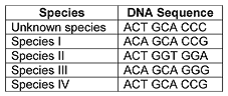
According to this data, the unknown bacterial species is most closely related to: 
a)
Species I
b)
Species II
c)
Species III
d)
Species IV
52.
All genes present in a population is called:
a)
Genetic Drift
b)
Gene Flow
c)
Gene Pool
53.
The similarities of organisms in which two areas numbered in the picture provide the best evidence for common ancestry?
a)
1 and 2
b)
3 and 4
c)
5 and 6
d)
7 and 8
54.
Common baboons live on the savanna in breeding groups called troops. While females tend to stay with the troop, younger or less dominant males may leave to join a neighboring troop.
Which of these is a likely outcome of movement by young males? 
a)
Gene flow occurs between the populations
b)
relative genotypic frequencies reach a constant state
c)
Allele frequencies suddenly change
55.

Camouflage means:

a)

A special dessert

b)

When an animal looks like another animal

c)

A way an animal can look like its surroundings

56.

Mimicry means:

a)

A tree that has pink flowers in the spring

b)

When one living thing looks like a different kind of living thing

c)

A way an animal blends in with its environment

57.

Some butterflies have spots on their wings that look like snake eyes. This is called

a)

A pretty butterfly

b)

Instinct

c)

camouflage

d)

mimicry

58.

This king snake looking just like the deadly coral snake to stay protected is an example of_________

a)

mimicry

b)

adaptation

c)

adoption

d)

camouflage

59.

How would a warming climate affect the species in an ecosystem?

a)

individuals might die off but a species cannot disappear completely

b)

species would increase in number to offset the numbers killed by the heat

c)

species that have never been seen before would suddenly appear

d)

individuals best able to survive the heat would become more numerous

60.

Which of the following would most likely prevent two populations of field mice from breeding?

a)

Active time of day

b)

Color

c)

Average weight

d)

Favorite food

61.

Based on the image, why are these similar looking birds now considered different species, even though they have a common ancestor?

a)

all these birds could swim, so they went to different continents to evolve

b)

their environments changed over time, so those who had adaptations to the new environment survived

c)

the birds acquired the new traits while trying to adapt to their new environments

d)

there were fewer species of birds in the past, now there are more

62.
Which layer is the oldest?
a)
1
b)
2
c)
3
d)
4
63.
Which species’ DNA is most similar to the DNA of the toothed whale? 
a)
Hippopotamus 
b)
Baleen Whale
c)
Grazing Mammals
d)
Camels
64.
What is this an example of?
a)
diversity of species
b)
variation
c)
vestigial structures
d)
DNA studies
65.
Some organisms that share a common ancestor have features that have different functions, but similar structures.  These are known as
a)
vestigial structures
b)
analogous structures
c)
homologous structures
d)
fossil structures
66.

The diagram below shows a model of the proposed relationship among some groups of mammals. Which of these organisms is MOST CLOSELY related to whales?

a)

camel

b)

bison

c)

hippo

67.

Why is diversity important?

a)

It ensures that species stay the same

b)

It ensures the survival of the species in a changed environment

c)

It ensures that there will always be enough resources to support the population

d)

It ensures that the abiotic factors will not change

68.
What type of evolution where there is a sudden, rapid change then no change for a long time?
a)
Co-Evolution
b)
Punctuated Equilibrium
c)
Divergent Evolution
d)
Convergent Evolution
69.

Evolution occurring quickly due to catastrophic events

a)

Homeostasis

b)

Gradualism

c)

Statsis

d)

Punctuated Equilibrim

70.

Henry was studying two populations of the same species of lizards. One population lived on an island and the other lived on the mainland. Both populations were affected by a hurricane that hit the island and the mainland with equal force. A year later, Henry was testing the gene frequency and saw a decrease in genetic variation in the island species, but not in the mainland species. Which best describes a conclusion he might have reached?

a)

Gene flow greatly affects small populations, but large populations can recover.

b)

Genetic drift greatly affects small populations, but large populations can recover.

c)

Gene flow greatly affects large populations, but small populations can recover.

d)

Genetic drift greatly affects large populations, but small populations can recover.