wayground logo

Free Printable Worksheets

NEW

Font size

S
M
L
XL
Worksheets

year 9 heat & electricity

Total questions: 72

Worksheet time: 59mins

Name
Class
Date
1.

Static electricity is produced by:

a)

Friction

b)

Turning on the power switch

c)

plugging in the appliance

d)

electrical current

2.

Lightning is an example of ___________ electricity.

a)

static

b)

current

3.
If two charges repel each other, the two charges must be
a)
Positive and neutra
b)
Positive and negative
c)
positive and neutral
d)
negative and negative
4.
An object becomes charged when the atoms in the object gain or lose
a)
electrons
b)
protons
c)
neutrons
d)
all of the above
5.
If you rub a glass rod with a piece of silk, the rod becomes positively charged. This means that
a)
friction destroyed electrons in the rod.
b)
the silk has become negatively charged.
c)
protons have moved to the rod.
d)
glass attracts more protons.
6.
Objects that have opposite charges
a)
are attracted to each other, and the force between the objects pulls them together.
b)
are attracted to each other, and the force between the objects pushes them apart.
c)
are repelled by each other, and the force between the objects pulls them together.
d)
are repelled by each other, and the force between the objects pushes them apart.  
7.
If a substance has a higher number of electrons than protons on its surface, what type of charge does it have?
a)
A positive charge.
b)
A negative charge.
c)
A neutral charge
d)
No charge at all
8.
Electrical charge built up on the surface of an object is called _________________.
a)
static electricity
b)
current electricity
c)
lightning
d)
electrons
9.
What types of charges attract?
a)
Positive and Positive
b)
Positive and Neutral
c)
Negative and Neutral
d)
Positive and Negative
10.
Which of the following is caused by static electricity?
a)
a stove getting hot when it is turned on
b)
a magnet being attracted to a refrigerator
c)
a lightning strike during a storm
d)
a light bulb coming on when a switch is turned on
11.

Static electricity can "jump" from the charged object to another object, causing . . .

a)

static cling (objects sticking together)

b)

electric discharge (and a shock!)

12.

What happens to the average kinetic energy of matter when it is heated?

a)

It increases

b)

It stays the same

c)

It decreases

d)

It cannot be determined

13.

If the atoms of an object are moving fast, the temperature would be...

a)

High

b)

Low

14.

The type of heat transfer that happens through direct contact of molecules or particles with each other is ___________________.

a)

Convection

b)

Conduction

c)

Radiation

15.

The kind of heat transfer that travels through space in electromagnetic waves is ______________________.

a)

Convection

b)

Radiation

c)

Conduction

16.

___________________ is the type of heat transfer that occurs in fluids, such as warm air rising and cold air sinking; creating wind.

a)

Convection

b)

Conduction

c)

Radiation

17.

When you use a microwave, what is the main way that heat is transferred?

a)

Convection

b)

Conduction

c)

Radiation

18.

The handle of a metal spoon warms up when it is placed in a hot bowl of soup because of

a)

Convection

b)

Conduction

c)

Radiation

19.
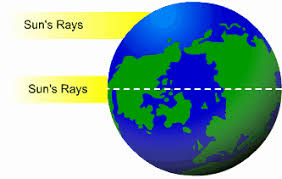
What kind of heat transfer happens when the sun is heating your body?
a)
Conduction
b)
Radiation
c)
Convection
d)
Density
20.
Which of the following is an example of convection?
a)
A hair dryer is drying up your hair.
b)
When the AC or heater changes the temperature.
c)
When a car engine turns hot after being turned on.
d)
When you are making soup and the water is rising and lowering.
21.
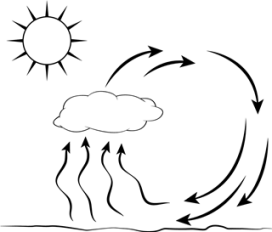
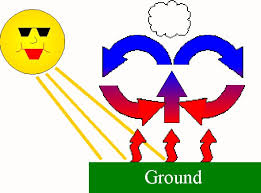
What causes the circulation of air in the atmosphere?
a)
Air in the atmosphere is heated by the sun and sinks to the ground.
b)
The ground is heated by the sun and then heats the air, causing the air to rise.
c)
Air loses heat to the ground and then rises upward to obtain more energy.
d)
The sun heats the clouds which forces the cooler air to move away and sink.
22.

The energy of motion of the particles of a substance is

a)

thermal energy

b)

traditional energy

c)

radiation energy

d)

kinetic energy

23.
Why does warm air rise?
a)
Warm air is more dense than cooler air.
b)
Warm air has more pressure than cooler air.
c)
Warm air is less dense than cooler air.
d)
Warm air has a higher dew point than cooler air.
24.

Most differences in air pressure are caused by _______________ heating of the atmosphere.

a)

some

b)

equal

c)

unequal

d)

great

25.

The horizontal movement of air from and area of high pressure to an area of low pressure is called ____________.

a)

wind

b)

climate

c)

high pressure

d)

air pressure

26.
Warm air rises and the cool air sinks demonstrates this type of heat transfer. 
a)
conduction
b)
convection
c)
radiation
d)
Insolation 
27.

wind

a)

warm, less dense air rises

b)

cool, dense air sinks

c)

large circular patterns of moving air

d)

movement of air cause by differences in air pressure

28.

sea breeze

a)

cool air moves down a mountain slope towards a valley

b)

warm air rises up a mountain slope from a valley

c)

cool land air flows to the ocean at night, causing warm ocean air to rise

d)

cool ocean air flows to land during the day, causing warm land air to rise

29.

land breeze

a)

cool air moves down a mountain slope toward a valley

b)

warm air rises up a mountain slope from a valley

c)

cool land air flows to the ocean at night, causing warm ocean air to rise

d)

cool ocean air flows to land during the day, causing warm land air to rise

30.
Where does the initial source of energy come from that creates winds?
a)
the moon
b)
the sun
c)
the Earth's surface
d)
the rotation of the Earth
31.
The baby chickens are kept warm from the heat lamps demonstrates what type of heat transfer?
a)
conduction
b)
convection
c)
radiation
32.
This is a lava lamp. When the light bulb heats the wax, the wax rises. When the wax cools, it falls. This cycle of rising/falling is an example of:
a)
Conduction.
b)
Convection.
c)
Radiation.
33.
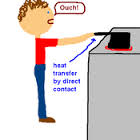
Johnny accidentally grabbed the handle of the hot pot.
a)
conduction
b)
convection
c)
radiation
34.
Winds are caused by 
a)
equal heating 
b)
unequal heating
35.
We depend on what kind of heat transfer when riding in a hot air balloon?
a)
Convection
b)
Conduction
c)
Radiation
36.
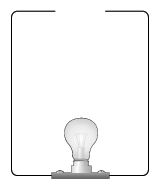
This circuit won't work. What essential part is missing from this circuit?
a)
resistance
b)
source of electric current
c)
conductor
d)
ammeter
37.
The force that pushes the electricity through a circuit is called...
a)
resistance
b)
voltage
c)
current
d)
switch
38.
The flow of electricity through a conductor is called...
a)
resistance
b)
voltage
c)
current
d)
source of electric current
39.
The best conductors for electricity are made of...
a)
wood
b)
plastic
c)
rubber
d)
metal
40.
This measures the speed of the current in a circuit
a)
voltage
b)
ammeter
c)
switch
d)
resistance
41.
What slows down the flow of electricity in a circuit?
a)
resistance
b)
voltage
c)
current
d)
source of electric current
42.
Which circuit (s) are parallel?
a)
A
b)
A and B
c)
B and C
d)
C
43.
Which one will still function if one light bulb goes out?
a)
A-Series
b)
B-Parallel
c)
A-Parallel
d)
B-Seriese
44.
If I add more light bulbs to a series circuit what happens?
a)
The current speeds up and the lights get brighter
b)
The current slows down and the lights dim lower
c)
The current speeds up and the lights dim lower
d)
The current slows down and the lights get brighter
45.
What type of circuit is show in the image?
a)
Series Circuit
b)
Parallel Circuit
46.
What is a switch's function in a circuit?
a)
to make the current hotter or colder
b)
turn on and off the flow of current
c)
the pathway that current flows
d)
to add more power to the circuit
47.
A flow of electrons through a conductor is called:
a)
A river
b)
A spark
c)
An electron flow
d)
A current
48.
What is a common energy source for a circuit?
a)
Light bulb
b)
Battery
c)
Wire
d)
Switch
49.
Current is measured in....
a)
Amps 
b)
Volts
c)
Ohms
d)
Coulombs
50.
this is the symbol for a _____?
a)
switch
b)
light 
c)
battery
d)
wires
51.
what is this symbol for?
a)
light bulb
b)
switch
c)
battery
d)
resistor
52.
In a parallel circuit if one of the light bulbs burns out the rest _________.
a)
stop the flow of electricity
b)
 can still light up
c)
 will go out
d)
of the light bulbs burn out also
53.
Voltage is measured in __.
a)
volts.
b)
watts.
c)
coulombs. 
54.
What 'flows' in a wire?
a)
Protons
b)
Neutrons
c)
Atoms
d)
Electrons
55.

Voltage is measured in __.

a)

Volts.

b)

Watts.

c)

Coulombs.

56.

Which wire has more resistance (long or short)?

a)
b)
57.

What is the total resistance in this circuit?

a)

700 Ohms

b)

500 Ohms

c)

no resistance

d)

7 Volts

58.

What is the total resistance in this circuit?

a)

no resistance

b)

450 Ohms

c)

9 Volts

d)

150 Ohms

59.

Total resistance?

a)

no resistance shown

b)

300 Ohms

c)

330 Ohms

d)

10 Volts

60.

Total resistance?

a)

5 Ohms

b)

50 Ohms

c)

500 Ohms

d)

12 Volts

61.

The voltage of the entire circuit is 18V. What is the voltage of Lamp B

a)

18V

b)

3V

c)

9V

d)

6V

62.

In the circuit below, the battery supplies 4 V

to the light bulbs. This is a parallel circuit with two branches.

Identify the voltage across each of the light bulbs.

a)

2 V

b)

1 V

c)

6 V

d)

4 V

63.

In the circuit below, the battery supplies 18 V

to the light bulbs. This is a parallel circuit with three branches.

Identify the voltage across each of the light bulbs.

a)

9 V

b)

18 V

c)

6 V

d)

21 V

64.
a)
A2 = A3
b)
A2 + A3 = A1
c)
A1 + A2 = A3
d)
A4 = A2 - A3
65.
Unit for current
a)
Ohm
b)
Ampere
c)
Volt
d)
Watt
66.

Which circuit is an example of a series circuit?

a)
b)
c)
67.

Which circuit is an example of a Parallel circuit?

a)
b)
c)
68.

How do you place an ammeter in a circuit?

a)

parallel to the component

b)

in series with the component

69.

How do you place a voltmeter in a circuit?

a)

parallel to the component

b)

in series with the component

70.

This is a/ an...

a)

voltage

b)

Voltmeter

c)

Volume meter

d)

Velocity meter

71.

This is a/ an...

a)

Ampere

b)

Switch

c)

Bulb

d)

Battery

72.

In a series circuit, how is the brightness of a light bulb affected when another bulb is connected?

a)

It gets brighter

b)

It stays the same

c)

It gets dimmer

d)

It goes out