
 Worksheets
Current Electricity (Compiled)
Total questions: 50
Worksheet time: 55mins

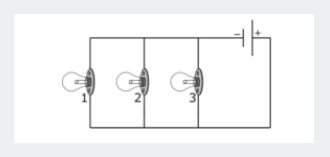

Though we specify the direction of direct current by putting an arrow, why is it not considered a vector quantity ?
Because current does not obey the laws of vector addition
Because charge is Quantized
Because conventional direction of current is only virtual
Because current obeys Kirchhoff Laws
Current carriers in Electrolyte are/is
Free electrons
Holes
Electrons and holes both
Positive and negative ions
An electrical junction has three wires A, B and C connected to it. Wire A carries 4.2 A going in, wire B carries 2.6 A going out. What does wire C carry?
1.6 A going in
1.6 A going out
6.8 A going in
6.8 A going out
Current is shared between two resistors of 3 Ω and 6 Ω, if the current in the 6 Ω is 12 A what is the total incoming current?
24 A
36 A
18 A
72 A
How do you measure voltage, current, and resistance in a physical circuit?
Multimeter
Voltmeter
Ohmeter
Odometer
"The sum of all voltage drops in a series circuit equals the total applied voltage." This is know as what?
Ohm's Law
Kirchhoff's Voltage Law
Kirchhoff's Current Law
Bolen's Law
What does Kirchhoff's second law show?
conservation of charge
conservation of energy
In any closed loop, the sum of the e.m.f. is equal to the sum of the products of the current and the resistance (potential difference).
The sum of the current entering a junction is the sum of the current leaving the junction.

Given the direction of the current shown. Which side of the resistor has the high electric potential energy?
left side is higher
right side is higher
- Kirchhoff's junction rule is a reflection of
Conservation of current density vector
Conservation of charge and no accumulation of charge at the the junction
the momentum with which a charged particle approaches a junction is unchanged as the charged particle leaves the junction
Conservation of energy
Which of the following characteristics of electrons determines the current in a conductor?
Drift velocity alone
Thermal velocity alone
Both A and B
Neither A nor B
13. Drift velocity vd varies with the intensity of electric field as per the relation
(a) vd ∝ E
(b) vd ∝ 1/E
(c) vd = constant
(d) vd ∝ E²

15. From the graph between current I and voltage V shown below, identify the portion corresponding to negative resistance
(a) AB
(b) BC
(c) CD
(d) DE

16. Which of the following I-V graph represents ohmic conductors?
(a) A
(b) B
(c) C
(d) D
20. The resistivity of alloy manganin is
(a) Nearly independent of temperature
(b) Increases rapidly with increase in temperature
(c) Decreases with increase in temperature
(d) Increases rapidly with decrease in temperature
21. In parallel combination of n cells, we obtain
(a) more voltage
(b) more current
(c) less voltage
(d) less current
Voltage is a form of:
Kinetic energy
Potential energy
both Potential and Kinetic energy
None of the above
Ohm's law can be written in vector form as ______________
J = σ E
J = ρ E
J = R E
The quantity which remains same in series combination of resistors is ________________
Voltage
Current
Power
Expression for internal resistance is given by _______________
r = I(ξ − V)
r = V(ξ − I)
r = ξ(V − I)
kilowatt hour is the commercial unit of --------------
Electric power
Electrical energy
Time
Kirchhoff's second law is in accordance with law of conservation of ------------------
Current
Charge
Energy
The mathematical expression of Kirchhoff's first law is ------------
x∑y V = 0
x∑y I = 0
x∑y R = 0

If 4 resistances P, Q, R, and S are connected as shown in the figure,then we get QP = SR .This relation is known as ---------
Voltmeter principle
Potentiometer principle
Wheatstone's principle
Working principle of Potentiometer is ----------------
Ohm's law
Wheatstone's principle
emf ∝ balancing length
If we get the resistance of the wire as 6 ohm,on introducing a 2 ohm resistance in the resistance box, in a meter bridge circuit, find the corresponding balancing length.
3 cm
25 cm
75 cm
The expression of internal resistance of the cell,obtained using potentiometer is given by ---------------
r = R l 2l 1
r = R l1(l 1 − l2 )
r = R l2(l1 − l2)

The V - I graph of a conductor at 3 different temperatures T1, T2, and T3 are given.At what temperature, is the resistance highest?
T1
T2
T3
When is the Wheatstone bridge is most sensitive ?
When all the four resistances of the bridge are equal
When the bridge is balanced
When high amount of current is flowing through the bridge
When a very low amount of current is flowing through the bridge
What will be the new resistivity of a metallic wire if it's length becomes double
Increases two times
Becomes half
Increases four times
Remains same
Wheatstone is one type of ______ bridge
AC
DC
DAC
ADC
14. For measurement of potential difference, a potentiometer is preferred over voltmeter because
(a) potentiometer is more sensitive than voltmeter.
(b) the resistance of potentiometer is less than voltmeter.
(c) potentiometer is cheaper than voltmeter.
(d) potentiometer does not take current from the circuit.
An ideal voltmeter in physics has...
...an easily readable scale
...an infinite resistance
...zero resistance
...a negligible internal resistance
In Physics, an ideal ammeter has...
...a 10A fuse
...infinite resistance
...an autoranging function
...zero resistance
What is emf?
the electro motive "force" or the force on electrons
the electromotive "force" or the Voltage of a cell measured when there is no current flowing
the electromotive "field" or the Voltage of a cell measured when there is no current
the electromotive "force" or Voltage of a cell measured when connected to a circuit
Name the material used for making potentiometer wire
Copper
Aluminium
Brass
Manganin
silver
How to increase the sensitivity of a potentiometer?
1. Connect a resistance series to the primary circuit of the potentiometer
2. Use a cell of low emf in the primary circuit
3. Increase the length of the potentiometer wire
only 1 & 2
1, 2 & 3
Copper wires are not used in the construction of potentiometer because
low resistance
high temperature coefficient
low resistance & high temperature coefficient
expensive
non availability
What is the use of a potentiometer?
1. comparison of emf's of two primary cells
2. finding internal resistance of a cell
3. can be used as a variable resistor
1 & 2
1,2 & 3
Name the factors decide internal resistance of a cell
1. temperature
2. nature of the electrolyte
3. nature of the electrodes
4.distance between the electrodes
1,2,3 & 4

What happens to the balancing length if the value of the variable resistance R is increased?
decreases
increases
no change
can not predict
In a Wheatstone bridge if the battery and galvanometer are interchanged then the deflection in galvanometer will
(a) change in previous direction
(b) not change
(c) change in opposite direction
(d) none of these.
In the wheatstone Bridge all four arms have equal resistance R and Galvanometer also has R resistance. Find the equivalent resistance of the ckt
R
R/2
R/4
2R
Select the correct statement:
The current in parallel resistors is always equal.
The sum of the sources of EMF and volt-drops in a closed loop is zero.
The sum of the currents in a closed loop is zero.
The sum of the voltages at a node is zero.
"The total current in a parallel circuit equals the sum of the individual branch currents."
Ohm's Law
Kirchhoff's Voltage Law
Kirchhoff's Current Law
Bolen's Law
If a billion electrons enter a point in 1 s, then number of electrons
leaving that point in 1 s are
2 billion
3 billion
1 billion
10 billion
1 V is equal to
1 J C-1
1 J-1C
2 J-1C
2 J C-1
Combined resistance of 5 Ω and 10 Ω are connected in parallel is equal to
3/10 Ω
10/3 Ω
20/3 Ω
15/2 Ω

