
 Worksheets
Motion and Forces Intro Questions
Total questions: 50
Worksheet time: 33mins
The velocity of a car can be described as going north at 20 meters per ________.
second
mile
hour
______________ is the length between starting and ending points.
Motion
Distance
Speed
Frame of reference
_____________ is a change in speed, a change in direction, or both.
Acceleration
Velocity
Time
Increasing speed is ____________.
acceleration
deceleration
Acceleration= change in speed divided by time. If an object goes from 0 to 10 m/s for 5 seconds, what is its acceleration?
2 m/s per second
10 m/s/s
50 m/s/s
10 m/s^2
Two cars traveling in different directions at the same speed have the same velocities.
True
False
____________ is defined as the rate an object is moving.
Speed
Velocity
Acceleration
Which of the following is a possible velocity of a train?
moving south
traveling south at 20 meters per second
traveling at 20 meters per second
traveling south and slowing down
A(n) __________ is a position that is already known. Its position can be used to describe the position of another object.
frame of reference
acceleration
velocity
speed
speed=
distance divided by time
time divided by distance
distance x time
The position of an object is its location.
True
False
The park is 2 miles east of the school. What is the frame of reference in the sentence?
the school
the park
east
What makes a good reference point?
Something that is in constant motion
Something that is acceleration
Something that is stationary (not moving)
Something that is decelerating
What would be a good reference point to describe the motion of the Earth within our solar system?
The sun
The Earth
The mountains on Earth
The Milky Way


an object's change in position relative to a reference point
speed
reference point
motion
positon
an object's location
the path in which an object is facing or moving
the change in an object's position over time
a force that pulls an object towards Earth
To calculate average speed, divide the total _________ by the total _________
distance
acceleration
time
velocity
What is the amount of space between two points?
distance
force
friction
motion
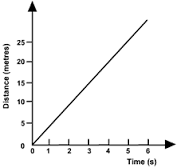
What is the line on this graph showing?
moving away from starting point at a constant speed
moving back towards the starting point at a constant speed
acceleration (getting faster)
deceleration (getting slower)
An object accelerates if it speeds up, slows down, or changes directions.
True
False
select the three changes in motion that show that an object is accelerating:
speeding up
slowing down
changing direction
spinning
What is position?
Movement
Place where something is
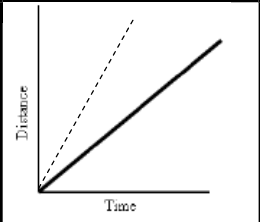
What does this graph represent?
Constant Speed
changing speeds
Not moving
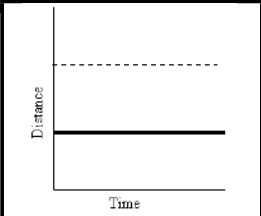
What does this graph represent?
Constant speed
changing speeds
Not moving


In a duck race, a rubber duck traveled 40 meters in 10 minutes? What was the rubber duck´s speed?
40 kilometers/hour
40 minutes
40 m/ min
4 meters per minute

Describe the motion in the graph:
Constant Speed (positive slope)
Stopped (at rest)
Acceleration (increasing speed)
Return Home (negative slope)
Describe the motion in the graph:
Constant Speed (positive slope)
Stopped (at rest)
Acceleration (increasing speed)
Return Home (negative slope)

Describe the motion in the graph:
Constant Speed (positive slope)
Stopped (at rest)
Acceleration (increasing speed)
Return Home (negative slope)

Describe the motion in the graph:
Constant Speed (positive slope)
Stopped (at rest)
Acceleration (increasing speed)
Return Home (negative slope)

Describe the motion in the graph:
Constant Speed (positive slope)
Stopped (at rest)
Acceleration (increasing speed)
Return Home (negative slope)
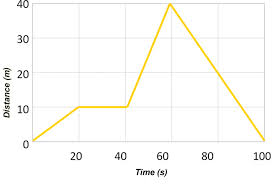


A position-time graph of an athlete winning the 100-m run is shown. Estimate the time taken by the athlete to reach 65 m.
5.0 s
6.5 s
4.5 s
9.0 s
You can describe the motion of an object by its ...
mass, height, and color
density, position, temperature
position, speed, direction, and acceleration
if I see it moving
How can you calculate speed?
by dividing its displacement by distance
by dividing the distance covered by time
by multiplying speed by time
by dividing speed by time
How do you calculate acceleration?
by dividing the change in its distance by time
by dividing the change in its momentum by time
by dividing the change in its velocity by time
by dividing the change in its size by time
The speed at any instant is called
instantaneous speed
average speed
unknown speed
Average speed is
the distance of the whole trip divided by the total time of the trip.
The speed at any moment in time
The speed that is marked on the limit speed sign
Velocity is
directed speed
the same as speed
how fast something moves without considering direction
acceleration is...
change in speed divided by distance traveled
change in speed divided by time interval. In other words, the change in speed in time.
distance divided by time.
speed x time
A car goes from 0 to 100 m/s in 10 seconds. What is acceleration?
acceleration = change in speed divided by time = 10 m/s/s
acceleration = 1000
acceleration = 10/100
a = 0
What is your speed if you run 10 meters in 5 seconds?
50 meters per second
2 m/s (or 2 meters per second)
15 m/s
500 m/s
What is your distance if you run at a speed of 10 m/s for 5 seconds?
distance = speed x time = 50 m
distance = 2 m
distance = 15 m
distance = 500 m
The rise over run (rise/run) of a graph of distance versus time represents the slope of...
the speed (or how the distance is changing in time)
the acceleration
the displacement
i need to review this
The slope of a graph of speed versus time represents..
the velocity
the acceleration
the distance
the displacement

