wayground logo

Free Printable Worksheets

NEW

Font size

S
M
L
XL
Worksheets

FORCE AND LAWS OF MOTION

Total questions: 45

Worksheet time: 1hrs 16mins

Name
Class
Date
1.

What is a force?

a)

A push or pull

b)

Speed or acceleration

c)

Potential or Kinetic energy

d)

Balanced or unbalanced force

2.

What is the force that causes everything to be pulled down to the Earth?

a)

Friction

b)

Gravity

c)

Balanced

d)

Unbalanced

3.

What is Inertia?

a)

For every action, there is an equal and opposite reaction.

b)

Larger objects take more force to move.

c)

An object in motion tends to stay in motion unless acted on by an opposite force.

d)

A push that acts in the opposite direction and it slows down.

4.

What is a force that works AGAINST MOTION?

a)

Force

b)

Gravity

c)

Motion

d)

Friction

5.

If you push a tennis ball, a bowling ball, and a basketball with the same amount of force, which one will go farthest?

a)

Bowling Ball

b)

Tennis Ball

c)

Basketball

6.

If a magician pulls a tablecloth from under a table of dishes, what should happen based on Newton's 1st law?

a)

The dishes will stay in place on the table.

b)

The dishes will fall to the ground.

c)

The dishes will accelerate and then slow down.

7.

A force of 90N is applied to each cart below, which one will accelerate the fastest?

a)

Cart 1

b)

Cart 2

c)

Cart 3

d)

Cart 4

8.

What does this graph represent?

a)

Constant Speed

b)

Acceleration

c)

No Movement

9.

What does this graph represent?

a)

Constant Speed

b)

Acceleration

c)

No Movement

10.

The SI unit for acceleration is...

a)

Miles per Hour (mph)

b)

Meters per Second (m/s)

c)

Meters per Second per Second (m/s2)

11.

Force = Mass x Acceleration

a)

Newton's First Law

b)

Newton's Second Law

c)

Newton's Third Law

d)

Newton's Fig Law

12.
When a large truck pushes a small car with a given force, the small car is applying an equal and opposite force on the truck.
a)
True
b)
False
13.
If a 10 kilogram object accelerates suddenly at 15 m/s2, how much force was applied to the object?
a)
150 Newtons
b)
15 Newtons
c)
150 kilograms
d)
100 kilograms
14.
What law of motion does this picture represent?
a)
Newtons 1st law
b)
Newtons 4th law 
c)
Newtons 3rd law 
d)
Newtons 2nd law
15.
If a 6 kg bowling ball is thrown with 28 N of force, how fast will it accelerate?
a)
4.67 m/s2
b)
0.21 m/s2
c)
168 m/s2
16.

Forces that are equal in size but in opposite directions are called ______________ forces.

a)

Strong

b)

Crazy

c)

Balanced

d)

Unbalanced

17.
What kind(s) of objects have inertia?
a)
all objects with mass
b)
only objects at rest
c)
only objects in motion
d)
only objects whose motion is being changed
18.
As the acceleration of an object increases, what happens to the force of the object? 
a)
force increases
b)
force decreases
c)
force remain the same
d)
mass increases
19.
If these boys are pulling with the same amount of force.  What will happen?
a)
The boy in blue will win.
b)
They will not move at all.
c)
The boy in red will win.
d)
Both will fall down.
20.
What is the Average Speed?
Distance: 10m
Time: 5s
a)
2
b)
1/2
c)
50
d)
100
21.
Which force produces a change in motion?
a)
unbalanced force
b)
balanced force
c)
gravitational force
d)
frictional force
22.
What is the formula for force?
a)
F=M/A
b)
F=A/M
c)
F=M*A
d)
F=M*F
23.
When you tell the direction and speed of an object, you give its
a)
motion
b)
velocity
c)
acceleration
d)
mass
24.
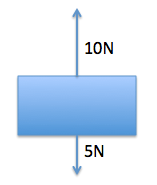
What is the net force on the block? (click on the words to view the picture)
a)
5 Newtons up
b)
5 Newtons down
c)
15 Newtons up
d)
15 Newtons down
25.
If a 10 kilogram object accelerates suddenly at 15 m/s2, how much force was applied to the object?
a)
150 Newtons
b)
15 Newtons
c)
150 kilograms
d)
100 kilograms
26.
8 N to the left , and 4 N to the right. Find the net force. Is this balanced 
a)
12 N Right  No
b)
4 N Left  No
c)
12 N Right  Yes
d)
4 N Left  Yes
27.
When a bird flies, its wings push air downward. As a result the air pushes back upward on the bird. Which law of motion most applies to the way the wings of a bird beat? 
a)
Every action has an equal and opposite reaction
b)
The rate of acceleration of an object depends on the amount of force applied.
c)
Objects in motion tend to remain in motion until acted upon by an another force. 
d)
Force is defined by mass times acceleration
28.
A student walking quickly while carrying an orange on his lunch tray stops suddenly. The orange will most likely roll off the tray due to
a)
inertia of the orange. 
b)
centripetal force of the orange
c)
the friction acting on the orange.
d)
the balanced forces acting on the orange.
29.
Angela blows air into a balloon and holds the end of it closed with her fingers. When she lets go of the end of the balloon, Angela observes that the release of the air propels the balloon.  The propelling of the balloon from the release of the air is an example of which of Newton’s laws? 
a)
The force of an object is the product of its mass multiplied by its acceleration. 
b)
 A force of attraction exists between any two objects with mass. 
c)
 For every action, there is an equal and opposite reaction.
d)
An object in motion tends to stay in motion unless an unbalanced force acts upon it. 
30.
When you kick a football, you are applying ________ to the ball.
a)
mass
b)
gravity
c)
unbalanced force
d)
balanced force
31.
Newton’s first law of motion is also called the law of ________?
a)
Mass
b)
Inertia
c)
Force
d)
Velocity
32.
How long will an object remain at rest, according to Newton's First Law of Motion?
a)
it can't rest
b)
until noon
c)
until an unbalanced force occurs
d)
as long as there are unbalanced forces acting on it 
33.
When a person jumps horizontally off the end of a boat, the person goes forward and the boat goes backward. This is an example of 
a)
inertia
b)
action and reaction
c)
Newton's 1st law
d)
Newton's 2nd law
34.

If you double the mass of an object but apply the same force apply on it, the acceleration will __________________.

a)

double

b)

cut in half

c)

the same

d)

zero

35.

A 20 kg bike accelerates at 10 m/s2. What was the net force?

a)

25 Newtons

b)

20 Newtons

c)

200 Newtons

d)

10 Newtons

36.

Which arrow shows the direction of the friction force?

a)

A

b)

B

c)

C

d)

D

37.

45 m/s2 represents the ___________________________.

a)

mass

b)

force

c)

acceleration

d)

weight

38.

A bike accelerates at 10 m/s2 when a force of 50N is applied. What is the mass of the bike and its rider?

a)

25 kg

b)

200 kg

c)

20 kg

d)

5 kg

39.
The momentum of an object depends upon the object's ___________&_____________.  
a)
size and shape
b)
mass and speed
c)
mass and veloctiy
d)
mass and energy
40.
The equation to calculate momentum is
a)
p=mv
b)
p=1/2mv2
c)
p=mgh
d)
p=mg
41.
Determine the momentum of 1000-kg car moving southward at 20 m/s......... 
a)
20000 N
b)
20000 Joules
c)
20000 Kg * m/s south
d)
10000 kg * m/s south
42.
A runner has a momentum of 720 kg m/s and is traveling at a velocity of 5 m/s. What is his mass?
a)
14.4 kg
b)
1400 kg
c)
144 kg
d)
360 kg
43.
When the speed of an object is doubled, its momentum
a)
remains unchanged in accord with the conservation of momentum.
b)
doubles
c)
quadruples
d)
decreases
44.
Momentum is a ____________________ quantity
a)
science
b)
scalar
c)
vector
d)
energy
45.
The total momentum before a collision is _________ the total momentum after a collision.
a)
equal to 
b)
less than 
c)
more than
d)
It depends on the type of collision