wayground logo

Free Printable Worksheets

Font size

S
M
L
XL
Worksheets

Macromolecules Review

Total questions: 40

Worksheet time: 44mins

Name
Class
Date
1.

The monomers and building blocks of proteins.

a)

Carbohydrates

b)

Hydrochloric Acids

c)

Nucleic Acids

d)

Amino Acids

2.

Biomolecules containing the genetic code for heredity.

a)

Nucleic Acids

b)

Proteins

c)

Carbohydrates

d)

Lipids

3.

The monomers of nucleic acids.

a)

Monosaccharide

b)

Amino Acid

c)

Fatty Acid

d)

Nucleotide

4.

Enzymes are an example of which macromolecule?

a)

Carbohydrates

b)

Lipids

c)

Proteins

d)

Nucleic Acids

5.
DNA and RNA are examples of...
a)
proteins
b)
nucleic acids
c)
carbohydrates
d)
lipids
6.
What is the function of nucleic acids?
a)
Stores energy
b)
Stores genetic information
c)
Movement
d)
Physical structure
7.
Which macromolecule is shown?
a)
lipid
b)
protein
c)
nucleic acid
d)
carbohydrate
8.

Carbon, Hydrogen, Oxygen and Nitrogen are elements in what biomolecule or macromolecule?

a)

Carbohydrate

b)

Lipid

c)

Protein

d)

Nucleic acid

9.
What is the purpose  of an enzyme?
a)
give permission for the reaction
b)
raise activation energy
c)
speed up reactions
d)
control how many reactions occur
10.
Enzymes are capable of increasing the rate of a chemical reaction within a living cell.  Enzymes accomplish this through which of the following means?
a)
reducing the number of products   
b)

lowering the activation energy

c)
increasing the temperature of the cell
d)
increasing the concentration of reactants 
11.
What 3 letters do enzymes typically end in?
a)
-ose
b)
-ase
c)
-ese
d)
-tic
12.
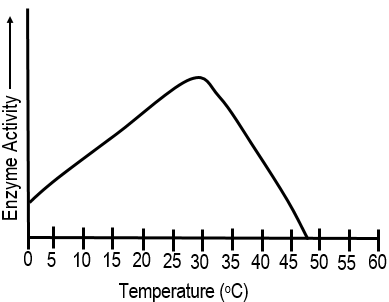
Based on the graph, what is the optimal temperature for this enzyme? 
a)
15oC
b)
40oC
c)
30oC
d)
35oC
13.
What happens when enzymes are heated to a high temperature?
a)

The enzymes remains unchanged.

b)

The shapes of the enzyme are altered, denature

c)
The enzymes' amino acid sequence changes.
d)
The enzymes remain the same
14.

Which polysaccharide is used by plants to make their cell wall?

a)

starch

b)

glycogen

c)

cellulose

d)

chitin

15.

Which macromolecule has the function of quick energy?

a)

Lipids

b)

Carbohydrates

c)

Protein

d)

Nucleic Acids

16.

Which macromolecule has the function of long term energy or energy storage

a)

Nucleic Acids

b)

Carbohydrates

c)

Lipids

d)

Protein

17.
Glycerol and fatty acids are the monomers of
a)
Carbohydrates
b)
Lipids
c)
Proteins
d)
Nucleic Acids
18.

Identify the macromolecule in the picture

* cholesterol and triglycerides

a)

lipid

b)

protein

c)

nucleic acid

d)

carbohydrate

19.

What is the function of a protein?

a)

genetic information

b)

insulation

c)

build structures like hair and nails

d)

quick energy

20.
What are the three components of a nucleotide?
a)
sugar, hydrogen, nitrogen base
b)
sugar, oxygen, nitrogen base
c)
sugar, phosphate, nitrogen base
d)
sugar, phosphate, protein
21.

Which macromolecule includes waterproofing?

a)
Carbohydrates
b)
Lipids
c)
Proteins
d)
Nucleic Acids
22.

What happens to an enzyme after it catalyzes a substrate?

a)

It changes shape.

b)

It denatures.

c)

It is unchanged and is reused.

d)

It stops working.

23.

What is the arrow pointing to on the picture?

a)

Enzyme

b)

Substrate

c)

Active Site

d)

Product

24.
The picture indicates which macromolecule? 
a)
Carbohydrates
b)
Lipids
c)
Proteins
d)
Nucleic Acids 
25.
Hemoglobin and Insulin are examples of... 
a)
Carbohydrates 
b)
Lipids
c)
Proteins
d)
Nucleic Acids 
26.

This carbohydrate is used by animals to store energy in the liver.

a)

chitin

b)

glycogen

c)

glucose

d)

starch

27.

This carbohydrate is used by plants for storage?

a)

chitin

b)

glycogen

c)

glucose

d)

starch

28.
The bond that joins amino acids are called:
a)
Peptide Bonds
b)
Ester Bonds
c)
Glycosidic Linkages
d)
Phosphodiester Bonds
29.

Which elements can be found in proteins?

a)

C

b)

H

c)

N

d)

P

e)

O

30.

What is the monomer or building block of proteins?

a)

glucose

b)

nucleotides

c)

amino acids

d)

lipids

31.

Enzymes

a)

fats

b)

proteins

c)

catalysts

d)

dogalysts

e)

lower activation energy

32.

What can make an enzyme not work?

a)

changing the pH

b)

change the shape

c)

changing the temperature

d)

change the size

33.

What is the monomer of carbohydrates?

a)

Monosaccharide

b)

Nucleotide

c)

Fatty Acid

d)

Amino Acid

34.

What elements would be found in carbohydrates?

a)

Carbon, Hydrogen

b)

Carbon, Hydrogen, Oxygen

c)

Carbon, Hydrogen, Oxygen, Nitrogen

d)

Carbon, Hydrogen, Oxygen, Nitrogen, Phosphorous

35.

What elements would be found in lipids?

a)

Carbon, Hydrogen, Oxygen, Nitrogen, Phosphorous

b)

Carbon, Hydrogen, Oxygen, Nitrogen

c)

Carbon, Hydrogen, Oxygen

d)

Carbon, Hydrogen

36.

What elements would be found in proteins?

a)

Carbon, Hydrogen, Oxygen, Nitrogen, Phosphorous

b)

Carbon, Hydrogen, Oxygen, Nitrogen

c)

Carbon, Hydrogen, Oxygen

d)

Carbon, Hydrogen

37.
Which most directly affects the sequence of amino acids in a protein?
a)
the DNA in the nucleus of the cell
b)
the amino acids found in the cytoplasm
c)
the type of cell in which the protein is made
d)
the region of the cell in which the protein is made
38.
DNA codes for __________ which determine ___________
a)
mRNA, tRNA
b)
mRNA, ribosomes
c)
proteins. traits
d)
proteins, peptide bonds
39.

Primary functions of DNA are (mark all that apply)

a)

Transmit information on heredity from one generation to the next

b)

Control cellular respiration

c)

Regulate homeostasis

d)

Provide a blueprint for making proteins

40.
A monomer is ...
a)
a single atom
b)
a building block for polymers
c)
a single element
d)
is an inorganic molecule