
 Worksheets
Badminton Unit Test
Total questions: 43
Worksheet time: 22mins
The origins of badminton have been traced to:
India, China, & Poland
India, Japan, & Iceland
Pakistan, Iran, & South Africa
None of the above
Badminton got its name from England’s duke of Beaufort, whose English country _____, named Badminton, was the site of a lawn party in 1873. Guests played the game and afterward referred to it as the Badminton game.
property
estate
origin
tradition
Badminton was introduced in the United States by two British players in 1878. Today the game is played around the world, and badminton organizations are found in more than _____ countries.
45
90
100
None of the above
Badminton did not become popular in the United States until the _____.
1940's
1950's
1930's
1920's
The ABA was founded in 1935 (and renamed the U.S. Badminton Association in 1978). What does ABA stand for?
American Badminton Assembly
American Badminton Assertiveness
American Badminton Association
American Badminton Allegiance
The ABA has developed competitions over the years, including the _____ Cup for men in 1948, and the _____ Cup for women in 1957.
Thomas & Killip
Thomas & De Miguel
Thomas & Marshall
Thomas & Uber
Both competitions (listed in question #6) are held every _____ years and represent the best in badminton play.
4
5
3
2
Badminton became an official medal sport during the 1992 Olympic Games in _____ Spain, after its introduction as an exhibition game in _____ Germany in 1972 and _____ South Korea in 1988.
Barcelona, Munich, & Seoul
Barcelona, Munich, & Moscow
Barcelona, London, & Seoul
Barcelona, Paris, & Seoul
Badminton is a great game for everyone, regardless of 3 things?
age, gender, or strength
aggression, speed, or agility
age, quickness, or ability
All of the above
Unlike many sports, badminton is a game in which new players can achieve success quickly. Although learning the essential skills of the game is relatively easy, mastering the _____ and _____ can be quite challenging.
strokes, competition
racket, shuttle
net, strategies
strokes, strategies
Because badminton is dominated not by strength but by skills and finesse, students need not be grouped by gender or size. Instead, complementary skills should be emphasized; in badminton, quickness, finesse, and accuracy are more valuable than power and strength. Indeed, perhaps more than any sport, badminton offers a game where _____ and _____ can compete on an equal footing.
females, males
adults, kids
middle school, high school
All of the above
Basic badminton equipment is relatively inexpensive for recreational players. Backyard sets, although not very _____, afford many hours of fun for a small investment.
expensive
durable
cool
None of the above
For the more serious player, even a high-quality _____, _____, and court _____ are still quite inexpensive when compared with the cost of playing gear for most other sports.
racket, shuttlecocks, net
racket, net, shoes
racket, shuttlecocks, shoes
net, shuttlecocks, shoes
Several courtesies should be observed during the game of badminton, including the following: (Choose the answer that does NOT belong)
Compliment an opponent’s good shots.
Offer your opponent positive suggestions on how to improve their play.
Call faults immediately.
Avoid talking or distracting opponents or a partner during play.
Badminton is a relatively safe activity. To avoid accidental collisions and hits with the racket, the following safety procedures should be implemented:
Students should maintain an adequate distance when swinging rackets.
When performing shuttle-hitting drills, students should face the same direction.
In doubles play, partners should call shots that could be taken by either player.
All of the above
The basic game involves the following:
serving & stroking
footwork & speed
keeping the opponent off-balance
All of the above
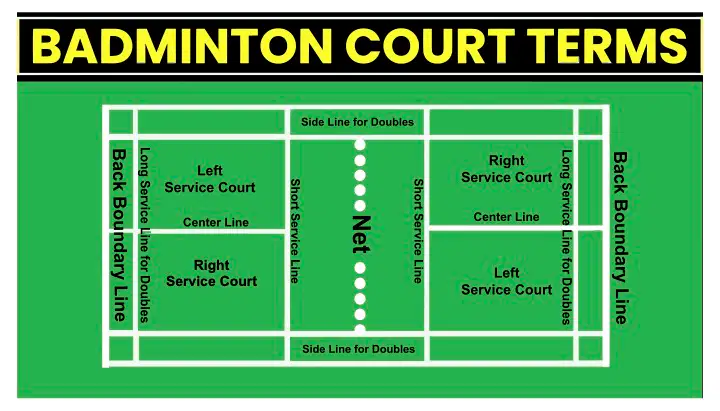
The doubles court in Badminton is:
doubles sidelines
doubles baseline
doubles sidelines to doubles baseline
All of the above
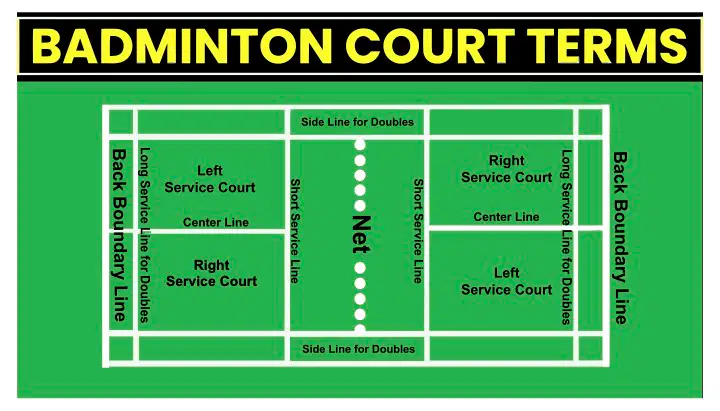
The serving lines in doubles for Badminton is:
short service line
long service line-doubles
short service line to the long service line-doubles
None of the above
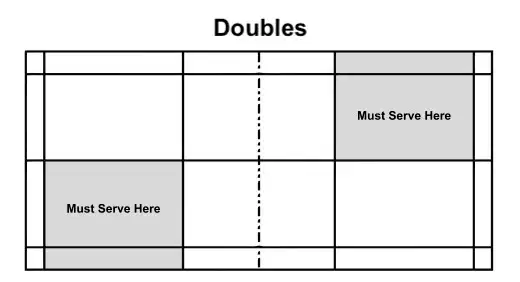
Server stands _____ the service line and strikes the shuttle with an underhand motion.
behind
in front of
below
above
The receiver must hit the _____ before it hits the floor.
ball
puck
birdie
shuttle
Players hit the ball back and forth (_____) until one side fails to return it legally over the net.
rally
competition
game
All of the above
Play ends when the shuttle hits the ______, or a player makes a fault.
net
opponent
floor
All of the above
If the serving side commits the fault, the opposing side gets the serve.
penalty
mistake
foul
fault
If the receiving side commits the fault, the serving side earns a _____.
goal
point
score
touchdown
A shuttle on the line is in play.
true
false
The racket may cross the net, but it can’t touch the _____.
net
floor
shuttle
All of the above
The shuttle may touch the net during a rally. If it falls inbounds, it is in play.
true
false
If on the serve or during a rally the shuttle goes out-of-bounds but the receiver makes contact, the shuttle is in play.
true
false
If on the other hand, the receiver swings and misses it completely (no contact) it is ruled out-of-bounds.
true
false
Doubles games are played to _____.
13
14
15
16
Only the serving team _____ points.
earns
wins
scores
gives
In doubles, the server alternates service courts until the serve is _____.
won
lost
completed
None of the above
won
lost
completed
None of the above
Only _____ partner on the team with the first serve to start the doubles games may serve in that team’s half of the inning. After a fault by the serving team, both opponent partners get to serve in their half of the inning. Thereafter, both partners serve in their respective half-innings.
one
two
three
four
If the shuttle touches the net on the serve but still falls into the proper service court, called a “_____”, the shuttle is served again.
redo
do over
let
All of the above
The server must strike the _____ of the shuttle first, or it's a fault.
front
back
skirt
top
The server must contact the shuttle above the _____, or it's a fault.
legs
waist
knees
All of the above
The server must keep his/her _____ stationary, or it's a fault.
hands
feet
elbows
knees
The server fails to hit the shuttle to the proper service _____.
box
line
court
All of the above
It’s a fault if the receiver on the serve is not _____ the service court.
inside
outside
It’s a fault if the receiver on the serve does not have both _____ on the floor at serve delivery.
partners
feet
rackets
shuttles
It’s a fault if the receiver on the serve is _____ before the serve is made.
talking
laughing
moving
All of the above
It’s a fault, if you hit the shuttle out-of-bounds.
true
false
It’s a fault, if you hit the shuttle into the ceiling, wall, etc.
true
false

