wayground logo

Free Printable Worksheets

Font size

S
M
L
XL
Worksheets

MOTION_R-1_IX

Total questions: 51

Worksheet time: 43mins

Name
Class
Date
1.

How is displacement different from distance?

a)

displacement is a vector, it must have magnitude and direction

b)

displacement is a vector, it must have magnitude only

c)

displacement is a scalar, it must have magnitude and direction

d)

displacement is a scalar, it must have magnitude only

2.
The Standard Units for Speed is ?
a)
m/s (meters per second)
b)
ms (meters times seconds)
c)
mskg (meters times seconds kilograms)
d)
m/s*kg (meters per second kilograms)
3.
Runner A (blue) has the same displacement as Runner B (black).
a)
False
b)
True
4.
Acceleration: is the rate of change in ___________.
a)
speed
b)
distance
c)
velocity 
d)
displacement 
5.
An object is _____ if its position changes relative to another object.
a)
in motion
b)
at reset
c)
a frame of refence
d)
magical
6.

How can you find the distance around a circle?

a)

2πr

b)

d/t

c)

v2

d)

T

7.

A truck driving at 60 km per hour travels 150 km. How long is it driving for?

a)

9000 hours

b)

0.4 hours

c)

210 hours

d)

2.5 hours

8.

Which of the following is a vector quantity?

a)

Work

b)

Speed

c)

Velocity

d)

Force

e)

Accelaration

9.

Ram travels at a speed of 20 km/hr while going to school. While coming back, he travels at a speed of 30 km/hr(due to less traffic). What his it’s average speed?

a)

25km/hr

b)

26km/hr

c)

20km/hr

d)

24km/hr

e)

Cant be determined

10.
When something has speed in a certain direction it is called ___________.
a)
motion
b)
position
c)
velocity
d)
speed
11.
What is the definition of velocity?
a)
A force that opposes motion
b)
Uniform circular motion
c)
The speed of an object in a particular direction
12.
What is the definition of speed?
a)
Distance/Time
b)
Change in velocity/Time
c)
A change in momentum
13.
How is velocity different than speed?
a)
Speed opposes velocity
b)
Velocity is speed with a direction
c)
None of the answers are correct
14.
Which of the following represents the equation for acceleration?
a)
a = ƒt/v
b)
a = Δt/f
c)
A = Λd/t
d)
a = Δv/t
15.
An object traveling in a circular motion is always changing its ______ and ______.
a)
rotation, velocity
b)
direction, velocity
16.
A force is an action exerted on a body in order to change the body's state of ______.
a)
Balance
b)
Being
c)
Proximity
d)
Motion
17.
A force that opposes motion between two surfaces that are in contact.
a)
Speed
b)
Velocity
c)
Friction
d)
Force
18.
The force that opposes the motion of two surfaces that are in contact and are sliding over each other.
a)
Static Friction
b)
Kinetic Friction
19.
a)
Velocity
b)
Speed
c)
Uniform Circular Motion
20.

An object is said to be in __________ if its position changes with time.

a)

rest

b)

motion

c)

both

21.

The motion of Earth around the sun is

a)

Circular motion

b)

translatory motion

c)

non uniform motion

22.

The motion of molecules of a liquid is

a)

random

b)

non random

c)

uniform

23.

The rate of change of displacement is called _______________.

a)

Speed

b)

Acceleration

c)

Motion

d)

None of them

24.

The S.I unit of acceleration is:

a)

m/s

b)

ms-2

c)

cm/s

d)

ft/s

25.
D-Lo watches a red buggy car, which is his favorite activity. He watches the car cover 2 meters every second. Which graph would represent this?
a)
A (upper left)
b)
B (bottom left)
c)
C (upper right)
d)
D (bottom right)
26.
Which is an example of zero acceleration?
a)
A merri-go-round moving at a constant rate
b)
A car coming to a stop
c)
A boat speeding up
d)
A person running on a treadmill at a rate of 6 MPH
27.
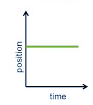
Which graph shows an object not moving?
a)
A
b)
B
c)
C
d)
D
28.
Which graph shows an object moving at a constant rate?
a)
A
b)
B
c)
D
d)
E
29.
Which graph shows an object increasing speed?
a)
A
b)
B
c)
D
d)
E
30.
Which graph shows an object going back to the start position?
a)
A
b)
B
c)
C
d)
D
31.

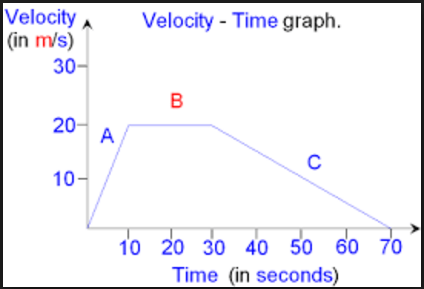
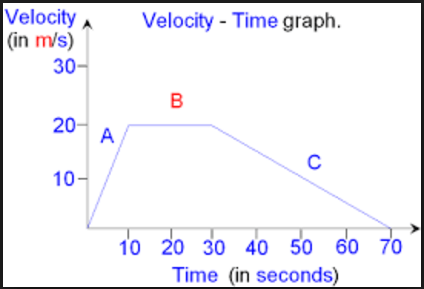
This is a velocity-time graph. What is the object doing in segment A?

a)

Speeding up

b)

Slowing down

c)

Constant Velocity

d)

Not moving

32.
This is a velocity-time graph.  What is the object doing in segment B?
a)
Positive acceleration
b)
Negative acceleration
c)
Constant Velocity
d)
Not moving
33.

This is a velocity-time graph. What is the object doing in segment C?

a)

Speeding up

b)

Slowing down

c)

Constant Velocity

d)

Not moving

34.

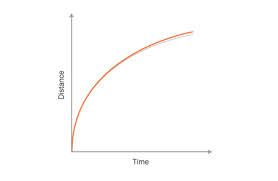
Describe the motion of the object in the graph

a)

Moving with constant speed

b)

Speeding up

c)

Not moving

35.
What is this graph showing?
a)
Constant Speed
b)
Acceleration (speeding up)
c)
Deceleration (slowing down)
d)
No motion
36.
Which graph shows the object standing still?
a)
A
b)
B
c)
C
d)
D
37.
Which graph represents zero acceleration (constant velocity)?
a)
A
b)
B
c)
C
d)
D
38.
Which graph represents the greatest acceleration?
a)
A
b)
B
c)
C
d)
D
39.

What is occurring on this graph?

a)

speeding up in the positive direction

b)

moving at a constant speed in the positive direction

c)

not moving

d)

moving at a constant speed in the negative direction

40.

What is occurring on this graph?

a)

Negative acceleration

b)

moving at a constant speed in the positive direction

c)

positive acceleration

d)

negative net force

41.
What is the formula to calculate speed?
a)
S = t/d
b)
S = d/t
c)
S = d x t
d)
S = t x d
42.
Which of the following is a unit of speed ?
a)
sec
b)
mi
c)
m/s
d)
min
43.

Instantaneous rate of change of displacement is a definition of

a)

Instantaneous velocity

b)

Instantaneous acceleration

c)

Instantaneous displacement

d)

velocity

44.

What value will you get if you calculate the gradient of a v-t graph

a)

acceleration

b)

velocity

c)

deceleration

d)

displacement

45.

S2 - S1 / t2 - t1 is defined as

a)

average velocity

b)

instantaneous velocity

c)

displacement

d)

instantaneous acceleration

46.

Describe this graph

a)

object move to left

b)

constant acceleration

c)

increasing displacement

d)

zero acceleration

47.

Describe this graph

a)

constant acceleration

b)

constant deceleration

c)

object move to the left

d)

constant velocity

48.

What is the similar graph with above graph?

a)
b)
c)
49.

describe this graph

a)

zero acceleration

b)

deceleration to right

c)

deceleration to left

d)

acceleration to right

50.

Which a-t graph represent above graph?

a)
b)
c)
51.

How can we find distance traveled?

a)

calculate area under v-t graph

b)

calculate area under a-t graph

c)

calculate area under s-t graph