
 Worksheets
Topic 1 (Bones, Joints, Levers, Personality) SEHS
Total questions: 70
Worksheet time: 1hrs 9mins
Where do you find tarsals, metatarsals, phalanges?
Foot
Hand
Head
Chest
Ribs, sternum, scapula, pelvis are all example of...
Long bones
Flat bones
Irregular bones
Short bones


the flares of the hip, largest part (the top area of the pelvis)
Which are components of the axial skeleton?
Ribs, Clavicle, Ilium
Skull, Vertebrae, Sternum
Ribs, Clavicle, Sternum
Skull, Vertebrae, Ilium
Which bones form part of the appendicular skeleton?
Femur, radius, ribs, patella
Coccyx, humerus, ulna, tibia
Pelvic girdle, clavicle, fibula, carpals
Sternum, phalanges, femur, tarsals

The diagram below shows a long bone. What is the structure labelled X?
Compact bone
Spongy bone
Diaphysis
Cartilage

What structure is labelled X in the diagram below?
Articular capsule
Synovial fluid
Articular cartilage
Synovial membrane
Which structure forms part of a long bone?
Bursae
Articular capsule
Meniscus
Articular cartilage

Which part of the long bone is labelled X in the diagram?
Epiphysis
Diaphysis
Periosteum
Yellow bone marrow
The thing that holds bone to bone is
ligaments
tendons
Which is an example of a hinge joint
knee and elbow
shoulder and hip
neck
ankle and wrist


The skull is an example of what type of joint?
Cartilaginous
Synovial
Fibrous
Bones that have complex shapes are called...
Flat bones
Irregular bones
Sesamoid bones
Long bones
A FREELY MOVABLE JOINT IS ALSO CALLED A SYNOVIAL JOINT.
TRUE
FALSE
Cushions bone surfaces
Articular Cartilage
Joint Cavity
Synovial Fluid
Articular Capsule
Ligament
Lubricates ends of bones
Articular Cartilage
Synovial Membrane
Synovial Fluid
Articular Capsule
Ligament
Produces synovial fluid
Articular Cartilage
Synovial Membrane
Synovial Fluid
Articular Capsule
Ligament
Strengthens/stabilizes joint so bones are not pulled apart
Articular Cartilage
Synovial Membrane
Synovial Fluid
Ligaments


What type of lever
First Class Lever
Second Class Lever
Third Class Lever

What class lever does this picture show?
1st
2nd
3rd

Which lever would be the easiest to lift the load?
A
B
C
In the human body, this acts as the lever arm.
Bones
Joints
Muscles
Tendons
In the human body, this acts as the fulcrum.
Bones
Joints
Muscles
Tendons
The elbow joint is an example of this type of lever:
First Class Lever
Second Class Lever
Third Class Lever
Fourth Class Lever
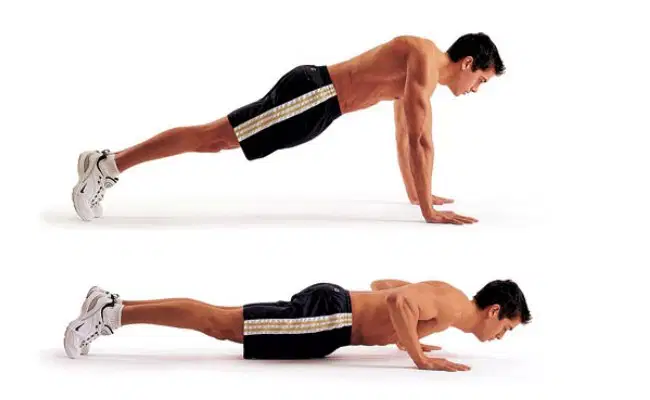
A push-up is an example of which type of lever?
First Class
Second Class
Third Class
Fourth Class
Movement of a limb laterally, away from the midline of the body.
Adduction
Abduction
Flexion
Extension
Hyperextension
Movement of a limb medially, towards the midline of the body.
Adduction
Abduction
Flexion
Extension
Hyperextension
Movement of a limb anteriorly; a forward motion; decreases angle between two bones.
Adduction
Abduction
Flexion
Extension
Hyperextension
Movement of a limb posteriorly to return body to neutral position; a backwards motion; increases angle between two bones.
Adduction
Abduction
Flexion
Extension
Hyperextension
Movement of a limb posteriorly to BEYOND neutral position; increases angle between two bones greater than 180 degrees but less than 360.
Adduction
Abduction
Flexion
Extension
Hyperextension
Moving your foot so that the SOLE faces medially.
Inversion
Eversion
Dorsiflexion
Plantar flexion
Opposition
Moving your foot so that the SOLE faces laterally.
Inversion
Eversion
Dorsiflexion
Plantar flexion
Opposition
Moving your foot so that the toe points inferiorly; "being on a tip toe"
Inversion
Eversion
Dorsiflexion
Plantar flexion
Opposition
Moving your foot so that the toe points superiorly; toe closest to crural region
Inversion
Eversion
Dorsiflexion
Plantar flexion
Opposition
Movement of a joint 360 degrees in a complete circle.
Supination
Pronation
Rotation
Circumduction
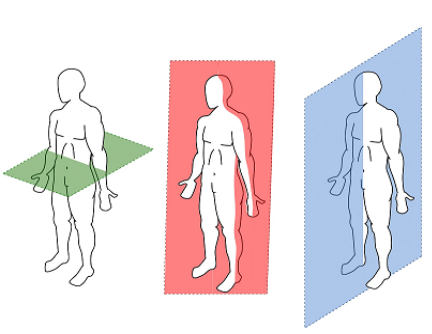
Divides the body into front and back portions.
Sagittal
Frontal
Transverse
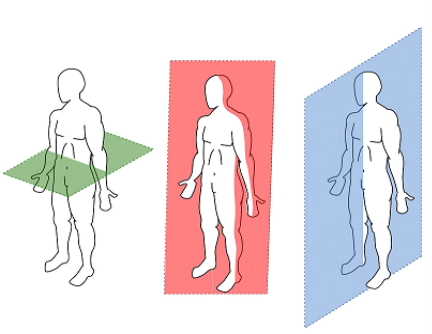
Divides the body into top and bottom portions.
Sagittal
Frontal
Transverse

Plane that divides body into left and right sides:
Sagittal
medial
transverse
A (a) is an aspect of one's personality that is reasonably stable.
True or False: Skeletal bones provide shape, support, protection and movement to your body.
True
False


