Wayground logo

Free Printable Worksheets

Font size

S
M
L
XL
Worksheets

Body Co-ordination CAT

Total questions: 54

Worksheet time: 54mins

Name
Class
Date
1.

1. The human nervous system has two main parts called

a)

the brain and the spine

b)

the central nervous system and the brain

c)

the peripheral nervous system and the brain

d)

the central nervous system and the peripheral nervous system

2.

Another name for a nerve cell is

a)

Neurone

b)

Brain cell

c)

Synapse

d)

impulse

3.

Nerve impulses travel all over the body

a)

but only in one direction

b)

5 directions

c)

via blood

d)

in both directions

4.

The four main parts of a neurone are

a)

sensory neurones, cell body, axon and dendrites

b)

effectors,

sensory neurones, cell body and dendrites

c)

Axon hillock, axon, dendrites and cell body

d)

motor neurones, sensory neurones, effectors and cell body

5.
A nerve cell that is the basic working unit of the brain and nervous system which processes and transmits information
a)
axon
b)
neuron
c)
dendrite
d)
neurotransmitter
6.
This insulating material forms a layer, around the axon of a neuron.  It enables electrical signals to travel down the axon at higher speeds.
a)
neuron
b)
myelin sheath
c)
dendrite
d)
neurotransmitter
7.
A chemical produced by neurons that carries messages to other neurons
a)
myelin sheath
b)
neurotransmitter
c)
axon
d)
axon terminal
8.
The tiny gap between neurons where nerve impulses are sent from one neuron to another.  It is where communication occurs between an axon and dendrite
a)
synapse
b)
axon terminal
c)
impulse
d)
myelin
9.

The part of the neuron that receives messages from adjacent neurons

a)

axon

b)

axon terminal

c)

dendrite

d)

neuron

10.

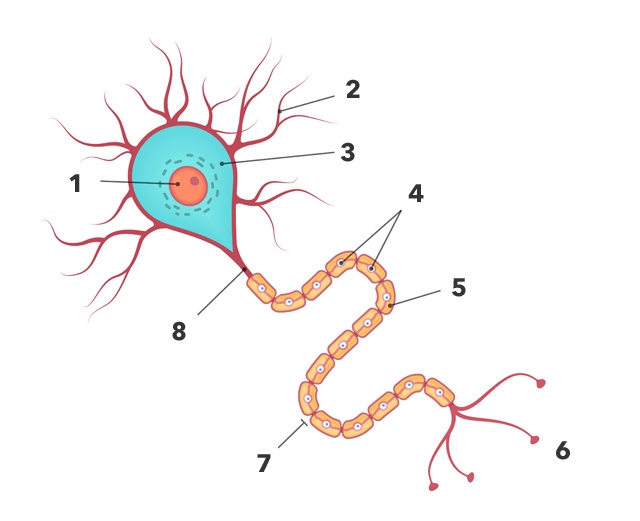
Identify #1

a)

axon

b)

cell body

c)

myelin sheath

d)

nucleus

11.

Identify #2

a)

axon

b)

cell body

c)

dendrite

d)

myelin sheath

12.

Identify #3

a)

axon

b)

cell body

c)

dendrite

d)

myelin sheath

13.
This is the electrical charge that travels down an axon when a neuron is firing
a)
Resting Potential
b)
Action Potential
c)
Threshold
d)
Refractory Period
14.
What is another name for a nerve cell?
a)
Muscle Fiber
b)
Connective Tissue
c)
Impulse
d)
Neuron
15.
This part of the neuron stores then releases neurotransmitters into the synapse.
a)
Axon 
b)
Dendrite
c)
Myelin Sheath
d)
Axon Terminal
16.
Which letter on the illustration represents the frontal lobe? 
a)
A
b)
B
c)
C
d)
D
17.
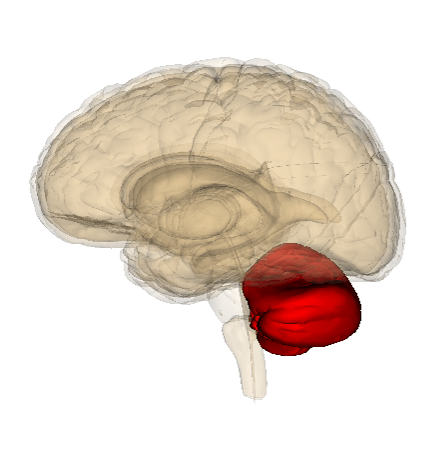
The red portion is the ________
a)
Cerebrum
b)
Cerebellum
c)
Brain Stem
d)
Diencephalon
18.
What part of the brain is Letter C pointing to?
a)
Frontal Lobe
b)
Parietal Lobe
c)
Occipital Lobe
d)
Temporal Lobe
19.

The main function of the occipital lobe is...

a)

vision.

b)

touch.

c)

taste.

d)

smell.

20.

What is the biggest function of the muscular system?

a)

to help digest food

b)

to help us move

c)

to help us breathe

d)

to help us remove waste

21.

What is the biggest function of the respiratory system?

a)

to pump blood

b)

to help us digest food

c)

to take in oxygen and release carbon dioxide

d)

to help us fight disease and infection

22.

Which system in the human body functions primarily to supply the blood with oxygen and remove carbon dioxide?

a)

excretory

b)

immune

c)

respiratory

d)

cardiovascular

23.

Which two body systems are primarily responsible for gas exchange between the body and the environment?

a)

skeletal and muscular

b)

circulatory and respiratory

c)

circulatory and digestive

d)

respiratory and excretory

24.

Which two systems are responsible for voluntary movement?

a)

circulatory and excretory

b)

digestive and circulatory

c)

skeletal and muscular

d)

skeletal and circulatory

25.

What is the most important function of the excretory system?

a)

Break down food

b)

Pump blood

c)

Remove waste

d)

Voluntary movement

26.

Which is not an important organ in the excretory system?

a)

Bladder

b)

Large Intestine

c)

Esophagus

d)

Kidneys

27.
 Which system is the stomach in?
a)
respiratory
b)
digestive
c)
nervous
d)
excretory
28.
 What is the main job of the digestive system? 
a)
break down foods into nutrients that can be used by the body
b)
take in oxygen and exhale waste like carbon dioxide
c)
pump blood throughout the body
d)
makes the body hungry
29.
Which systems main function is to allow movement of the body?
a)
muscular
b)
digestive
c)
skeletal
d)
excretory
30.
The smallest units or parts of living things; the body's building blocks.
a)
cells
b)
organs
c)
tissues
d)
system
31.
This tube is made of smooth muscle and carries food from your mouth to your stomach.
a)
trachea
b)
intestines
c)
esophagus
d)
urethra
32.
The main function of this organ is to break down and digest food to extract necessary nutrients.
a)
liver
b)
stomach
c)
esophagus
d)
lungs
33.
Your body couldn’t breathe without this system. Which one is it?
a)
circulatory
b)
skeletal
c)
respiratory
d)
urinary
34.
When you breathe in air, you inhale oxygen into your lungs and exhale ____.
a)
carbon dioxide
b)
oxygen
c)
nitrogen
d)
carbon monoxide
35.
The movement of blood through the heart and body is called ______.
a)
circulation
b)
ventriculation
c)
locomotion
d)
pumping heart
36.
With circulation, the heart provides your body with which of the following? Choose the best answer. 
a)
oxygen
b)
nutrients
c)
a way to get rid of waste
d)
all of the above
37.
Where is urine PRODUCED?
a)
intestines
b)
kidneys
c)
bladder
d)
blood
38.
Each bone has a particular job. What is the job of the rib cage?
a)
pumps blood to the body
b)
helps the body circulate blood
c)
protects the heart
d)
tells the heart what to do
39.
This system controls everything you do.
a)
nervous system
b)
olfactory system
c)
digestive system
d)
circulatory system
40.

Where is the thyroid gland?

a)

Below Adam's apple in neck

b)

Scrotum

c)

Brain

d)

Chest

41.

Which hormone is produced in the testes

a)

Insulin

b)

Adrenalin

c)

Testosterone

d)

Thyroxine

42.

Where is insulin produced

a)

Liver

b)

Heart

c)

Pancreas

d)

Pineal gland

43.

Which hormone controls the metabolic rate?

a)

Adrenalin

b)

Thyroxin

c)

Insulin

d)

Testosterone

44.

Which hormone is involved in regulating blood glucose levels?

a)

Thyroxine

b)

Oestrogen

c)

Testosterone

d)

Insulin

45.

Where is the pancreas? (pick the correct number in diagram)

a)

3

b)

2

c)

6

d)

8

46.

Which gland(s) is sometimes referred to as the master gland?

a)

Adrenal

b)

Pituitary

c)

Testes

d)

Ovaries

47.

What are hormones?

a)

your body's chemical messengers

b)

a collection of glands

48.

Which gland produces seven hormones?

a)

Pituitary

b)

Thyroid

49.

Which gland helps to react to danger with a fight or flight response?

a)

Adrenal

b)

Pancreas

50.
A goiter is an enlargement of what gland?
a)
Pituitary
b)
Adrenal
c)
Mammary
d)
Thyroid
51.
Which of the following anterior pituitary hormones stimulates growth of long bones?
a)
Prolactin
b)
Thyrotropin
c)
Adrenocorticotropic hormone
d)
Human growth hormone
52.
Glands located on the kidneys that regulate the use of carbohydrates and salt, and prepare the body for emergencies.
a)
Thyroid gland
b)
Pancreas
c)
Adrenal glands
d)
Ovaries/testes
53.
Progesterone is responsible for?
a)
Regulation of menstrual cycle
b)
Release of glucocorticoids
c)
Increase blood sugar level
d)
Decrease stress level
54.
Insulin and glucagon;
a)
Are secreted by the beta cells of the islets of Langerhans
b)
Elevate blood glucose
c)
Are secreted in response to declining plasma levels of glucose
d)
Are secreted by the pancreas and are concerned with the regulation of blood glucose