wayground logo

Free Printable Worksheets

Font size

S
M
L
XL
Worksheets

Test 1 - Why Chemistry

Total questions: 78

Worksheet time: 2hrs 0mins

Name
Class
Date
1.
What should you do if you break glass in the lab?
a)
Tell the teacher.
b)
Sweep up the glass.
c)
Pick up the glass with your hands.
d)
Ignore it; the teacher will clean it up when she sees it later.
2.
When you are in the lab, you should wear:
a)
bulky sweatshirts
b)
dangling jewelry
c)
open toe shoes
d)
closed toe shoes
3.
In the event of broken equipment, what should you do?
a)
stop using the equipment and report it immediately
b)
continue using the equipment and report it immediately
c)
stop using the equipment and report it later
d)
continue using the equipment and report it later
4.
While working in the lab, the lab table should ALWAYS be kept clear of:
a)
lab equipment
b)
books, purses and jewelry
c)
writing utensils
d)
lab worksheets
5.
In order to put out a fire in a person's hair or clothing, use:
a)
water in the sink
b)
fire extinguisher
c)
fire blanket
d)
wind produced from running
6.

why do we use goggles/eye protection?

a)

to stop our eyes from hurting

b)

to help you see the board

c)

to look cool

d)

to protect your eyes from chemicals, heat, or broken glassware

7.

What do you do if a fire breaks out during a lab?

a)

Run!

b)

Tell the teacher

c)

Just watch it burn

8.

If you don't understand something about a lab, what should you do?

a)

ask the teacher!

b)

just skip that part of the lab

c)

figure it out on your own

d)

ask your best friend in the class

9.

after completing an experiment, all chemical waste should be

a)

left at your lab station for the next class

b)

disposed of according to your teacher's instructions

c)

dumped in the sink

d)

taken home

10.

( Fill in the blank) Long hair should be ____________ in the laboratory.

a)

tied back

b)

cut

c)

down

d)

curled

11.

Which statements are false about the graph?

a)

Opera and jazz is more than country and rock.

b)

Half as many people like opera as rock.

c)

Jazz and country is less than opera and rock.

d)

Country and opera is more than rock.

12.

Bill's monthly budget is $3000. What part of his budget is worth $450?

a)

Rent

b)

Clothes

c)

Misc.

d)

Food

13.
How many students were greater than 55 inches tall but less than 70 inches tall?
a)
13
b)
15
c)
16
d)
17
14.
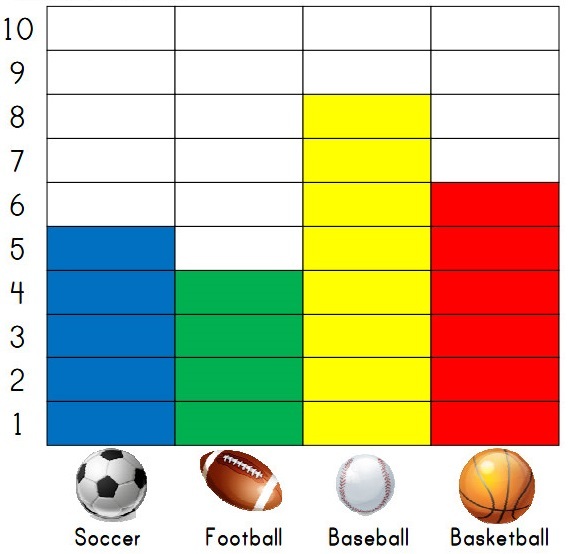
What type of graph is this?
a)
bar graph
b)
pictograph
c)
tally chart
15.

Science can change and is a continually ongoing process.

a)

True

b)

False

16.

What step does every scientific experiment begin with?

a)

hypothesis

b)

question/problem

c)

background research

d)

conclusion

17.
Should experiments be repeated over and over to see if the results are the same each time?
a)
yes
b)
no
18.

Choose the best-written hypothesis that answers the question:

Question: Why is my room warmer during the day than at night?

a)

Sunlight is making my room warmer.

b)

Mr. Nuzzo has the heat turned on in the morning.

c)

If I close my blinds during the day, then my room will be cooler because sunlight cant get in.

d)

Sunlight actually cools down a room.

19.

A prediction that can only be supported or not supported by scientific experimentation.

a)

hypothesis

b)

theory

c)

law

20.

Explains something we see in the natural world that has been verified through repeated experiments or testing.

a)

hypothesis

b)

law

c)

theory

21.

A ___ is observed and describes in the natural world what appears to always be true.

a)

hypothesis

b)

theory

c)

law

22.

Select ALL that both theories and laws have in common.

a)

based on empirical evidence

b)

supported by a large amount of data

c)

revised or updated with new evidence

d)

happens under very specific conditions in nature

23.

Help us understand laws.

a)

hypothesis

b)

theory

c)

another law

24.
Which weighs more: a pound of feathers or a pound of bricks?
a)
the feathers
b)
the bricks
c)
they weigh the same
25.
Which would be the best metric units to use to find the mass of a dog?
a)
milligram
b)
gram
c)
kilogram
d)
pound
26.

__________ is the amount of matter in an object. It does not change regardless of location

a)

Weight

b)

Mass

27.

______________ is how heavy an object is. It is determined by the pull of gravity

a)

Weight

b)

Mass

28.

The study of the composition, structure, and properties of matter and the changes it undergoes.

a)

Chemistry

b)

Physics

c)

Biology

d)

Social Science

29.

The study of carbon containing compounds.

a)

Organic Chemistry

b)

Inorganic Chemistry

c)

Physical Chemistry

d)

Biochemistry

30.

The study of compounds that do not contain carbon.

a)

Organic Chemistry

b)

Inorganic Chemistry

c)

Biochemistry

d)

Analytical Chemistry

31.

The study of the properties and changes in matter and their relation to energy.

a)

Physical Chemistry

b)

Biochemistry

c)

Organic Chemistry

d)

Inorganic Chemistry

32.

The identification of the components and composition of materials refers to___________________________

a)

Biochemistry

b)

Physical Chemistry

c)

Organic Chemistry

d)

Analytical Chemistry

33.

The study of substances and processes occurring in living things.

a)

Biochemistry

b)

organic Chemistry

c)

inorganic Chemistry

d)

Applied Chemistry

34.
What two types of measurements make up DENSITY
a)
Mass and Volume
b)
Temperature and Mass
c)
Grams and Centimeters
d)
Volume and Weight
35.
Look at this image.  Which object has the LOWEST density in water? How
a)
The Ping Pong Ball because it floats to the top 
b)
The bolt because it has sunk to the bottom
c)
The soda cap because it is not just full of air like the Ping Pong ball
36.
Jack has a rock. The rock has a mass of 14g and a volume of 2cm3. What is the density of the rock?
a)
7 mL
b)
7 g/cm3
c)
28 g/cm3
d)
1/7 g/cm3
37.
What units can be used to express density?
a)
g/mL
b)
grams
c)
millimeters
d)
milliliters
38.
Calculate the density of the cube.
a)
2 g/cm3
b)
4 g/cm3
c)
6 g/cm3
d)
8 g/cm3
39.
What is this tool to get volume?
a)
triple beam balance
b)
ruler
c)
thermometer
d)
graduate cylinder
40.

Find the mass if a substance has a volume of 35mL and a density of 15.4g/mL.

a)

539g

b)

2.27g

c)

.44g

d)

6.89g

41.

If the density and volume is known what is the correct formula for mass?

a)

m=d/v

b)

m=v/d

c)

m=d*v

d)

m=v+d

42.

If the density and mass is known what is the correct formula to find volume?

a)

v=m*d

b)

v=m/d

c)

v=d/m

d)

v=d+m

43.
What is the volume of the fish?
a)
18.0 cm3
b)
6.0 cm
c)
32.0 cm3
d)
38.0 cm3
44.
Find the density of a 2 cm x 2 cm x 2 cm cube with a mass of 64 g.
a)
6 cm3
b)
12 g/cm3
c)
128 g/cm3
d)
8  g/cm3
45.

Convert this number to standard notation: 7.1 x 10⁴

(a)  

46.

Convert this number into scientific notation: 0.068

a)

6.9 x 10⁶

b)

6.8 x 10⁻⁹

c)

6.8 x 10⁻²

d)

None of the above

47.

Convert this number to standard notation: 1.4 x 10⁻²

(a)  

48.

Convert this number into scientific notation: 950,000

a)

9.5 x 10⁵

b)

9.5 x 10⁻⁹

c)

9.5 x 10²

d)

None of the above

49.

Which value is the greatest

a)

5.0 x 10⁻⁹

b)

5.0 x 10⁻⁴

c)

5.0 x 10⁶

d)

5.0 x 10⁸

50.
Write 6,700 in scientific notation.
a)
6.7 x 10³
b)
6.7 x10⁻³
c)
67 x 102
d)
67 x 10-2
51.
The rule of scientific notation is to write all exponents with a base of ____.
a)
50
b)
5
c)
100
d)
10
52.
What is scientific notation?
a)
A long way to write really short  numbers
b)
A short way to write really long numbers
c)
I don't know...
d)
None of the above
53.

40 ft = __________ inches

a)

400

b)

3.3

c)

480

d)

12

54.

Convert 3.5 gallons into cups. (1gal = 16cups)

a)

56 cups

b)

0.21875 cups

c)

19.5 cups

d)

48 cups

55.
How many gallons are in a pool that holds 758,000 Liters?
(1 gallon = 3.79 Liters)
a)
200
b)
20,000
c)
200,000
d)
2,000,000
56.

How many years are in a 3 months?

a)

0.2 yrs

b)

0.75 yrs

c)

0.50 yrs

d)

0.25 yrs

57.
Convert 300 meters to centimeters:
a)
3000 cm
b)
0.3 cm
c)
30,000 cm
d)
3 cn
58.
1000 grams = _____ kilograms
a)
0.0001
b)
1,000,000
c)
10
d)
1
59.
The metric unit for mass is 
a)
newton
b)
kilogram
c)
joule
d)
g/ml
60.
Which lists metric units, in order, from smallest to largest?
a)
milligram, centigram, gram
b)
kilogram, gram, centigram
c)
decagram, hectogram, milligram
d)
kilogram, hectogram, decagram
61.
The appropriate abbreviation of centimeter is..
a)
cm
b)
Cm
c)
cM
d)
CM
62.
There are ___ meters in 25 kilometers (km)
a)
250 m
b)
2500 m
c)
25000 m
d)
.025 m
63.
The base unit for length is the
a)
second
b)
gram
c)
meter
d)
liter
64.
What does 10= ?
a)
100,000
b)
10 x 5
c)
50
d)
500
65.
A hippo's mass would most likely be described using with units?
a)
kilometers
b)
milligrams
c)
kilograms
d)
triple beam balance
66.
What is the approximate width of the classroom door?
a)
100 m
b)
101 m
c)
10-1 m
d)
10-2 m
67.
Convert 17 m to cm:
a)
0.17 cm
b)
0.017 cm
c)
1,700 cm
d)
170 cm
68.

The SI unit for volume is the __________.

a)

meter

b)

kilogram

c)

liter

d)

second

e)

Newton

69.

Which of the following is a unit that measures TEMPERATURE?

a)

grams

b)

meters

c)

seconds

d)

Ampere (Amp)

e)

Kelvin

70.

Which of the following is a basic unit that measures LENGTH?

a)

grams

b)

meters

c)

seconds

d)

Ampere (Amp)

e)

Kelvin

71.

Which of the following is a basic unit that measures TIME?

a)

grams

b)

meters

c)

seconds

d)

Ampere (Amp)

e)

Kelvin

72.
A passenger jet has a speed of 900 km/h.
What is its speed in m/s?
(1 km = 1000 m)
a)
250 m/s
b)
324 m/s
c)
1,500 m/s
d)
2,500 m/s
73.
A bicycle has a speed of 6 m/s. What is its speed in km/h?  (1 km=1000 m)
a)
21.6 km/h
b)
16.67 km/h
c)
2.16 km/h
d)
1.67 km/h
74.
Complete the statement:
5 cm/min = ______ m/day
(100 cm = 1 m)
a)
72
b)
840
c)
7.2
d)
5,040,000
75.
The Olympic record for the high jump is just over 2.6 yards. What is that distance in feet?  (3 ft=1 yd)
a)
0.867 ft
b)
7.8 ft
c)
8.07 ft
d)
8.27 ft
76.

How many kilograms of calcium are there in 173 pounds of calcium? (1 pound = 454 grams; 1 kg = 1000 g)

a)

1.10 kg

b)

78.5 kg

c)

110 kg

d)

78500 kg

77.
Gas costs $3.05 a gallon, and your car travels at 27 miles for each gallon of gas. How far can you travel in your car with $95 in your pocket?
a)
11 miles
b)
840 miles
c)
7800 miles
d)
870 miles
78.

The time that it takes to fill a tank depends upon the rate at which the water is flowing. It takes 40 minutes to fill the tank at the rate of 3 gallons per minute. How many minutes will it take to fill the tank at the rate of 4 gallons per minute?

a)

12∕40

b)

30

c)

50

d)

53 1⁄3