wayground logo

Free Printable Worksheets

Font size

S
M
L
XL
Worksheets

Mastering BIO ch1&2

Total questions: 65

Worksheet time: 45mins
Name
Class
Date
1.
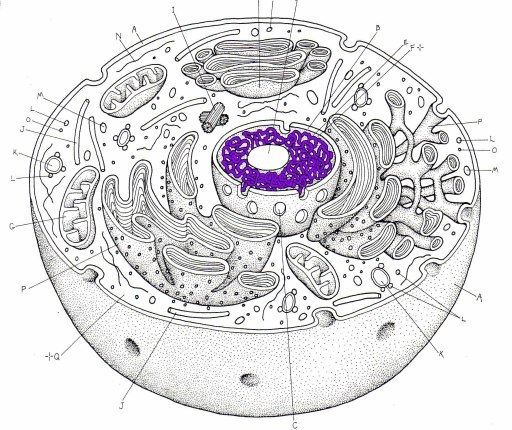
What kind of cell is this?
a)
Eukaryotic
b)
Prokaryotic
2.
What is multicellular? 
a)
one cell 
b)
no cells 
c)
many cells 
d)
no nucleus 
3.
What type of cell has a nucleus? 
a)
eukaryotic
b)
prokaryotic 
4.
What type of cell does not have a nucleus?
a)
eukaryotic 
b)
prokaryotic 
5.
Plants and animal cells are examples of ___ cells 
a)
prokaryotic cells 
b)
eukaryotic cells 
6.

What are the three domains?

a)

Bacteria

b)

Archaea

c)

Eukarya

d)

Prokarya

7.

What type of organism makes its own food?

a)

Autotroph

b)

Heterotroph

8.

What are humans?

a)

Autotrophs

b)

Heterotrophs

9.

What is asparagus?

a)

autotroph

b)

heterotroph

10.

Attractions between separate water molecules are called..

a)

Covalent bonds

b)

Ionic bonds

c)

Polar bonds

d)

Hydrogen bonds

11.

What type of particle is soluble in water but does not conduct electricity when dissolved in water ?

a)

Non-polar Covalent

b)

Polar Covalent

c)

Ionic

d)

Metallic

12.

What type of particle is often a soft or fluffy solid or a liquid with low viscosity and low surface tension ?

a)

Non-polar Covalent

b)

Polar Covalent

c)

Ionic

d)

Metallic

13.

What type of particle is soluble in water and also conducts electricity when dissolved in water ?

a)

Non-polar Covalent

b)

Polar Covalent

c)

Ionic

d)

Metallic

14.
What does DNA stand for?
a)
Deoxyribonucleic acid
b)
Denitrogenous acid
c)
Deribonucleic acid
d)
Diribonucleic acid
15.

Which is in order from largest to smallest structure?

a)

chromosome, DNA strand, gene, nucleotide

b)

chromosome, gene, DNA strand, nucleotide

c)

gene, DNA strand, chromosome, nucleotide

d)

DNA strand, chromosome, gene, nucleotide

16.
In a molecule of double-stranded DNA, the amount of adenine present is always equal to the amount of _________.
a)
cytosine
b)
guanine
c)
thymine
d)
uracil
17.

What is the correct order to make a protein?

a)

Protein, DNA, RNA

b)

RNA, DNA, Protein

c)

DNA, RNA, Protein

d)

Protein, RNA, DNA

18.
____ is the activation of a gene that results in transcription.
a)
Gene expression
b)
Gene technology
c)
Eukaryotic expression
d)
Prokaryotic expression
19.
What is a genome?
a)
The complete haploid amount of genetic material present in a cell or organism
b)
A garden ornament 
c)
The sum of all human material.
d)
A totally unique set of genetic material not shared with anything else
20.
The study of the genome is known as
a)
Biology
b)
Genomics
c)
Genes
d)
Heredity
21.

Proteomics is the study of

a)

whole sets of genes in one or more species

b)

Proteomics is the study of whole sets of proteins and their properties

22.

What did Darwin conclude?

a)

humans are dumb

b)

Individuals with traits that are best suited to their environment are more likely to survive and reproduce

c)

Species generally suit their environment

23.

What does deductive reasoning use to form its arguments?

a)

patterns

b)

specific cases

c)

observed examples

d)

facts, definitions, accepted properties, and laws of logic

24.
Using the statements:
If it is Friday, then I will get paid.
It is Friday.
Write the conclusion.
a)
It is not Friday
b)
It is Friday
c)
I will not get paid
d)
I will get paid
25.
The type of reasoning where a person makes  conclusions based on observations and patterns is called...
a)
Inductive reasoning
b)
Deductive reasoning
c)
Conjecture
d)
Experiments
26.
What is a conjecture?
a)
A statement believed to be true based on observations.
b)
An example which disproves an hypothesis.
c)
the performance of tricks that are seemingly magical
27.

The tree is tall

a)

quantitative data

b)

qualitative data

28.

The tree is 6 meters tall

a)

quantitative data

b)

qualitative data

29.

What is a hypothesis?

a)

the thing changed on purpose in the experiment

b)

an explanation about what you observed

c)

using your 5 senses to gather data

d)

an educated guess about the outcome of an experiment

30.

What two words should be in your hypothesis?

a)

I think

b)

If ...then...

c)

It will

d)

No idea

31.

The periodic table is organized in horizontal rows called...

a)

Groups

b)

Families

c)

Periods

d)

Chemical Symbols

32.

The vertical columns of the periodic table are called...

a)

Periods

b)

Families

c)

Chemical Symbols

d)

Groups

33.
All matter is made of tiny particles called___________________
a)
atoms
b)
bits
c)
dust
d)
molecules
34.

Matter is anything that has:

a)

mass

b)

volume

c)

mass and volume

d)

substance

35.

Mass is a measurement of:

a)

the amount of particles a substance has.

b)

the space an object occupies

36.

Subatomic particles with positive charge is

a)

Proton

b)

Neutron

c)

Electron

37.

Subatomic particle with negative charge is

a)

Proton

b)

Electron

c)

Neutron

38.
What is the atomic number?
a)
the number of protons
b)
the number of protons and neutrons
c)
the number of neutrons
d)
the number of protons and electrons
39.
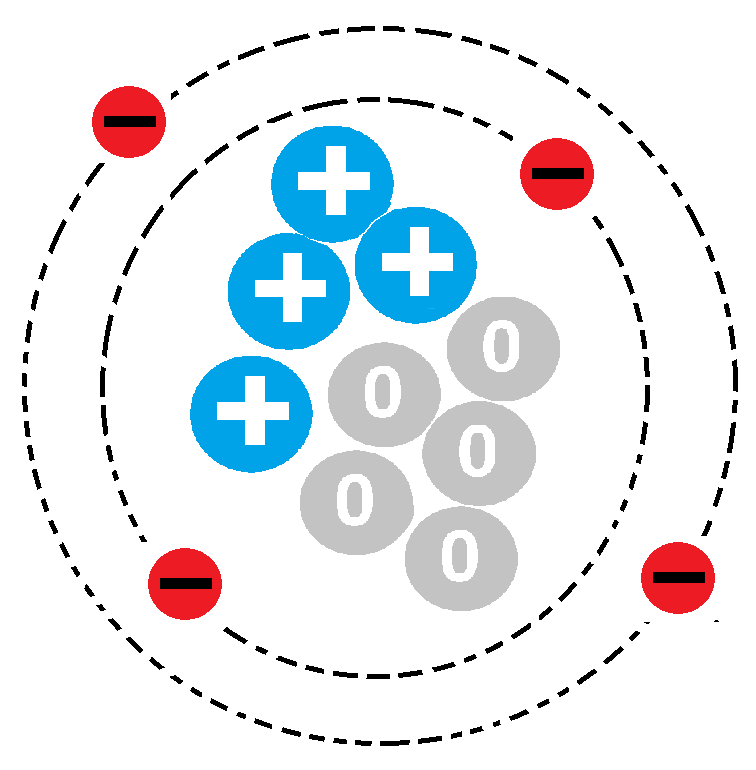
What is the atomic number of this atom?
a)
4
b)
5
c)
9
d)
none of the above
40.
What is the mass number defined as?
a)
the number of protons
b)
the number of protons and neutrons
c)
the number of neutrons
d)
the number of protons and electrons
41.

Isotopes have different numbers of

a)

protons

b)

neutrons

c)

electron

d)

properties

42.
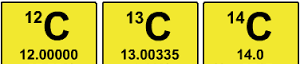
What do these isotopes of carbon all have in common?
a)
neutrons & mass number
b)
atomic number and neutrons
c)
atomic number and electrons
d)
protons, atomic number, and mass number
43.
What quantities vary between isotopes of an element?
a)
protons, electrons, and atomic mass
b)
protons, electrons, and atomic number
c)
neutrons and electrons
d)
neutrons and atomic mass
44.
Ions are: 
a)
atoms with a positive or negative charge
b)
atoms with no charge
c)
atoms with ONLY a positive charge
d)
atoms with ONLY a negative charge
45.
Which of the following correctly describes the electron cloud model?
a)
Electrons do not follow fixed orbits, but are found more frequently in areas around the nucleus.
b)
Electrons are found in fixed orbitals around a positive nucleus.
c)
All of an atom's mass is concentrated in the electron cloud around the nucleus.
d)
Electrons are evenly embedded throughout a positively charged sphere.
46.

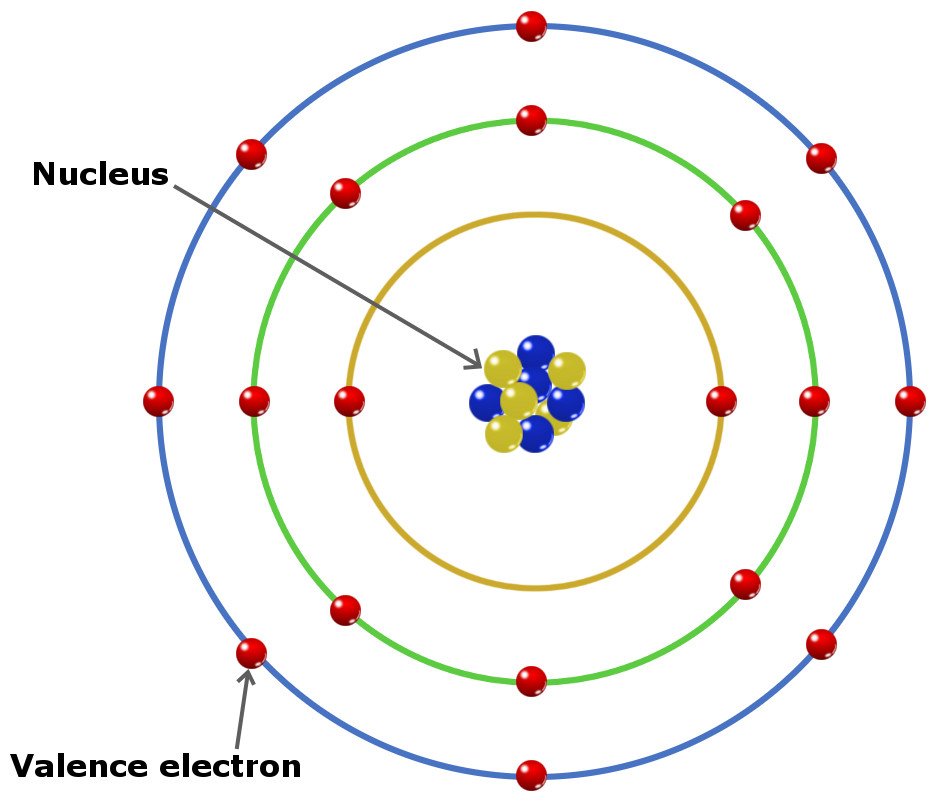
Valence electrons are located...

a)

inside the nucleus

b)

in outer space

c)

on the outermost electron shell in an atom

d)

on the electron shell closest to the nucleus.
47.
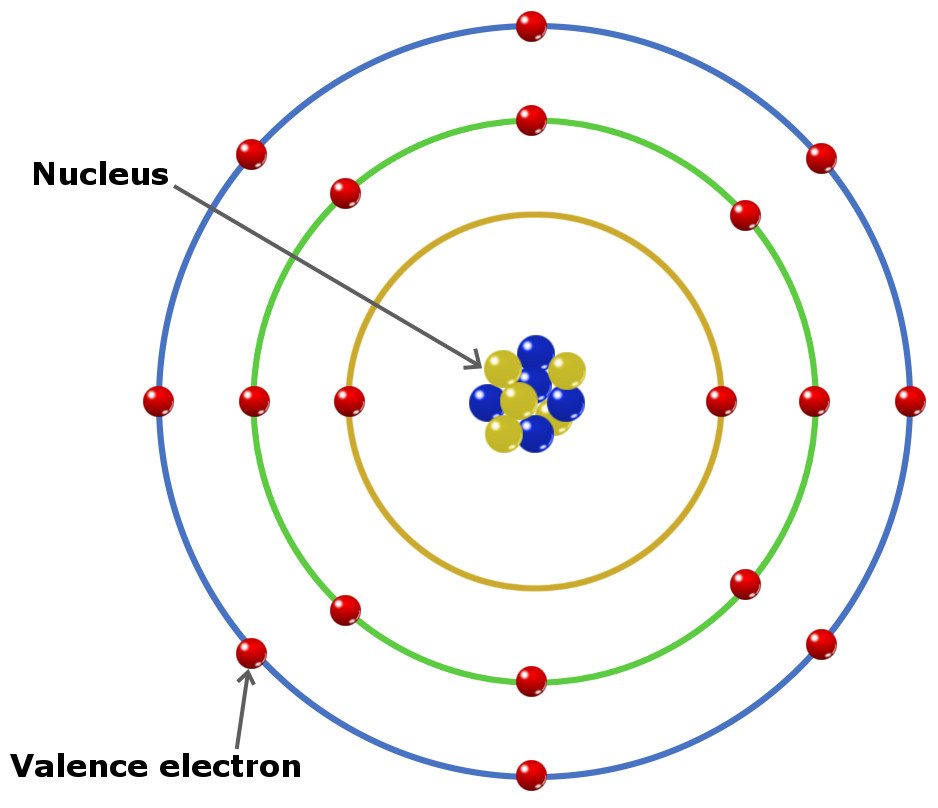
How many electrons can fit in the first energy level?
a)
8
b)
2
c)
4
d)
6
48.
The energy of an electron __________ as it moves further away from the nucleus
a)
increases
b)
decreases
49.

The outer most electrons are called...

a)

valence electrons

b)

heavy electrons

c)

emission electrons

d)

Excited electrons

50.

This subatomic particle is involved in forming chemical bonds and building compounds...

a)

protons

b)

neutrons

c)

valence electrons

d)

nucleus

51.
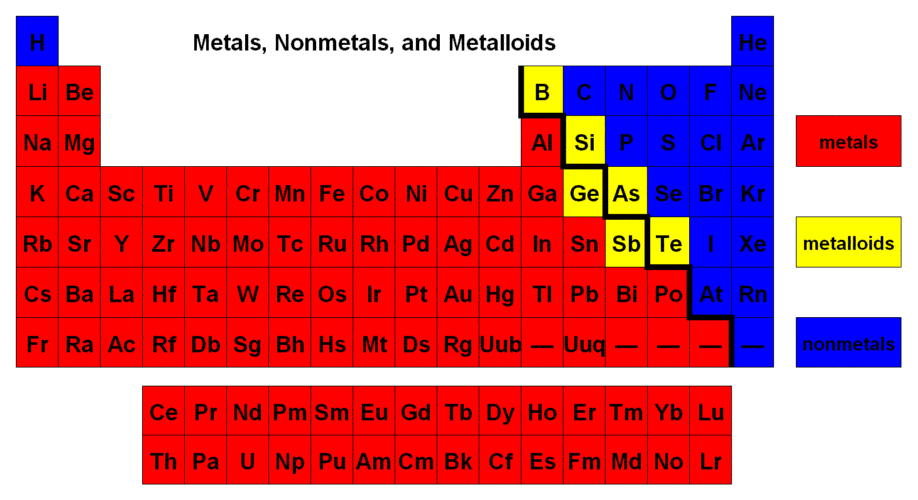
What elements generally make an ionic bond?
a)
metal and nonmetal
b)
2 or more nonmetals
c)
metal
d)
none of the above
52.
In chemical compounds, covalent bonds form when
a)
the electronegativity difference between two atoms is very large.
b)
electrons are completely transferred between two metals.
c)
pairs of electrons are shared between two nonmetal atoms.
d)
two nonmetal atoms are attracted to each other by opposite charges.
53.
When forming an ionic bond, a metal atom
a)
Gains electrons to form a cation
b)
Loses electrons to form a cation
c)
Gains electrons to form an anion
d)
Loses electrons to form an anion
54.
The polarity of a bond between two elements can be best determined by
a)
The difference in electronegativity between the elements
b)
The difference in first ionization energy between the elements
c)
The number of electrons shared in the bond
d)
The difference in atomic radius between the elements
55.
What elements generally make a covalent bond?
a)
metal and nonmetal
b)
2 or more nonmetals
c)
metal
d)
none of the above
56.

What type of bond would form between O and H?

a)

Polar Covalent

b)

Non-Polar Covalent

c)

Ionic

57.

What type of bond would form between O and O?

a)

Polar Covalent

b)

Non-Polar Covalent

c)

Ionic

58.

The bond between C and Cl is polar covalent. That means

a)

there is a pair of electrons shared equally between them

b)

there is a pair of electrons shared unequally between them

c)

an electron will be stolen from one and given to the other
59.

The bond between Hand F is ionic. That means

a)

there is a pair of electrons shared equally between them

b)

there is a pair of electrons shared unequally between them

c)

an electron will be stolen from one and given to the other

60.

The bond between C and H is non-polar covalent. That means

a)

there is a pair of electrons shared equally between them

b)

there is a pair of electrons shared unequally between them

c)

an electron will be stolen from one and given to the other

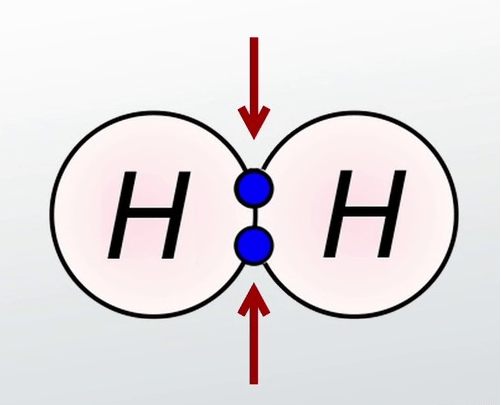
61.
What type of bond is shown in this image?
a)
Ionic
b)
Polar Covalent
c)
Nonpolar Covalent
d)
Van der Waals Force
62.

Which is the correct description about van der Waals' forces?

a)

They are the weakest of the intermolecular forces arising from instantaneous dipole - induced dipole interactions.

b)

They are the strongest of the intermolecular forces arising from dipole - dipole interactions.

63.
1.  What is the shape of an s orbital?
a)
sphere
b)
dumbbell
c)
double dumbbell
d)
TOO COMPLEX TO KNOW IT.
64.
What is the shape of a p orbital?
a)
sphere
b)
it's just too complex to thing about it
c)
dumbbell
d)
I don't know this stuff.
65.
How many electrons can each p orbital hold?
a)
6
b)
3
c)
2
d)
4