wayground logo

Free Printable Worksheets

NEW

Font size

S
M
L
XL
Worksheets

Air Test Review #3 (Evolution)

Total questions: 66

Worksheet time: 56mins

Name
Class
Date
1.
How evolution occurs; organisms that are best fit for an environment will have more babies and pass on their traits:
a)
Evolution
b)
Nucleotide 
c)
Adaptation
d)
Natural Selection
2.
Studying the difference between fossils and modern organisms helps scientists better understand the --
a)
Role of mutations in life functions
b)
Primary function of key macromolecules
c)
Adaptation of organisms through acquired traits
d)
Evolution of organisms overtime
3.
A change in DNA or alleles that can cause a change in a population's traits over time.
a)
natural selection
b)
genetic flow
c)
genetic mutation
d)
sexual reproduction
4.
Which is an activity that increases genetic variation within a population of earthworms?
a)
sexual reproduction
b)
genetic mutation
c)
genetic flow
d)
embryology
5.
What is a gene pool?
a)
Genes or DNA that have been changed.
b)
All the genes or DNA in a population.
c)
All the organisms in a population
d)
All the DNA or genes in a human
6.
Related organisms have similar _______.
a)
Genetic Material
b)
Diet
c)
Behavioral Patterns
7.
Which of the following provides molecular evidence in support of the idea of evolution?
a)
Developing pig embryo looking like a developing human embryo
b)
Human proteins having amino acids like monkey proteins
c)
Fossil skull of a 12 Million-yr-old mammal resembles horse
d)
Bones in a human arm are similar to bones in a frog's leg
8.
Organisms with a common ancestor have features of different functions but similar structures:
a)
Homologous structures
b)
Analogous structures
c)
Vestigial structures
9.
Which of the following is true of genetic bottlenecks?
a)
They reduce the fertility of the surviviors
b)
Occurs when there are major natural disasters that kill the majority of the population
c)
Result in increased genetic diversity
d)
Due to mutation rather than natural selection
10.

These are inferences made in the Principle of Natural Selection except:

a)

Individuals with less adaptive traits cannot survive.

b)

Adaptive traits may make an individual better suited to an environment.

c)

Individuals that better suited to environment are better able to survive tend to leave more offsprings

d)

Frequency of adaptive tends to become more common in a population over time.
11.
Why are advantageous traits more likely to be passed onto offspring?
a)
Because they are more likely to survive and reproduce.
b)
Because they come from dominant alleles.
c)
Because they come from recessive alleles.
d)
Because the trait is an acquired phenotype.
12.
Natural selection is when ____________ decides who survives and who doesn't
a)
nature
b)
humans
c)
animals
d)
years
13.
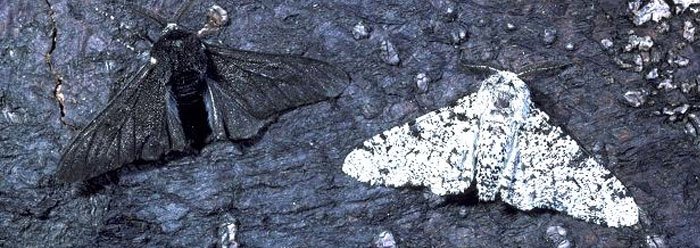
The trees these moths used to live on were white, but have been covered in soot from coal factories. Which moth will be more successful in this environment?
a)
Dark moth
b)
Light moth
c)
Both will be equally successful
d)
Neither will be successful
14.
Which best describes mutations?
a)
Always helpful
b)
Always harmful
c)
Can be helpful or harmful
d)
Always neutral
15.

Whales are aquatic mammals that contain a pelvis (hip) bone. Even though it does not aid in its movement, the function must have been used by a common ancestor of the whale. Thus, the pelvis is referred to as a(n)

a)

vestigial structure

b)

analogous structure

c)

homologous structure

16.
The difference in the physical traits of an individual from those of other individuals in a group is called a(n)
a)
change
b)
adaption
c)
species
d)
variation
17.
When a small group of a species gets separated from the original population geologically, they will often have a different ratio of traits.  This is due to the ____________ 
a)
founders effect
b)
bottleneck
c)
genetic drift
d)
adaptation
18.
When most of the population dies, leaving a very small group with a different ratio of traits than the orignal population this is called a/an ____________
a)
bottleneck
b)
genetic drift
c)
adaptation
d)
founders effect
19.
____________ is a change in the gene pool caused by chance.
a)
Genetic Drift
b)
Gene Flow
c)
Mutation
d)
Recombination
20.

Which one means "to separate"?

a)

diverge

b)

converge

c)

sepaverge

d)

reverge

21.

This picture shows:

a)

the bottleneck effect

b)

the founder effect

c)

sexual selection

d)

convergent evolution

22.

When two populations are separated by barriers such as mountains or rivers.

a)

temporal isolation

b)

behavioral isolation

c)

geographic isolation

d)

land isolation

23.
The graphs shows that the greater the population size the greater the:
a)
Death rate
b)
Genetic drift
c)
Genetic variation
d)
Natural selection
24.
Which of the following is not part of the Hardy-Weinberg Principle?
a)
Mutations
b)
Large population
c)
Random mating
d)
No natural selection
25.
When allele frequencies remain relatively constant, ____ has been reached.
a)
Genetic drift
b)
Gene flow
c)
Natural selection
d)
Genetic equilibrium
26.
Scientific tree that can show the evolutionary history of a species is a:
a)
Adaptation tree
b)
Phylogenetic tree
c)
Family tree
d)
Gene tree
27.
Which organisms are most closely related?
a)
Bushbaby & Loris
b)
Cat & Lemur
c)
Loris & Lemur
d)
Human & Squirrel monkey
28.
Which species’ DNA is most similar to the DNA of the toothed whale? 
a)
Hippopotamus 
b)
Baleen Whale
c)
Grazing Mammals
d)
Camels
29.
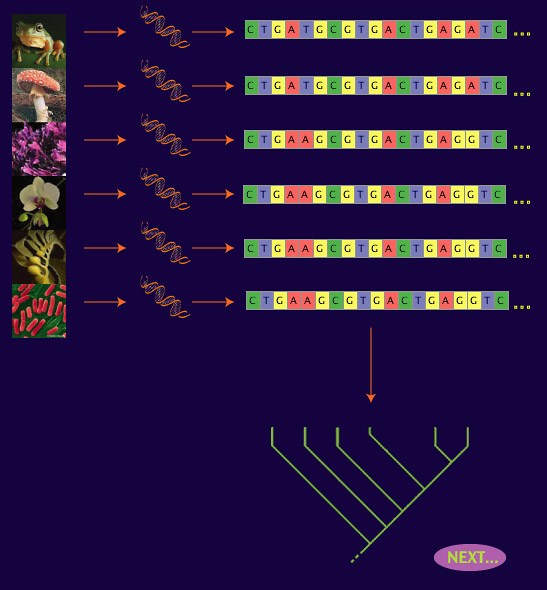
Two organisms that are closely related would have
a)
very similar DNA sequence
b)
exactly the same DNA sequences
c)
no proteins in common
d)
completely different DNA sequence
30.
The separation of a group of individuals from the rest of the population is referred to as 
a)
genetic drift
b)
natural selection
c)
geographic isolation
d)
survival of the fittest
31.
Which of the following statements best explains why some mosquitoes survived after the first spraying?
a)
Some mosquitoes had a genetic mutation that made them resistant to the insecticide
b)
A.  All mosquitoes had a genetic mutation that made them resistant to the insecticide
c)
A.  None of the mosquitoes had a genetic mutation that made them resistant to the pesticide
32.

Which of the following is not a source of variation in a population?

a)

Mutations

b)

Asexual Reproduction

c)

Independent Assortment

d)

Random Fertilization

33.

Pesticide resistance supports evolution because....

a)

It is natural selection we can see happening

b)

Certain bugs choose to survive to pass on their genes

c)

Bugs create their own adaptations to gain resistance

d)

Bugs don't like farmers

34.
Do organisms "decide" to evolve and change?
a)
Yes, they know they need to change to survive 
b)
No, they change because of natural selection
35.
Which of the following variations would help members of a rabbit population survive if the climate turned very hot?
a)
Thinner fur
b)
Ability to run faster
c)
Ability to jump higher
d)
Ability to eat more
36.
Which best describes an adaptation?
a)
A trait that helps an organism to survive in its environment.
b)
A trait that the organism can change when he wants.
c)
A trait that does not help the organism to survive in its environment.
d)
The place where an organism lives.
37.
Animals are able to pick and choose their adaptations.
a)
True
b)
False
38.
Comparing human hemoglobin of chimpanzees, horses, kangaroos, and chickens, reveal that humans have the fewest amino acid differences with 
a)
Kangaroos
b)
Horses
c)
chickens
d)
chimpanzees
39.
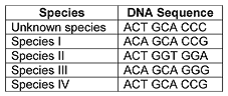
According to this data, the unknown bacterial species is most closely related to: 
a)
Species I
b)
Species II
c)
Species III
d)
Species IV
40.
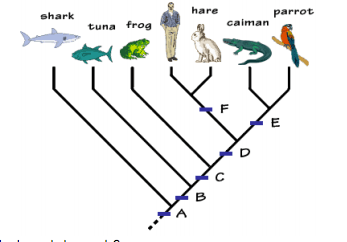
On the cladogram, which organism is the closest relative of the human?
a)
Frog
b)
Hare
c)
Caiman
d)
Parrot
41.
Which two species are most related?
a)
B&C
b)
A&B
c)
A&C
d)
C&B
42.
Which trait do only humans have, according to the cladogram?
a)
jaws
b)
mammary glands & hair
c)
terrestrial during all life stages
d)
bipedal & opposable thumbs
43.
Genetic variation can arise from a random change in the DNA of a gene.  The change is called a(n)
a)
mutation
b)
gene flow
c)
gene pool
d)
allele
44.
Natural selection results in change over time by acting on traits that are
a)
heritable
b)
new
c)
mutated 
d)
better than the best
45.

Brown mice survive and reproduce in their desert environment better than white mice because owls can see and eat the white mice more easily. In this situation, what part of the environment is doing the selecting?

a)

predator

b)

soil composition

c)

mouse fur color

d)

sexual preferences

46.
Which of the following is NOT an example of natural selection? 
a)
People selectively breeding hamsters.
b)
Insect populations developing resistance to certain pesticides.
c)
Bacteria becoming resistant to antibiotics.
d)
Male birds of certain species developing colorful feathers to attract female mates.
47.
Genetic drift is change in the allele frequency of a population due to...
a)
random chance
b)
natural selection
c)
non-random mating (sexual selection)
d)
artificial selection
48.

How does a species change over time?

a)

by adapting to the environment

b)

changes in the gene frequencies in a population

c)

acquiring new traits

d)

they do not change

49.
a measure of how commonly a particular allele occurs in a population is known as the 
a)
gene pool
b)
allele frequency
c)
mutation rate
d)
phenotype
50.

The more genetic variation a population has,

the more likely it is for some individuals to

a)

evolve

b)

migrate

c)

survive

d)

mutate

51.
protein sequences in one organism that resemble those of another suggest a 
a)
coincidence
b)
lack of evolutionary relationship
c)
great number of mutations
d)
shared ancestry
52.

The five-factors for evolution are gene flow, genetic drift, mutation, natural selection and ....

a)

non-random mating

b)

controlled mating

c)

emigration

d)

immigration

53.

Which of the following is a correct example of natural selection?

a)

The DNA of a frog changes due to radiation, chemicals, or some other mutagen.f

b)

A population of frogs experience a change in allele frequencies as more frogs immigrate into the population.

c)

Poisonous frogs with warning coloration are less likely to get eaten by predators. Individual frogs, therefore, develop warning coloration and poison during their lifetimes. Theses acquired characteristics are passed on to their offspring.

d)

Certain members of a frog population are better camouflaged, so they survive and reproduce more, passing on their color genes

54.

A virus killed most of the seals in the North Sea (e.g. dropped the population from 8000 to 800). In an effort to help preserve the species, scientists caught 20 of the remaining seals and used them to start a new population in the northwest Pacific Ocean. Which of the following statements would accurately describe the new population?

a)

The new seal population is genetically less diverse than the original population

b)

The new seal population is genetically more diverse than the original population

c)

There is equal genetic variety compared to the original population

d)

The "new" seals will turn into monsters and control the ocean.

55.

Light-colored oysters would blend into the rocks in the shallows, and the darkest would blend better into the shadows. The ones in the intermediate range make them easier prey.

a)

directional selection

b)

stabilizing selection

c)

disruptive selection

d)

artificial selection

56.
What type of natural selection is this: Small turtles are too weak to protect themselves from predators and large turtles are too slow to hide from predators. Average-sized turtles have high fitness.
a)
Disruptive Selection
b)
Directional Selection
c)
Stabilizing Selection
d)
Cake Selection
57.
What type of natural selection is this: When a group of deer migrated to a cold mountain, the thin-furred deer and average-furred deer died. The thick-furred deer survived and eventually the population became thicker-furred.
a)
Disruptive Selection
b)
Directional Selection
c)
Stabilizing Selection
d)
Slippery Selection
58.
If two species are closely related their DNA is: 
a)
Very similar
b)
Not similar
59.

A large population is less likely to undergo speciation compared to a small and isolated population because a population _____

a)

is more susceptible to gene flow

b)

is more affected by a genetic drift

c)

is more subject to errors during meiosis

d)

contains a greater amount of genetic diversity

60.
Based on the phylogenic tree, which of these shows a correct ancestral lineage?
a)
E is an ancestor to F and G
b)
C is an ancestor to D and E
c)
B is an ancestor to A
d)
E is an ancestor to H and I
61.
A common ancestor for both A and E could be at position __.
a)
1
b)
2
c)
3
d)
4
62.

What number is the common ancestor of C and D

a)

1

b)

2

c)

3

d)

4

63.

What is the common ancestor of Letters A, B, C, D, E?

a)

1

b)

2

c)

3

d)

4

64.

Which species is the least closely related to humans based on the comparisons of amino acids in cytochrome c?

a)

rhesus monkey

b)

chimpanzee

c)

yeast

d)

fruit fly

65.

Which species is most closely related to humans based on the comparisons of amino acids in cytochrome c?

a)

rhesus monkey

b)

chimpanzee

c)

cow

d)

fruit fly

66.

How many differences exist in the sequence of amino acids that codes for hemoglobin proteins in horses and zebras?

a)

1

b)

2

c)

3

d)

4