
 Worksheets
IGCSE CHEMISTRY: EXTRACTION OF METALS
Total questions: 100
Worksheet time: 59mins
What is an ore?
a solid metal
a rock containing a metal combined with other elements, often oxygen
an element
an object used to row a boat
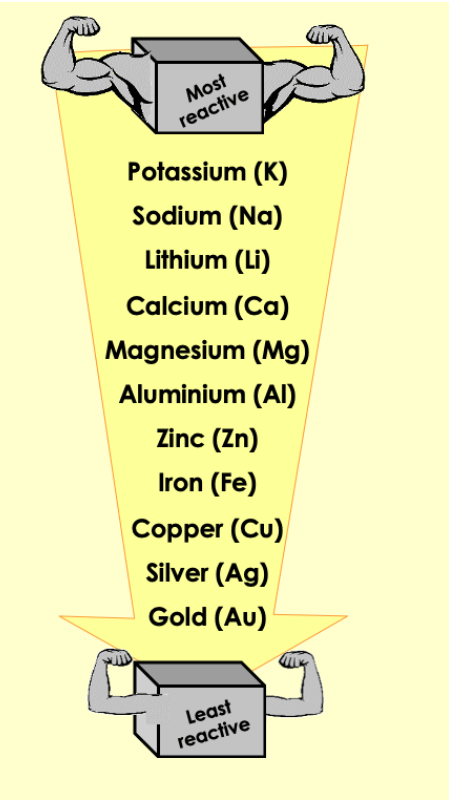
Which of these elements are unlikely to be found uncombined in the earth's crust?
gold
potassium
aluminium
silver
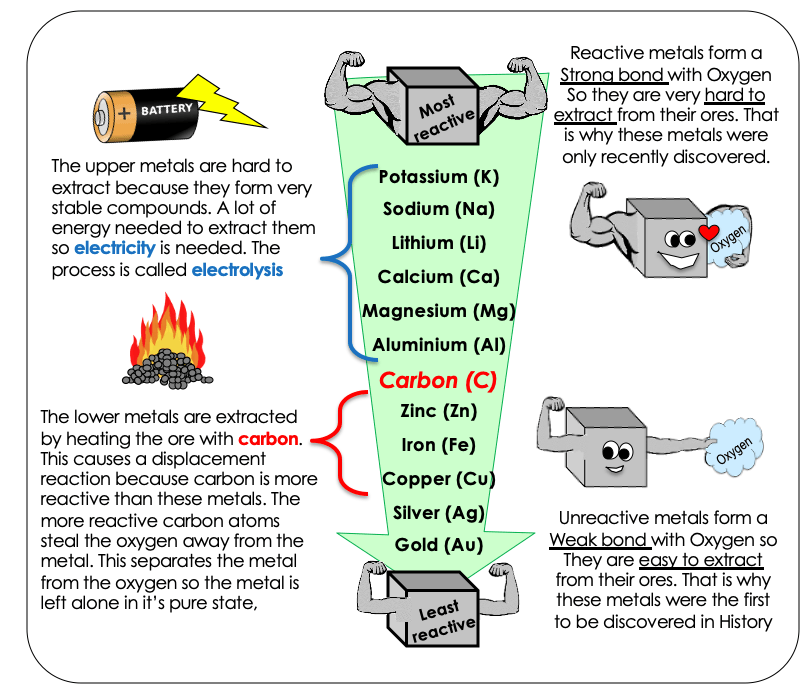
Which element cannot be extracted from its ore by reduction with carbon?
iron
aluminium
copper
zinc

What is the name of the process that uses electricity to separate the elements in a compound?
reduction
electrolysis
extraction
mining
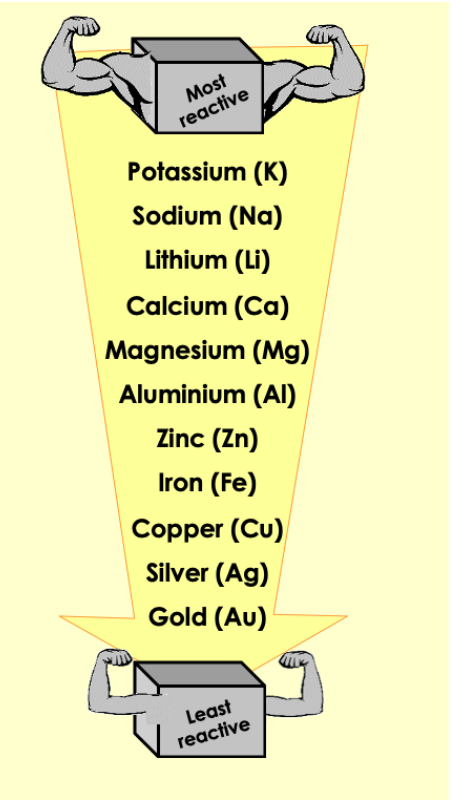
How would you best extract iron from haematite (iron ore)?
reduction by carbon
electrolysis
decomposition
oxidation
Many metals are extracted from their ores by heating them with carbon in huge furnaces. Which metal(s) cannot be extracted using this method?
Aluminum
Calcium
Zinc
Copper
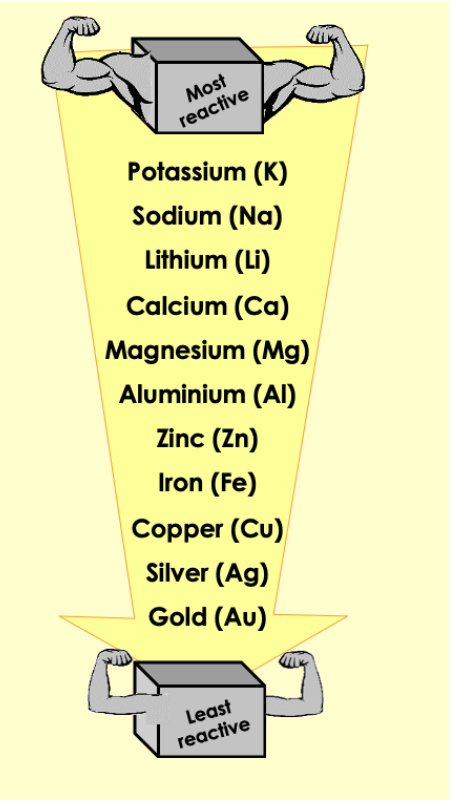
A method of extracting the most reactive metals, like potassium or aluminium.
carbon extraction
fractional distillation
electrolysis
cracking
How would you extract Silver?
Heating with coke
Electrolysis
The blast furnace
Silver is found uncombined
Metal compounds called ores can only be separated by
physical methods
chemical methods

The four materials needed to extract Iron ore are...
Haematite
Limstones
Carbon
Air
Calcium Hydroxide

The name of the huge oven where iron is extracted is known as ___.
A blast furnace
A Hydron Collider
A Satellite
An oil refinery
The following gases are useful when extracting Iron from its ore.
Carbon Monoxide
Carbon Dioxide
Methane
Haematite.
Iron oxide is _____ in the following reaction:
Fe2O3 (s) + 3CO (g) ---> 2Fe (l) + 3CO2 (g)
Oxidised
Reduced
Oxidised and Reduced
None of the above

Why is the Iron from the reaction not suitable for immediate industrial use?
It breaks easily / Not strong
It is toxic.
It is expensive
it is unattractive

Steel is a mixture of these two substances.
Iron
Carbon
Gold
Silver

Silver and Gold are found naturally and are easily separated from impurities because _____.
They are expensive.
They are very unreactive.
They are too reactive.
None of the above.
Which substance is not involved in extraction of iron from hematite?
carbon
carbon monoxide
calcium carbonate
nitrogen
In the extraction of aluminium, what compound of aluminium is used for the electrolyte?
aluminium oxide
aluminium sulfate
aluminium nitrate
aluminium sulfide
In aluminium extraction, the melting point of the electrolyte is lowered by adding (a)

Copper is a transition element used to make saucepans.
Which property is not correct for copper?
good conductor of heat
insoluble in water
low melting point
malleable
Which statements is not correct?
aluminium - used in food container because of its resistance to corrosion
aluminium - used in manufacture of aircraft because of its strength and low density
mild steel - used in car bodies because of its strength and low density
stainless steel - used in chemical plant because of its strength and resistance to corrosion
What are the advantages of recycling metals? Select all correct options.
Conserves metals as they are finite resources.
Reduces waste and problems in its disposal.
Takes time to collect and sort waste metals.
Reduces pollution due to extraction activities.
Which of these metals can be extracted from ores using carbon:
Iron
Tin
Potassium
Copper
Calcium

Which method of metal extraction is used to extract metals that are more reactive than carbon?
carbon reduction
electrolysis
Which method of metal extraction is used to extract metals that are less reactive than carbon?
carbon reduction
electrolysis
Which method of metal extraction is used to extract aluminium?
carbon reduction
electrolysis
Why is Iron extracted by carbon reduction?
Lead is less reactive than carbon.
Lead is more reactive than carbon

When a metal is extracted from its oxide using carbon, the products of the reaction are a metal and carbon dioxide gas. Which is the general word equation for extracting a metal from its oxide using carbon?
equation A
equation B
equation C

What is the correct word equation for extracting copper from copper oxide?
equation A
equation B
equation C

Hot air is blasted into the bottom of a blast furnace. Oxygen in the air reacts with carbon, forming carbon monoxide.
Select the equation for the reaction between carbon and oxygen.
equation A
equation B
equation C

Carbon monoxide then reacts with iron oxide to form iron and carbon dioxide. Select the equation for the reaction between carbon monoxide and iron oxide.
equation A
equation B
equation C

Which equation is a balanced symbol equation representing the reaction shown?
equation A
equation B
equation C
What volume of carbon dioxide is produced if 160g of iron (III) oxide react?
2Fe2O3 + 3C → 4Fe + 3CO2
[Fe = 56, O = 16, C = 12]
36cm3
72dm3
72cm3
36dm3
What is the raw iron-containing mineral called, which is used in a blast furnace?
Halite
Bauxite
Hematite
Quartz
A piece of zinc is placed in 2mol/dm3 hydrochloric acid. Identify the correct half-equation for the reaction.
Zn + 2H+ → Zn2+ + H2
Zn + 2HCl → ZnCl2 + H2
Zn + HCl → ZnCl + H2
Zn → Zn2+ + 2e-
According to the following equation:
2Fe2O3 + 3C → 4Fe + 3CO2
How much iron is produced if 0.16g of iron (III) oxide are reacted?
[Fe = 56, O = 16, C = 12]
0.224g
0.112g
0.056g
0.16g
Which of the following elements do not need to be extracted, and can be found as a native metal on Earth?
Platinum
Magnesium
Iron
Aluminium
Hematite is the ore used in the blast furnace. Which other raw materials are required for the extraction of iron?
Fe2O3 + 3CO → 2Fe + 3CO2
Coke
Calcium carbonate
Nitrogen from air
Oxygen from air
What is the change in the charge of the iron in the following reaction?
2Fe2O3 + 3C → 4Fe + 3CO2
0 to 3+
6+ to 0
3+ to 0
2+ to 0
According to the following equation, what is the maximum mass of iron that can be obtained from 9.0g iron(III) oxide?
2Fe2O3 + 3C → 4Fe + 3CO2
[Fe = 56, O = 16, C = 12]
9.0g
720g
6.3g
3.2g
Which reaction does not occur in the blast furnace?
C + O2 → CO2
C + CO2 → 2CO
4Fe + 3O2 → 2Fe2O3
Fe2O3 + 3CO → 2Fe + 3CO2
To which electrode do aluminium ions move during the electrolysis?
anode
cathode
Which statements about the manufacture of aluminium by electrolysis is correct? Select all the correct options.
Aluminium is extracted from its ore haematite.
Aluminium ions gain electrons to form aluminium.
The carbon anodes need to be replaced.
Carbon dioxide is formed in the process.
Limestone is added to remove impurities.
Iron from the blast furnace is impure. To remove these impurities, .....
add additives to molten iron.
filter the molten iron.
blow oxygen into molten iron.
add coke to molten iron.
The malleability of iron ....... as the percentage of carbon in the iron increases.
increases
decreases
Which is NOT a use of zinc?
Galvanizing
Sacrificial protection
Making brass
Making bronze
Which is NOT a use of aluminium?
as food containers
in aircraft bodies
as electricity cables
as insulators
A mixture of concentrated _____________, ____________ and ____________ is added into a blast furnace through the top of a blast furnace.
oxygen
iron oxide
coke
limestone
Coke or carbon reacts with oxygen in the hot air to produce carbon dioxide and heat.
Carbon + oxygen -> carbon dioxide
Then, the carbon dioxide reacts with the rest of the hot coke to produce _________________.
carbon monoxide and iron
carbon dioxide and hydrogen
carbon monoxide
carbon dioxide and heat

At the end of extraction of iron from its ore process, slag or calcium silicate that is produced will melt, flows into the bottom part of furnace and then floats on top of molten iron.
After sometime, molten slag is tapped off and is used for _________________________________________.
walls of a blast furnace
cast iron
base of buildings and roads
base of a blast furnace
Calcium carbonate is a natural compound that consists of a combination of several elements. Which elements combine in calcium carbonate?
Calcium
Carbon
Oxygen
Hydrogen
Iron is extracted from hematite in a blast furnace. Which reaction increases the temperature in the blast furnace to over 1500°C?
calcium carbonate → calcium oxide + carbon dioxide
calcium oxide + silicon dioxide → calcium silicate
carbon + oxygen → carbon dioxide
carbon dioxide + carbon → carbon monoxide
lead oxide + carbon --> lead + carbon monoxide. Which statement about the reaction is right
Carbon is an oxidizing agent
Carbon reduced lead oxide to lead
all statements are right

Aluminium oxide + Carbon --->
no chemical reaction
aluminium + carbon dioxide
Zinc oxide + Carbon --->
no chemical reaction
Zinc + carbon dioxide
Zinc + water
What is the boiling point of Zinc?
907 °C
1500 °C
Does not have one
100 °C
How can obtain Zinc Oxide from Zinc blende?
Naturally occurs
Roasting
Electrolysis
Dipping in water
Why does brass need zinc?
To decrease Strength
For appearance
Brass does not include Zinc
To increase Strength
Why is Zinc used to galvanize instead of copper?
We don't use Zinc, instead we use copper
We don't use both
Zinc Oxidizes faster
Copper oxidizes faster
What are the waste gas that escapes in Zinc Extraction?
Carbon and Carbon dioxide
Carbon monoxide and Oxygen
Carbon and Oxygen
Carbon monoxide and Carbon dioxide
What state is Zinc in the Final Mixture?
Solid
Liquid
Gas
We remove the impurities of Zinc by Filtration
True
False
Zinc Ore is called Zinc Blende
True
False
Why do we galvanize metal?
To make the surface of the metal smooth
To prevent rusting
To melt the metal
To corrode the metal
Zinc Blende is also known as...
Zinc Sulfide, ZnS
Zinc Sulfate, ZnSO₄
What acid is sulfur dioxide used to make?
Ethanoic acid
Hydrochloric acid
Citric acid
Sulfuric acid
The balanced equation for the reaction of zinc oxide and coke is
Zn + CO —> Zn + C
2Zno + C —> Zn + CO
zinc oxide + carbon —> Zinc + Carbon monoxide
Zn + C —> Zn + CO

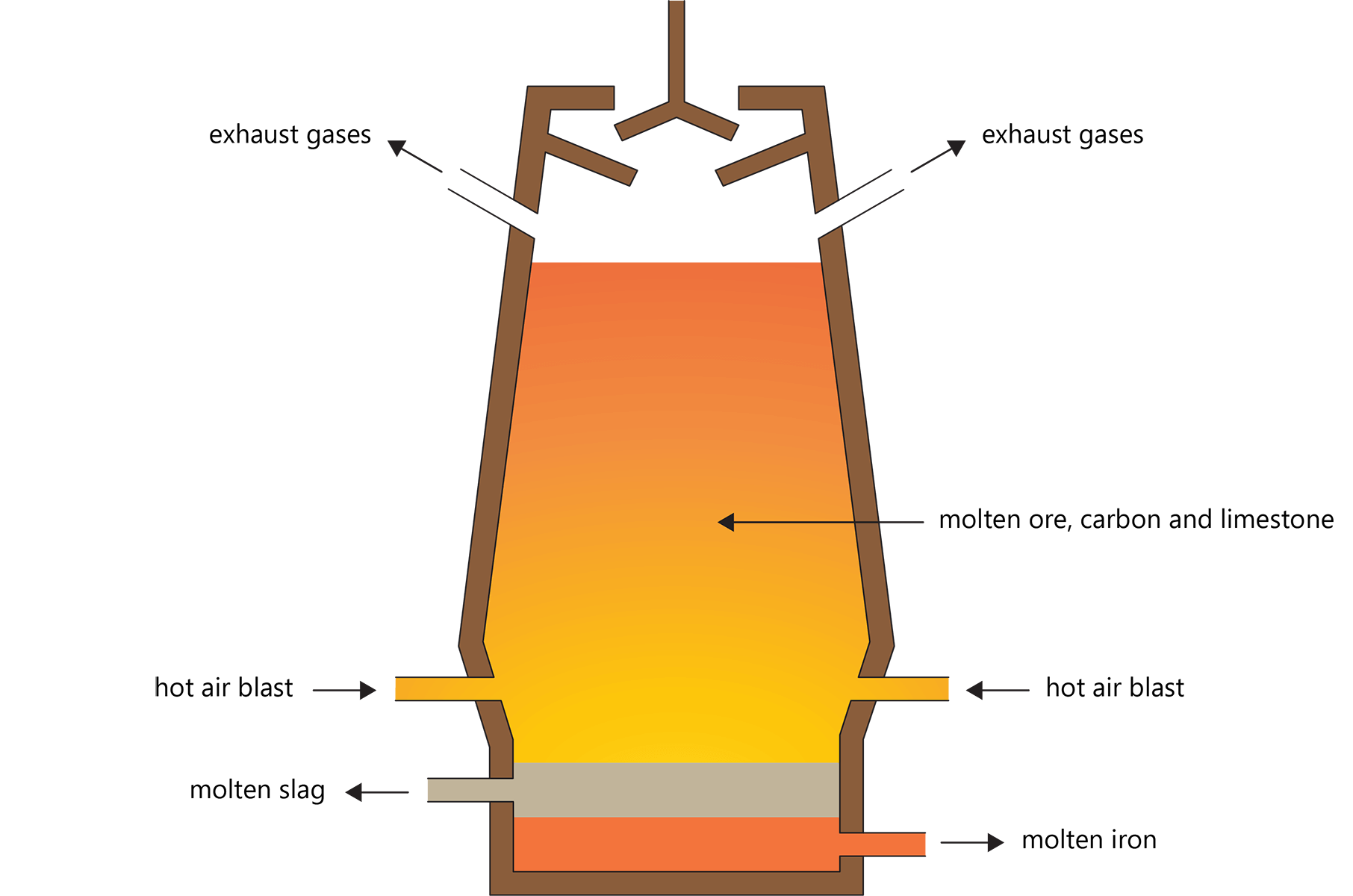
The diagram shows the blast furnace used in the extraction of Iron. The furnace is loaded with the 'Charge' which consists of
Calcium Oxide, Coke and Iron Ore
Calcium Carbonate, Coke and Iron Chloride
Calcium Carbonate, Coke and Iron Ore
Calcium Oxide, Coke and Iron Ore
What is the name of the Iron ore?
Iron Chloride
Bauxite
Hematite
Iron Pyrite
One of the major impurities in the iron ore is....
Silica, SiO2
Sulfur, S
Calcium Silicate, CaSiO3
Carbon
The iron produced from the extraction process flows to the bottom of the furnace and is then tapped off because....
The temperature of the furnace is lower than the melting point of iron
The temperature of the furnace is higher than the melting point of iron
The impurities in the iron ore will be reacted with Calcium Oxide to produce...
Sulfur dioxide
Calcium Silicate
Calcium Carbonate
Silica
Calcium Carbonate (Limestone) is converted to Calcium oxide through which reaction
Nautralisation
Displacement
Thermal Decomposition
Exothermic
Iron ore(Iron(III) Oxide) is reduced by carbon monoxide through the following reaction..
Fe3O2 + CO ---> 2Fe + 3CO2
Fe2O3 + 3CO ---> 2Fe + 3CO2
Fe3O2 + C ---> 2Fe + 3CO2
Fe2O3 + CO ---> 2Fe + 3CO2
The following gases are useful when extracting Iron from its ore.
Carbon Dioxide
Oxygen
Carbon Monoxide
Sulfur Dioxide
What is the name of the ore that contains aluminum
Bauxite
Cryolite
Aluminum oxide
Heamatite
Which is not a reason that cryolite is used in aluminum extraction?
Cryolite dissolves aluminum oxide
Cryolite reduces the melting point of aluminum oxide
Cryolite decreases the cost of aluminum extraction
Cryolite removes impurities from aluminum oxide
The positive electrode is called the
anode
cathode
The negative electrode is called the
anode
cathode
Aluminum ions are attracted to the
anode
cathode
Oxide ions are attracted to the
cathode
anode
In aluminum extraction the electrodes are made of
carbon (graphite)
aluminum and oxygen
platinum
steel
The anode has to be replaced frequently because
The oxygen reacts with the carbon anode to form carbon dioxide
Aluminum reacts with the carbon to form aluminum carbide
The anode gets impurities that impact the extraction
The anode is too hot and it will reduce their electrical conductivity
What do you add to aluminium ore to reduce its melting temperature?
Dendrite
Malachite
Bauxite
Cryolite
Which is the wrong observation in extracting aluminum using electrolysis?
size of the anode getting smaller
size of the cathode getting bigger
fizzing at the anode
silver liquid formed at the cathode
To extract aluminum, the electrolyte must be molten aluminum oxide. Why water must not be present in the electrolyte?
hydrogen gas will be produced instead of aluminum.
water will be reacted with aluminum oxide.
the yield of aluminum will be lesser.
it will cause an explosion.
The electrodes in electrolysis of aluminium are made of
Steel
Anodes
Graphite
Plastic

