
Font size
 Worksheets
Motion in 1 Dimension
Total questions: 40
Worksheet time: 37mins
If two speedboats pass each other going opposite directions and each are moving 10Km/hour, they have the same-
distance
velocity
length
speed
Slope of displacement -time graph gives
velocity
speed
acceleration
displacement
The unit of linear acceleration is
sm
s2 m
s2 rad
Which one of the choices gives you displacement?
area under a velocity-time graph
slope of a velocity-time graph
slope of a position-time graph
area under a position-time graph
Slope of velocity -time graph gives
velocity
speed
acceleration
displacement
An increase or decrease in speed or change in direction is known as-
acceleration
time
speed
velocity
If two lines are on a motion graph, the line with the steeper_______________ indicates a greater speed.
run
slope
rise
distance
A horizontal line on a position versus time graph represents an object that is-
gaining speed
slowing down
not moving at all
maintaining a constant speed
Velocity is determined by
distance the object has traveled
average speed of the object
knowing the speed and direction of the object's motion
instantaneous speed of the object
A horizontal line on a velocity versus time graph represents an object that is-
gaining speed
slowing down
not moving at all
maintaining a constant speed
a=Δt(vf−vi)
A dog runs with an initial speed of 7.5 m/s on a waxed floor. It slides to a stop in 15 seconds. What is the acceleration?
-7.5 m/s
-7.5 m/s2
-0.5 m/s2
7.5 mi//hr
Acceleration is defined as the change in
time it takes for one place to move to another place.
velocity of an object.
distance divided by the change in time
velocity divided by the change in time
In which of the following cases does the car have zero acceleration?
A car shortly after a stoplight turns green.
A car approaching a red light
A car with the cruise control set at 80 km/h
A car turning a curve at a constant speed

Which graph shows the object at rest?
A
B
C
D

Which graph demonstrates the greatest positive velocity?
A
B
C
D
a=Δt(vf−vi)
A car accelerates from a standstill to 70 m/s in 10 seconds. What is the acceleration?
0.7m/s2
7m/s2
14m/s2
none of the above

a=Δt(vf−vi)
Mark slams on the brakes after traveling 25 m/s. It takes him 3.0 seconds to come to a complete stop. What is his acceleration?
8.3 m/s/s
-8.3 m/s/s
75 m/s/s
-75 m/s/s
t=a(vf−vi)
How much time did it take Matthew to slow down to a complete stop, after traveling at 30 m/s. His acceleration is -12 m/s/s
2.5 s
360 s
0.4 s
-2.5 s
t=g(vf−v1)
Falling objects drop with an average acceleration of 9.8 m/s/s. If an object falls from a tall building, how long will it take before it reaches a speed of 49 m/s?
5.0 s
480 s
0.2 s
58 s
While traveling along a highway a driver slows from 24 m/s to 15 m/s in 12 seconds. What is the car's acceleration? (a) m/s/s
a=Δt(vf−vi)
A parachute on a racing dragster opens and changes the velocity of the car from 85 m/s to 45 m/s in a period of 4.5 s. What is the acceleration of the dragster?
(a) m/s/s
a=Δt(vf−vi)
A ball starting from rest rolls down a hill. After 10.0 seconds its velocity is 15 m/s. What is the acceleration of the ball?
(a) m/s/s
t=a(vf−vi)
A car traveling at a velocity of 30.0 m/s encounters an emergency and comes to a complete stop. How much time will it take for the car to stop if it decelerates at -4.0 m/s/s?
(a) seconds
vf=vi+at
A cart rolling down an incline for 5.0 s has an acceleration of 4.0 m/s/s. If the cart has a beginning speed of 2.0 m/s, what is the final velocity? (a) m/s
vf=vi+at
A motorcycle traveling at 25 m/s accelerates at a rate of 7.0 m/s/s for 6.0 seconds. What is the final velocity of the motorcycle? (a) m/s
t=a(vf−vi)
A cyclist accelerates from rest to a rate of 7.0 m/s/s. How long will it take the cyclist to reach a speed of 18 m/s? (a) seconds
Displacement is
position of object
final position minus initial position
distance divided by time
initial position plus final position
What is the speed of a car that traveled 32 m in 2.0 s?
64 m/s
34 m/s
16 m/s
0.0625 m/s
t=vd
Andres traveled at a speed of 4.00 m/s. How long did it take him to travel 724 m?
0.006 s
181 s
2896 s
t=vd
Sarah backstrokes at an average speed of 8.0 m/s. How long will it take her to complete a 200.-meter race?
0.04 s
1600 s
50 s
25 s
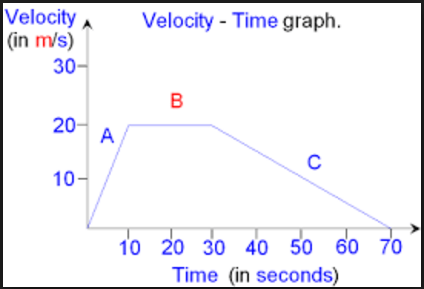
This is a velocity-time graph. What is the object doing in segment A?
Speeding up
Slowing down
Constant Velocity
Not moving

This is a velocity-time graph. What is the object doing in segment B?
Speeding up
Slowing down
Constant Velocity
Not moving
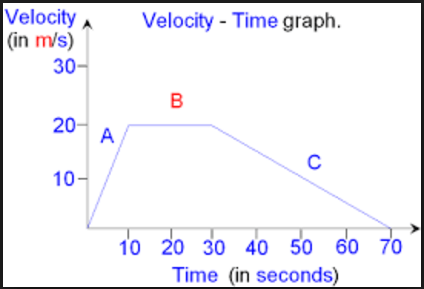
This is a velocity-time graph. What is the object doing in segment C?
Speeding up
Slowing down
Constant Velocity
Not moving

The graph shows the relationship between speed and time for two objects, A and B. Compared with the acceleration of object B, the acceleration of object A is
one-third as great
the same
three times as great
twice as great

This is a position-time graph. What is the object doing in segment B?
Moving towards the starting point
Moving towards the starting point
Constant Velocity
at rest

This is a position-time graph. What is the object doing in segment C?
Moving away from the starting point
Moving towards the starting point
Constant Velocity
at rest

This is a position-time graph. What is the object doing in segment A?
Moving away from the starting point
Moving towards the starting point
Constant Velocity
at rest

