wayground logo

Free Printable Worksheets

Font size

S
M
L
XL
Worksheets

Module 2: Motion, Acceleration and Velocity

Total questions: 88

Worksheet time: 2hrs 36mins

Name
Class
Date
1.

the amount of space between one point and another

a)

Position

b)

Displacement

c)

Distance

d)

Time

2.

distance traveled per unit of time

a)

Speed

b)

Velocity

c)

Acceleration

d)

Motion

3.

a change in the position of an object compared to another object

a)

Position

b)

Distance

c)

Speed

d)

Motion

4.

measured period during which something occurs

a)

Position

b)

Distance

c)

Time

d)

Origin

5.

a pull or push that is applied to an object

a)

Distance

b)

Speed

c)

Force

d)

Velocity

e)

Acceleration

6.

the change in position of an object

a)

Displacement

b)

Distance

c)

Motion

d)

Origin

7.

the speed and direction of moving objects

a)

Speed

b)

Motion

c)

Acceleration

d)

Velocity

8.

a change in the velocity (speed, direction, or both) of a body

a)

Displacement

b)

Acceleration

c)

Position

d)

Motion

9.

the point or place where something begins

a)

Position

b)

Distance

c)

Origin

d)

Displacement

10.

If it takes 45 s to travel 50 m, what was your average speed over the course of the trip?

a)

2,250 m/s

b)

0.9 m/s

c)

1.1 m/s

d)

95 m/s

11.
Bill runs 400 meters to Andy's house, turns around, and runs 400 meters back home.  What is Bill's displacement?
a)
0 meters
b)
400 meters
c)
800 meters
d)
1600 meters
12.
Bill runs 400 meters to Andy's house, turns around, and runs 400 meters back home.  What is Bill's distance?
a)
0 meters
b)
400 meters
c)
800 meters
d)
1600 meters
13.
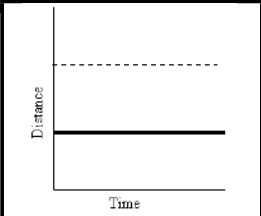
What does this graph represent?
a)
Constant speed
b)
Acceleration
c)
Not moving
14.
This graph demonstrates an object that is -
a)
Increasing speed away from the start
b)
Moving away from the start at a constant speed
c)
Decreasing speed toward the start
d)
Moving toward the start at a constant speed
15.
This graph demonstrates an object that is -
a)
Increasing speed toward the start
b)
Moving away from the start at a constant speed
c)
Decreasing speed away from the start
d)
Moving toward the start at a constant speed
16.

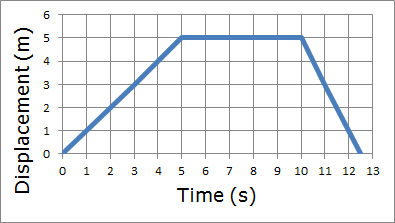
According to the graph how far does the person travel in the first 5 seconds?

a)

2 m

b)

10 m

c)

0 m

d)

5 m

17.

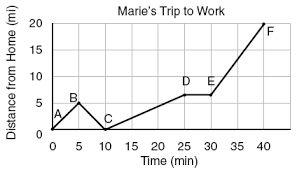
When was Marie driving the fastest?

a)

C to D

b)

D to E

c)

E to F

18.

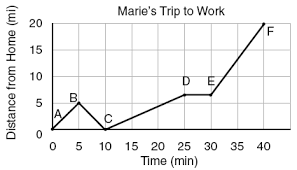
During what period of time was Marie stopped?

a)

0-5 minutes

b)

5-10 minutes

c)

10-25 minutes

d)

25-30 minutes

19.

The starting point you choose to describe the location, or position, of an object.

a)

position

b)

reference point

c)

motion

d)

displacement

20.

An object’s distance and direction from a reference point.

a)

Motion

b)

Force

c)

Contact Force

d)

Position

21.

A quantity that has both magnitude and direction.

a)

Velocity

b)

Vector

c)

Friction

d)

Acceleration

22.

Then process of changing position.

a)

Motion

b)

Displacement

c)

Force

d)

Friction

23.

The difference between the initial, or starting, position and the final position.

a)

Displacement

b)

Velocity

c)

Vector

d)

Contact Force

24.

A measure of the distance an object travels in a given amount of time.

a)

Speed

b)

Force

c)

Friction

d)

Acceleration

25.

Average Speed Equation=

a)

F=maF=ma

b)

A=lwA=lw

c)

v=dtv=\frac{d}{t}

d)

P=2l + 2wP=2l\ +\ 2w

26.

Acceleration can be... (select all that apply)

a)

speeding up

b)

slowing down

c)

staying at constant speed

d)

changing directions

27.

Select the equation for acceleration.

a)
b)
c)
d)
28.

Select the equation for speed
a)
b)
c)
d)
29.
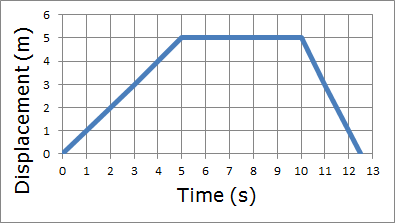
According to the graph how far does the person travel in the first 5 seconds?
a)
2 m
b)
10 m
c)
0 m
d)
5 m
30.

Use the graph above and pick the most accurate description of the object's motion

a)

object is moving at constant speed

b)

object is speeding up

c)

object is at rest

d)

object is slowing down

31.
Describe the speed of the object from 4-6 seconds using the distance vs. time graph.
a)
Increasing speed
b)
Decreasing speed
c)
Not moving
d)
Constant speed
32.

Use the picture above to choose the most accurate description of the object's motion

a)

object is at rest

b)

object is slowing down

c)

object is moving at a constant speed

d)

object is speeding up

33.

The slope of the position-time graph tells us the

a)

acceleration

b)

displacement

c)

velocity

d)

direction of travel

34.

The slope of the velocity-time graph tells us the

a)

acceleration

b)

displacement

c)

velocity

d)

direction of travel

35.
Acceleration is defined as the CHANGE in 
a)
time it takes for one place to move to another place. 
b)
velocity of an object.
c)
distance divided by the time interval 
d)
velocity divided by the time interval 
36.
Why does a car accelerate as it round a corner at a constant speed?
a)
Its direction changes
b)
It doesn't
c)
It slows down
d)
Its speeds up  
37.
Acceleration only takes place when things speed up. 
a)
True
b)
False
38.
Describe the motion of the car. (Car is stopped)
a)
The car has acceleration because it is at rest 
b)
The car does not have acceleration because it is at rest 
c)
The car has velocity because it is at rest 
d)
The car has acceleration because it is at rest 
39.
What kind of acceleration is shown here?
a)
none
b)
positive
c)
negative
d)
varies
40.
What is the velocity?
a)
not moving
b)
increasing
c)
positive
d)
negative
41.
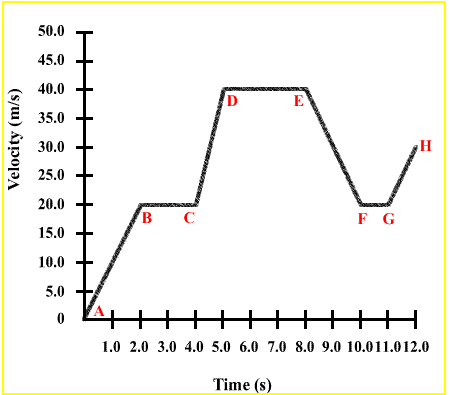
Which section of the graph shows constant velocity?
a)
AB
b)
BC
c)
EF
d)
GH
42.
Speed is a _________  quantity
a)
scalar
b)
vector
43.
Any vector quantity has ____________
a)
magnitude
b)
direction
c)
both magnitude and direction
44.

Which of the following position vs. time graphs shows an object that is moving with a constant positive velocity?

a)

A

b)

B

c)

C

d)

D

45.
Speed equals distance divided by
a)
time
b)
velocity
c)
size
d)
motion
46.
When you know both the speed and direction of an object's motion, you know the
a)
average speed of the object
b)
acceleration of the object
c)
distance the object has traveled
d)
velocity of the object
47.
The rate at which velocity changes is called
a)
speed
b)
direction
c)
acceleration
d)
motion
48.
A train that travels 100 kilometers in 4 hours is traveling at what average speed?
a)
50 km/h
b)
100 km/h
c)
2 km/h
d)
25 km/h
49.
If a bicyclist travels 30 km in 2 hours, her average speed is
a)
30 km/h
b)
60 km/h
c)
15 km/h
d)
2 km/h
50.
The correct equation to calculate speed is
a)
distance/time
b)
time/distance
c)
distance x time
d)
distance/time2
51.
A car accelerates from a standstill to 70 m/s in 10 seconds.  What is the acceleration?
a)
0.7m/s2
b)
7m/s2
c)
14m/s2
d)
none of the above
52.
A ball rolls 144 cm in 12 sec. What is its speed in meters per second?
a)
12 cm/sec
b)
12 m/s
c)
1.2 m/s
d)
0.12 m/s
53.
What is velocity?
a)
the quickness of an object
b)
the location of an object
c)
acceleration
d)
speed in a specific direction
54.
What is the equation to calculate time?
a)
time = speed/distance
b)
time = distance/speed 
c)
time = speed x distance 
d)
time = distance x speed
55.
What is the equation to calculate speed?
a)
speed = distance/time
b)
speed = time/distance
c)
speed = time x distance 
d)
speed = speed/time 
56.
What is the equation to calculate distance?
a)
distance = speed/time
b)
distance = time/speed
c)
distance = speed/distance
d)
distance = speed x time 
57.
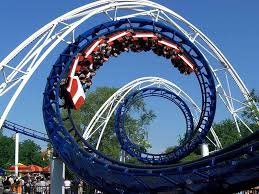
A roller coasters accelerates from an initial velocity of of 6.0 m/s to a final velocity of 70 m/s over 4 seconds.  What's the acceleration?
a)
24 m/s2
b)
18 m/s2
c)
16 m/s2
d)
16 m/s
58.

Acceleration occurs when there is a change in speed.

a)

True

b)

False

59.

What is change in velocity during a period of time?

a)

acceleration

b)

vertical

c)

acceleration formula

d)

speed

60.
The metric unit for velocity is ________.
a)
m
b)
m/s
c)
m/s2
d)
s
61.
The metric unit for acceleration is ______.
a)
m
b)
m/s
c)
m/s2
d)
s
62.
Velocity is the rate at which _______ changes with time.
a)
distance 
b)
acceleration
c)
speed
d)
average speed
63.
Acceleration is the rate at which _____ changes with time.
a)
position
b)
distance
c)
velocity
d)
none of the above
64.
Acceleration is the rate at which _____ changes with time.
a)
position
b)
distance
c)
velocity
d)
none of the above
65.
The location of an object relative to its point of origin is ______.
a)
position
b)
distance
c)
velocity
d)
acceleration
66.
Which is not an example of acceleration?
a)
a car going around a curve
b)
a car applying the brakes
c)
a car going 55 mph on a straight road
d)
a car speeding up
67.
A vehicle is making a long drive down the highway. The speedometer shows 70 mph. This is a measure of:
a)
average speed
b)
instantaneous speed
c)
time
d)
constant acceleration
68.
An object travels 300 meters in 15 seconds. This information allows you to calculate its:
a)
instant speed
b)
average speed
c)
acceleration
d)
change in speed
69.
A car is going around a curve with constant speed. Which of the following is not true?
a)
The car is accelerating
b)
The speed of the car is constant
c)
The velocity is constant
d)
The direction is constantly changing
70.
The slope of a position vs time graph is:
a)
acceleration
b)
velocity
c)
distance
d)
time
71.
An object travels 200 m in 5 s. The objects average speed is:
a)
40 m/s
b)
60 m/s
c)
1000 m/s
d)
250 m/s
72.
At 60 seconds, how far had this object traveled? 
a)
0 m
b)
10 m
c)
20 m
d)
40 m
73.
What is happening in this graph from point B to C?
a)
The object is going down a hill.
b)
The object is returning to its starting location.
c)
The object is slowing down.
d)
The object is staying still.
74.
The picture of the position vs. time graph shows an object that is...
a)
accelerating/speeding up
b)
moving at a constant speed 
c)
not moving 
d)
accelerating/slowing down. 
75.
Acceleration only takes place when things speed up. 
a)
True
b)
False
76.
A car drives 84 meters forward.  It's displacement and distance would be the same.
a)
True
b)
False
77.
Unit of speed?
a)
seconds
b)
metres
c)
seconds per metre
d)
metres per second
78.
A car Travels 30 m/s. What is 30 m/s?
a)
Distance
b)
Time
c)
Velocity
d)
Acceleration
79.
How can I recognize a velocity unit?
a)
It's a distance
b)
It's a time
c)
distance/ time
d)
distance/time/time
80.
What is speed?
a)
how far you go
b)
how much distance is covered over a period of time
c)
how fast you accelerate
d)
the change in the location of a object
81.
Velocity is both ____ and _____. 
a)
speed , direction 
b)
direction, mass
c)
volume, density 
d)
direction, magnitude 
82.
What is the speed of the red line?  
a)
4 m/s 
b)
16 m/s 
c)
32 m/s 
d)
2 m/s 
83.
The gees fly 23 mph to the south when they migrate for the winter. 
a)
speed
b)
velocity
c)
acceleration
84.
The tornado is traveling northwest at 20 mph. 
a)
speed
b)
velocity
c)
acceleration
85.
The Olympian swam 200 meters in 20 seconds. 
a)
speed
b)
velocity
c)
acceleration
86.
A runner races in the 100 meter dash.  It takes her 10 seconds to finish.  What is her average speed?
a)
10 m/s
b)
1000 m/s
c)
100 seconds
d)
10 seconds
87.
Which of the following is a unit for acceleration?
a)
km/s
b)
m/s2
c)
mi/hr
d)
ft
88.

Velocity is different from speed because...

a)

Velocity is distance/time. Speed is displacement/time.

b)

Velocity is speed in a certain direction and can be positive or negative.

c)

Speed is velocity in a certain direction. Both can only be positive.

d)

Velocity is how much speed changes over time.