
 Worksheets
By Design, Chapter 4 Lesson 1
Total questions: 65
Worksheet time: 49mins
Which of the following descriptions about the organization of an ecosystem is correct?
Communities make up species, which make up populations.
Populations make up species, which make up communities.
Species make up communities, which make up populations.
Species make up populations, which make up communities.
A group of different species that live together and interact in an environment are called a/an
individual
community
population
habitat
ecosystem
What is it called when a group of the same type of organism are living together in the same place at the same time?
biome
biosphere
organism
population
community
The non-living parts of an organism's environment are called...
community
biotic factors
habitat
abiotic factors
Choose the correct levels of Organization from lowest to highest...
population, community, ecosystem, organism
organism, population, community, ecosystem
organism, population, ecosystem, community
population, organism, community, ecosystem
A community is a level in organization that is....
made of populations of different species that live in the same place and interact.
a single individual species of organisms that are similar.
all the individual organisms of the same species in the same place.
The living or once living parts of an organism's environment are called its...
community
habitat
biotic factors
abiotic factors
An organism is an abiotic factor
True
False
An example of a population is
all trees in a forest
all maple trees in a forest
all plants in a forest
all animals in a forest

What ecological level of organization can be seen here?
Species
Population
Community
Ecosystem
Which levels of ecological organization are made up of ONLY BIOTIC factors?
Ecosystem
Community
Population
Factors used to describe a habitat would include...
Amount of rainfall
An organisms "profession or role"
Temperature range
The type of plants found there

What is one ABIOTIC factor in this ecosystem?
frog
tadpole
water
snail

What is one BIOTIC factor in this ecosystem?
Soil
Water weeds
Sun
Water


What organisms are part of the carbon cycle?
plants
animals
bacteria
all living things
Plants use carbon dioxide in the process of _____________.
decay
shedding leaves
photosynthesis
respiration
What are two ways that CO2 is released into the atmosphere?
Vacuuming and dusting.
Combustion and decomposition.
Swimming and decomposition.
None of the above.
Nitrogen is essential for building _____________________.
Fats
Mountains
High rise buildings
Proteins
Matter cycles through the biotic and abiotic components of the Earth's ecosystems.
True
False
Which of the following removes carbon from the atmosphere?
Combustion
Respiration
Photosynthesis
Carbon molecules cannot be created or destroyed
True
False
Not enough information to answer
Plants and animals cannot use nitrogen directly from the air.
True
False
What converts nitrogen gas into a usable form for plants and animals?
bacteria
rain
fungi
car exhaust
Bacteria fix nitrogen from the atmosphere into a form plants can use.
True
False

What is denitrification?
Conversation of nitrite back to nitrogen gas
Conversation of ammonia back to nitrogen gas
The process in which nitrogen circulates and is recycled is called
The nitrogen cycle
The carbon cycle
The water cycle
The phosphorus cycle
Organisms that need nitrogen to survive.
only plants
only animals
only bacteria
all living things
How is nitrogen "fixed" into a usable form for plants?
Through action of bacteria only
Through lightning only
Through action of bacteria and lightning
Through photosynthesis
Gas that makes up 78% of our atmosphere.
Oxygen
Nitrogen
Hydrogen
Carbon Dioxide
What is the process of combining nitrogen gas with other elements to make nitrogen into usable compounds?
nitrogen composition
nitrogen fixation
ammonia
denitrification
What process occurs when dead plant and animal matter decomposes and nitrogen is released back into the atmosphere?
Assimilation
Fixation
Ammonification
Denitrification
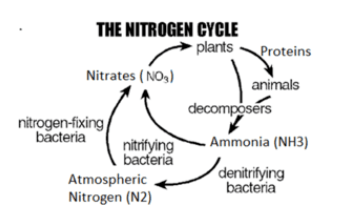
According to this diagram, plants use nitrogen to make _________________________
bacteria
animals
proteins
decomposers
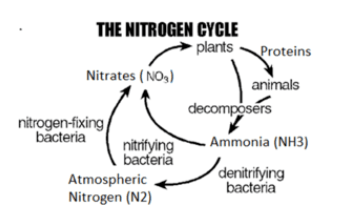
According to this diagram, plants absorb
nitrates
nitrogen fixing bacteria
animals
decomposers

How do animals and people get the nitrates they need?
By eating plants
By eating animals that eat plants.
Both
None of the above.
Trophic Levels show the
what grade each organism has achieved in the ecosystem
position that an organism occupies in a food chain - what it eats, and what eats it
part of the triangle the organism likes the most
elevation the organism likes to live in

The trophic pyramid is a triangular shape because
90% of energy is lost to heat, movement, and survival, and only 10% of energy goes to the next level
People see the top of the pyramid so it is important to know the keystone species.
10% of energy is lost to heat, movement, and survival, and only 90% of energy goes to the next level
the top of the pyramid is the pinnacle organism of an ecosystem
Producers obtain their energy by
the process of hunting for prey
the process of eating plants
the process of photosynthesis to make their own food from sunlight
the process of breaking down once living things

The carnivore level in this diagram are also known as
Producers
Primary consumers
Secondary consumers
Tertiary consumers
The herbivore level in this diagram are also known as
Producers
Primary consumers
Secondary consumers
Tertiary consumers

What is the difference between a Trophic Pyramid and Food Web?
A Trophic Pyramid shows the energy & mass available, but the food web shows directly who eats who.
A food web shows the mass & energy available, but the Trophic Pyramid shows directly who eats who.
A food web is so pretty to look at.
A trophic pyramid is so beautiful.
Which of the following are producers. Select all that apply.
Grass
Flower
Humans
Horse
Strawberries


