wayground logo

Free Printable Worksheets

Font size

S
M
L
XL
Worksheets

Biological molecules

Total questions: 50

Worksheet time: 50mins

Name
Class
Date
1.

Select all types of molecule which are used as energy store molecules

a)

starch

b)

fat

c)

protein

d)

glucose

2.

Proteins can be structural. Select the structural protein from this list

a)

amylase (an enzyme in the mouth)

b)

insulin ( a hormone in the blood)

c)

collagen ( a protein to strengthen skin)

d)

glycogen (a store of glucose in the muscle)

3.
Carbohydrates, proteins and lipid monomers are joined in reactions called...
a)
Condensation Reactions
b)
Hydrolysis Reactions
4.
Carbohydrates, proteins and lipids are broken down in reactions called...
a)
Condensation reactions
b)
Hydrolysis Reactions
5.
The bonds linking amino acids are called
a)
Peptide bonds
b)
Glycosidic bonds
c)
Ester bonds
6.
The bonds linking monosaccharides into polysaccharides are called
a)
Peptide bonds
b)
Glycosidic bonds
c)
Ester bonds
7.
The bonds linking fatty acids to glycerol in triglycerides are called
a)
Peptide bonds
b)
Glycosidic bonds
c)
Ester bonds
8.
This is a section of which molecule?
a)
Amylopectin
b)
Amylose
c)
Cellulose
9.
This is a section of which molecule?
a)
Amylose
b)
Amylopectin
c)
Cellulose
10.
Which branch of the amino acid determines its overall function?
a)
Amino group
b)
Hydrogen atom
c)
Carboxyl Group
d)
R group
11.
What type of fatty acid is this?
a)
Unsaturated
b)
Saturated
c)
Monounsaturated
12.
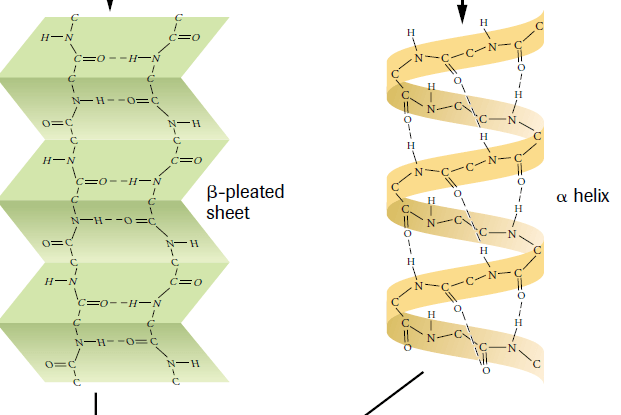
What level of protein structure is this?
a)
Primary
b)
Secondary
c)
Tertiary
d)
Quaternary
13.
How many fatty acid tails do phospholipids have?
a)
3
b)
1
c)
2
d)
4
14.

Maltose is made up of...

a)

glucose and glucose

b)

glucose and fructose

c)

glucose and galactose

d)

galactose and galactose

15.

Keratin in human hair has a high percentage of the amino acid cystiene which is responsible for the formation of this trait ?

a)

Ionic bond

b)

hydrogen bond

c)

Disulphide bridge

d)

hydrophobic interaction

16.

Which property of water enables light weight insects to walk on its surface ?

a)

bipolar

b)

low viscosity

c)

high adhesion

d)

high cohesion

17.

Which sugar is a monosaccharide?

a)

lactose

b)

maltose

c)

sucrose

d)

galactose

18.

Which proteins are non- globular?

a)

lipase

b)

cellulase

c)

collagen

d)

myogobin

19.

Which sugar does not react with copper sulhate solution to produce copper oxide ?

a)

fructose

b)

lactose

c)

maltose

d)

sucrose

20.

What type of intermolecular forces hold together the secondary structure of proteins?

a)

Van der Waals

b)

Dipole-dipole

c)

Hydrogen bonds

d)

Ionic

21.

In a carbohydrate, which of the following best describes the ratio of carbon to hydrogen to oxygen (in that order)?

a)

1:1:1

b)

2:1:1

c)

1:2:1

d)

1:1:2

22.
Which isomer of glucose is this?
a)
Beta glucose
b)
Alpha glucose
c)
Neither
23.
Which two polysaccharides contains 1,6 glycosidic bonds?
a)
Amylose and Amylopectin
b)
Amylopectin and Glycogen
c)
Cellulose and Glycogen
d)
Glycogen and Amylose
24.

Which of these is a lipid?

a)
b)
c)
d)
25.
What bonds form between cellulose molecules to make the resulting fibrils stronger?
a)
Covalent bonds
b)
Ionic bonds
c)
Hydrogen bonds
d)
Metallic bonds
26.
What is the main function of phospholipids?
a)
Storage
b)
Cell membranes
c)
Protection
d)
Support
27.

The diagram shows part of a protein molecule. What does X represent?

a)

amino acid

b)

fatty acid

c)

glycerol

d)

sugar

28.

The diagram shows two food tests carried out on solution X. Which nutrients are present in solution X?

a)

protein and starch

b)

protein and sugar

c)

starch and fat

d)

starch and sugar

29.

The graphs show the quantities of selected vitamins and mineral ions in four foods. Which food is the richest source of the vitamin or mineral ions essential for the transport of oxygen by the blood?

a)

beans

b)

egg

c)

fish

d)

fruit

30.
a)

A

b)

B

c)

C

d)

D

31.
a)

A

b)

B

c)

C

d)

D

32.
a)

A

b)

B

c)

C

d)

D

33.
a)

A

b)

B

c)

C

d)

D

34.
a)

A

b)

B

c)

C

d)

D

35.
a)

A

b)

B

c)

C

d)

D

36.
a)

A

b)

B

c)

C

d)

D

37.
a)

A

b)

B

c)

C

d)

D

38.

a)

A

b)

B

c)

C

d)

D

39.

a)

A

b)

B

c)

C

d)

D

40.

a)

A

b)

B

c)

C

d)

D

41.

a)

A

b)

B

c)

C

d)

D

42.

a)

A

b)

B

c)

C

d)

D

43.

a)

A

b)

B

c)

C

d)

D

44.

a)

A

b)

B

c)

C

d)

D

45.

a)

A

b)

B

c)

C

d)

D

46.

a)

A

b)

B

c)

C

d)

D

47.

a)

A

b)

B

c)

C

d)

D

48.

a)

A

b)

B

c)

C

d)

D

49.

a)

A

b)

B

c)

C

d)

D

50.

a)

A

b)

B

c)

C

d)

D