
Font size
 Worksheets
YEAR 12 Chem
Total questions: 61
Worksheet time: 1hrs 2mins
Removing O2(g) will
Adding SO2(g) will
At elevated temperatures ammonium carbonate, NH2COONH4, is in equilibrium with NH3 and CO2 according to the equation;
NH2COONH4(s) ↔ 2 NH3(g) + CO2(g)
What is the equilibrium expression for this reaction?
K = 2 [NH3][CO2]
[NH2COONH4]
K = [NH3]2[CO2]
[NH2COONH4]
K = 2 [NH3][CO2]
K = [NH3]2[CO2]
CO2(g) + H2(g) ↔ CO(g) + H2O(l)
Decreasing volume of container will
Which compound is the conjugate acid? (Hint: Determine the base)
PO43- + HNO3 ==> NO3- + HPO42-
PO43-
HNO3
NO3-
HPO42-
In the reaction below, H2O is a(n):
H2SO3 + H2O --> H3O+ + HSO3-
base
acid
conjugate acid
conjugate base
Identify the Acid in the above reaction.
KOH has a pOH of 3.0, what is the [OH-]?
0.01 M
0.001 M
0.0001 M
0.1 M
What is the pH of a 1.53 x 10⁻⁶ M solution of HCl?
5.82
8.18
6.99
4.15
3 LiOH + H3PO4 →
A titration can be used to determine the _______________ of a solution.
Molarity
Density
Boiling point
Reactivity
CO2 + H20 -->
H2CO3
CO3
CO2
H3O+
In a Galvanic Cell, the anode is...
positive
negative
In a Galvanic Cell, the cathode is...
positive
negative
Oxidation occurs at the...
anode
cathode
In a Galvanic cell, the electrons flow from the...
anode to the cathode
cathode to the anode
Ecell =
Ered - Eox
Ered + Eox
Eox - Ered
Eox + Ered
In the list of standard electrode potentials, the strongest reducing agent is...
K
K+
F2
F-
In the list of standard electrode potentials, the strongest oxidising agent is...
K
K+
F2
F-
In a redox reaction, the oxidising agent... (choose two options)
is oxidised
is reduced
increases its oxidation number
decreases its oxidation number
In a Galvanic cell, the cations in the salt bridge...
flow the same way as the electrons flow in the wire
flow the opposite way to the electron flow in the wire
stay in the salt bridge
In a Galvanic Cell, the salt bridge...
completes the circuit so that electrons can flow through the wire
maintains charge balance
is soaked in an unreactive electrolyte such as KNO3
all of the above
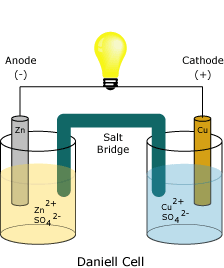
In the above Galvanic Cell, which half cell is undergoing reduction?
Cu | Cu2+
Zn | Zn2+
A certain galvanic cell has for its spontaneous cell reaction: Zn + HgO → ZnO + Hg
Which is the half-reaction occurring at the anode?
HgO + 2 e- → Hg + O2-
Zn2+ + 2 e- → Zn
Zn → Zn2+ + 2 e-
ZnO + 2 e- → Zn
What is the standard electrode which all other standard electrode potentials are measured against?
helium
hydrogen
magnesium
potassium
Select all the standard conditions used to measure the standard electrode potentials:
electrolyte solution 1 moldm-3
298K temperature
all chemicals in gaseous form
1atm pressure
standard hydrogen electrode as comparison
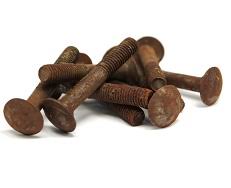
What two things cause Iron to Rust ?
Air and Oxygen
Oxygen and Water
Water and Carbon dioxide
Carbon dioxide and Air
Rusting can be prevented by
Alloying
Tinning
Galvanizing
All of above
Coating of Zn, Al and Cd on steel are _________ , because their electrode potentials are lower
Cathodic
Anodic
Not affecting
Expensive
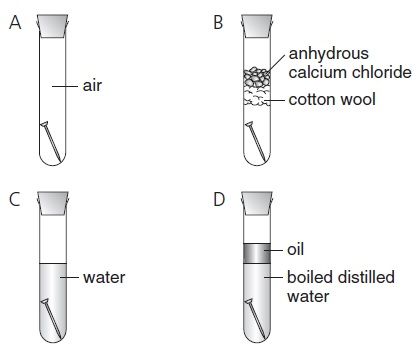
Which diagram shows the most favourable conditions for rust to appear on the nail?
A
B
C
D
Galvanizing is a process of:
Applying a Zinc coating to bare steel
Washing the body with the phosphate coating
dipping a body in E-COAT
Chemically etching primer to steel
What are the classification of polymer based on molecular forces
Homomer, co-polymer
Thermosetting, thermoplastic, elastomers
Addition condensation
Linear , branched, crosslinked
What is the classification of polymer based on Polymerisation
Linear,branched, crosslinked
Addition, condensation
Natural, synthetic
Homomer, co-polymer
In ------------ polymerization, two different monomers are involved with the elimination of small molecules.
addition
condensation
copolymerization
bulk

A section of a polyester is shown in the diagram. Which two molecules (monomers) could be reacted to form this polymer?
Dicarboxylic acid
Dialcohol
Alkene
Ester
Which two molecules (monomers) could be reacted to make a polyester?


Amino acids react to form peptides and proteins, this process is known as
addition polymerization
substitution polymerization
condensation polymerization
hydration polymerization
Monomers of ethene in thousand numbers react together in addition polymerization to produce
polyamides
polyesters
poly(ethene)
all of them
Once formed, it can be heated and reformed over and over again
thermoset
thermoplastic
elastomer
kevlar
Which of these is an example of synthetic polymer?
cotton fibers
rubber
wool
polyvinyl chloride (PVC)

Which one of the following polymers is prepared by condensation polymerization?
Teflon
Rubber
Styrene
Nylon-6,6

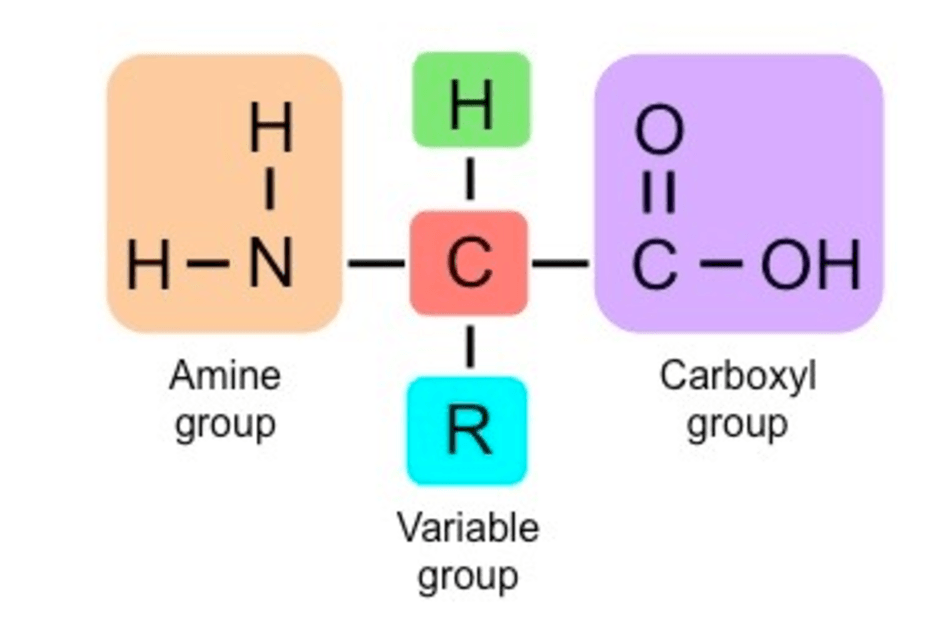
Based on its R group, one property of this amino acid is that it is...
Nonpolar/hydrophobic
Polar/hydrophillic
Positve
Negative

Based on its R group, one property of this amino acid is that it is...
Nonpolar/hydrophobic
Polar/hydrophillic
Positve
Negative
What type of bond is a peptide bond?
Ionic
Covalent
Hydrogen
Van der Waals

Which of the following describes the secondary structure of proteins?
The sequence of amino acids
The α-helix and β-pleated sheet folding
The folding of the polypeptide chain due to the 'R' groups
The joining of different protein molecules to make one big molecule
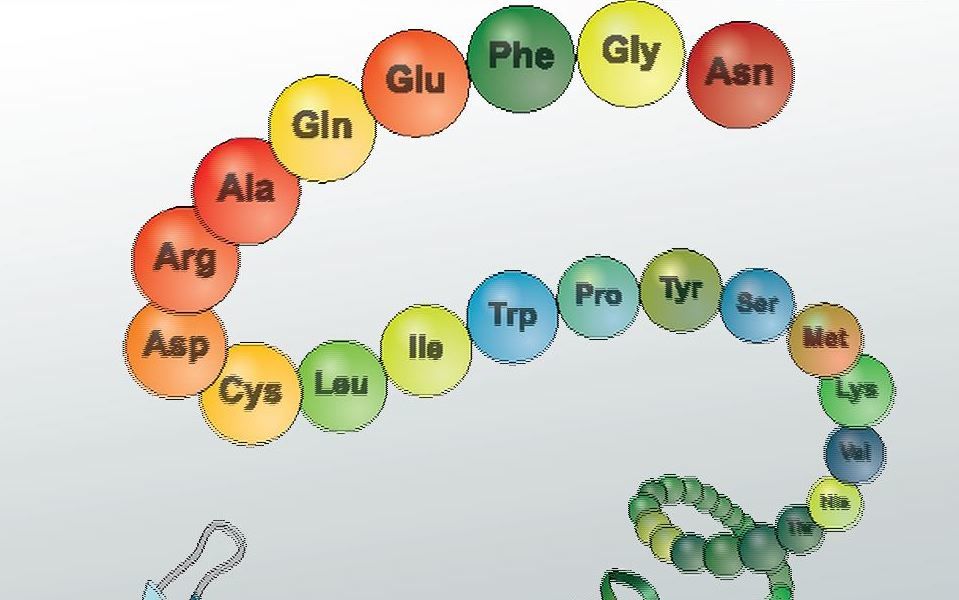

The main bonding in the secondary structure of a protein is due to.....
covalent bonding
ionic bonding
hydrogen bonding
polar bonding

The tertiary structure folding in proteins is primary due to the interactions of....
the 'R' groups
the 'P' groups
the 'A' groups
the 'S'
Proteins that are roughly spherical
globular proteins
fibrous proteins
enzymatic proteins
storage proteins
motor proteins
Proteins that are long and thin
globular proteins
fibrous proteins
enzymatic proteins
storage proteins
motor proteins
Which of the following term refers to the order in which amino acids are linked together in a protein.
primary structure
secondary structure
tertiary structure
quaternary structure

