Worksheets
Biology Unit 1 -AHHHHH Bald
Total questions: 75
Worksheet time: 1hrs 11mins
Organs are composed of tissues, which are composed of cells. This is an example of which characteristic of life?
Living things grow and develop.
Living things maintain themselves by homeostasis.
Living things respond to stimuli.
Living things have levels of hierarchical organization
The smallest unit that has all of the characteristics of life is the:
Cell
tissue
organ
organism
A fossil was once a living organism but its tissues have now been replaced by minerals and it no longer exhibits
most properties of life, except for:
homeostasis
organization
growth and reproduction
respond to stimuli
Outside, the non-living world is unorganized and chaotic while inside the cell or organism there is a relatively
constant environment; maintaining this environment is a process of:
thermodynamics
metabolism
homeostasis
behavior
Which of the following is an example of an organism maintaining homeostasis??
A plant using the openings on its leaves, stomata, to exchange gases and evaporate water to allow more water to get into the plant
A Runner perspiring while running on a hot summer day
The human body releasing insulin to keep blood sugar steady
The maintain ace of a body temperature around 98.6 degrees F
All of the above

Why do the shared electrons in the water molecule like to spend more time with Oxygen?? (this causes a polar covalent bond)
•A- Hydrogen has more protons than oxygen
•B- Oxygen has more protons than hydrogen
•C- Oxygen and Hydrogen have equal amounts of protons
•D- True Love

Why is the water molecule polar??
The electrons spend more time around Hydrogen
The electrons spend more time around Oxygen
The water molecule has ionic bonds
The water molecule has no polarity

The identity of an atom is based on...
the number of electrons it has
the number of protons it has
the number of neutrons it has
the number of shells it has

which kind of bond occurs when atoms transfer electrons and as a result are oppositely charged and bonded together?
ionic
covalent
hydrogen
polar covalent
which statement best explains why a new scientific investigation would be performed to test a theory that is already accepted?
discovery of new evidence
loss of funding for new theories
lack of availability of new theories
public pressure and demand for change

trees use narrow tubes to transport water upward. which property of water does this involve?
high specific heat
net charge of molecule
cohesion and adhesion of molecules
desity of molecules
which of the following statements concerning scientific hypotheses is false?
they must be testable by experimentation
they are not always correct
they are the same as theories
they are constructed based on observations

water is the universal....
solute
solvent
when a person does alot of exercise, blood vessels near the surface of the skin increase in diameter to allow blood to be nearer to the surface and help cool the body. this best illustrates...
synthesis
homeostasis
excretion
locomotion

Water has a special density because it's solid form is...
less dense than its liquid form
more dense than its liquid form
the most dense substance on Earth
the same density as its liquid form
Which of the following list these levels in the correct order of organization from the simplest to the most complex?
biomolecule, organelle, Organisms, organ systems, organs, tissues, cells
biomolecule, Tissues, organelle, cells, organs, organisms, organ systems
biomolecule, organelle, Cells, tissues, organs, organ systems, organisms
Organs, organ systems, organelle, organisms, cells, tissues, biomolecule
Reasons that viruses are considered to be nonliving is because
They are not contain cellular organelles
They cannot reproduce on their own
They cannot metabolize/ use energy
all of the above
Which best describes the basic structure of a virus?
genetic material strand surrounded by a protein coat
a tail surrounded by a protein coat
a tail surrounded by a carbohydrate coat
nucleic acid strand surrounded by a carbohydrate coat
What is the purpose of surface proteins on a virus?
replication of the virus
attachment to a host cell
protection of DNA
movement
Prokaryotic cells do not have.....
membrane bound organelles
cell membrane
DNA or RNA
life
You can distinguish a prokaryote apart from a eukaryote by--
The presence of a ribosome
The presence of a cell membrane
The presence of DNA
The presence of a nuclear membrane

Looking at the chart above, which molecule stores the most energy?
Protein
Carbohydrate
Fat/Lipid
nucleic acid
All cells have to be able to....
Reproduce
Respond to environment
use energy
all of the above
What structure do plant cells and bacteria have but NOT animal cells?
ribosome
cytoplasm
cell wall
cell membrane
What is the name of the theory that explains how the more complex Eukaryotes evolved from Prokaryotes?
Autogenous
Endosymbiotic
Cell
Evolution
What is the study of life?
Anatomy
Biology
Psychology
An amoeba and a bacteria are unicellular.
True
False
An unicellular organism is one that...
Can make its own food.
Cannot make its own food.
Has only one cell.
Has many cells.
What is a biosphere?
basic unit of life
everything that lives on Earth
species
chemicals
What is a species?
particular type of living things that can breed and reproduce
characteristic of life
study of life
step in scientific method
What is metabolism?
single stage of offspring
group of related parts that work together
fully grown
chemical processes that happen in an organism
Which of the following does not result from hydrogen bonding in water molecules?
Cohesion
Adhesion
Surface Tension
Dissolving fats
Why is water considered polar?
Nonpolar covalent bonds in structure
Ionic bonds in structure
Polar covalent bonds in structure
Hydrophobic interaction in structure
Which macromolecule(s) have nitrogen?
Carbohydrates
Proteins
Nucleic Acids
Nucleic Acids & Proteins
Which macromolecule(s) have phosphorus?
Carbohydrates
Proteins
Nucleic Acids
Fats
Which macromolecule(s) have sulfur?
Carbohydrates
Proteins
Nucleic Acids
Fats
Describes the forming of a bond between monomers with the removal of a water molecule.
Hydrolysis
Dehydration
Describes the breaking of a bond within a polymer using water.
Hydrolysis
Dehydration
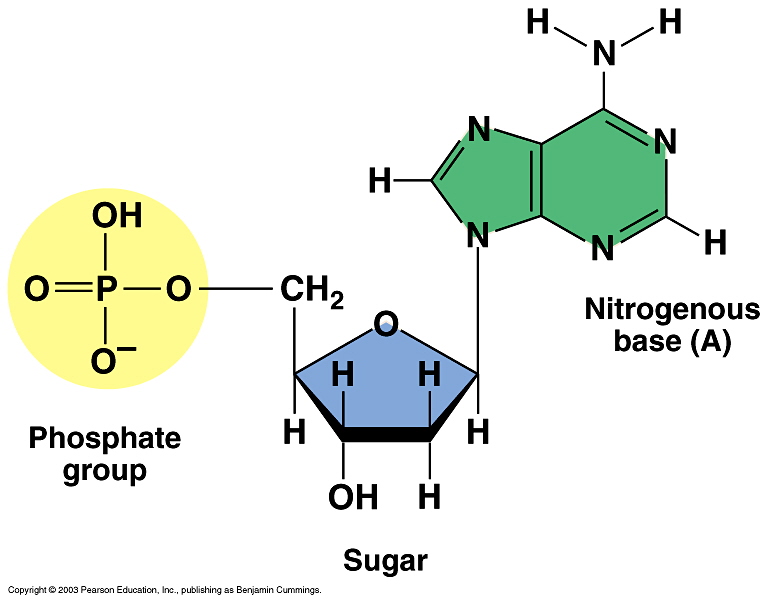
Which of the following is NOT in the monomer of a nucleic acid?
pentose sugar
nitrogenous base
phosphate
amino acid
Which of the following is NOT in the monomer of a protein?
Amine Group
R Group
Carboxyl Group
Nitrogenous Base
What component of the polypeptide is the next amino acid added forming the peptide bond?
amino group
hydrogen
carboxyl group
R groups
Which protein involves R group bonding to form the final three dimensional structure?
primary
secondary
tertiary
quaternary
Which protein structure involves the peptide bonds between amino acids?
primary
secondary
tertiary
quaternary
DNA and RNA differ on many qualities, which of the following is NOT a difference?
Sugar
Nitrogenous Base
Phosphate Group
Strandedness


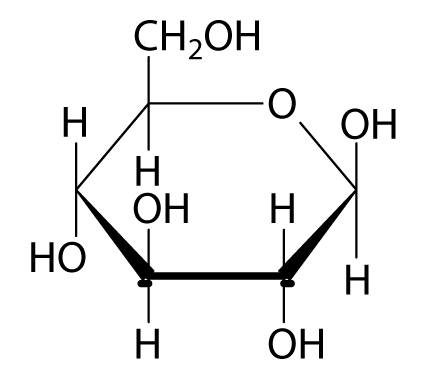
Simple sugars like glucose can be used to make larger organic molecules. Identify a larger molecule made from simple sugars.