
 Worksheets
A&P 1 Major Review 4
Total questions: 71
Worksheet time: 37mins
If I wanted to increase heart rate by sending signals from the brain to the cardiac muscle, making it contract more often, I would need to send signals through which section of the PNS?
somatic sensory afferent
visceral sensory afferent
somatic motor efferent
autonomic motor efferent
When I start exercise, my body treats it as a major disturbance/stressor, and my heart rate rises. What system causes this?
Somatic Motor
Parasympathetic
Sympathetic
Central Nervous System
Which of the following are characteristics of neurons?
High metabolic rate
Highly mitotic
Extreme longevity
Cell body and one or more processes
The biosynthetic center of a neuron that synthesizes neurotransmitters is the:
Dendrite
Soma
Axon
Movement of broken down neurotransmitter from the axon towards the soma to be recycled is known as:
Anterograde
Retrograde
Which neuron type makes up most sensory neurons?
Multipolar
Bipolar
Unipolar
Anaxonic
The neuron type that contains one dendrite and one axon, and is found in the retina of the eye and the olfactory epithelium of the nose is:
Multipolar
Bipolar
Unipolar
Anaxonic
From a functional perspective, what neuron type is responsible for integration of information, and makes up 99% of neurons?
Sensory
Interneuron
Motor
The fluid filled area between the axon terminal of the presynaptic neuron and the receptive area of the postsynaptic neuron is called the:
Synaptic Cleft
Junctional Fold
Neuromuscular Junction
Motor Unit
___ produce myelin sheaths in the CNS, and ___ produce myelin sheaths in the PNS
schwann cells (neurolemmocytes);
oligodendrocytes
astrocytes; satellite cells
oligodendrocytes; schwann cells (neurolemmocytes)
satellite cells; astrocytes
What glial cell is the most abundant, helps form the blood brain barrier, anchors structures in nervous tissue, and can be found in the CNS?
Astrocyte
Satellite Cell
Microglia
Ependymal Cell
True or False: a myelinated axon is cable of transmitting impulses faster than an unmyelinated axon due to the process of saltatory conduction
True
False
True or False: Multiple Sclerosis is an autoimmune disorder that causes demyelination in axons in the CNS.
True
False
A chemically gated channel would open in response to:
It is always open
Binding of neurotransmitter
A change in membrane potential
A response to specific sensory stimuli
In a neuron at rest, there is a higher concentration of ___ inside the cell and a higher concentration of ___ outside the cell
Potassium; Sodium
Chlorine; Sodium
Sodium; Potassium
Chlorine; Anions
Which ion is the most important in setting resting membrane potential inside the neuron?
Potassium
Sodium
Chlorine
Calcium
The circuit that produces cyclic activity like the ones that allow us to breathe in our sleep is:
Diverging
Converging
Reverberating
Parallel-After-Discharge
What type of summation is occurring if one or more presynaptic neurons is sending rapid signals to a postsynaptic neuron
Spatial
Temporal
Place the following steps in the correct order.
A. Graded potentials take the membrane potential from -70mv -> -55mv
B. -55mv -> +30mv
C. Voltage gated K+ channels open
D. Voltage gated Na+ channels open
E. Voltage gated Na+ channels close
F. Hyperpolarization
G. Repolarization
H. Return to RMP by closing K+ channels and using Na+/K+ pump
ABEDCFGH
ADBECGFH
ACBEDGFH
ABCDEGFH
Which event occurs due to excess potassium efflux from voltage gated K+ channels staying open for too long, and can be associated with a membrane potential of -80mv?
Depolarization
Repolarization
Hyperpolarization
Excess Polarization
The time where no stimulus can initiate another action potential is the:
Absolute Refractory Period
Relative Refractory Period
A postsynaptic potential that results in hyperpolarization in the postsynaptic neuron is:
Excitatory
Inhibitory
In the PNS, clusters of cell bodies are called ___ and bundles of neuron processes are called ___.
ganglia; tracts
ganglia; nerves
nuclei; tracts
nuclei; nerves
Which of the following fibers would have the fastest conduction speed?
Thick Unmyelinated
Thin Unmyelinated
Thick Myelinated
Thin Myelinated
What neurotransmitter is used in neuromuscular and neuron excitation, that binds to ligand gated channels on the cell membrane?
Acetylcholine
Biogenic Amines
Amino Acids
Neuropeptides
Which region of the brain consists of the thalamus, epithalamus, and hypothalamus?
Cerebrum
Diancephalon
Brainstem
Cerebellum
___ are ridges and ___ are shallow grooves.
sulci; gyri
gyri; fissures
gyri; sulci
fissures; sulci
What structure separates the brain into two separate hemispheres?
Central Sulcus
Corpus Collosum
Longitudinal Fissure
Transverse Fissure
Which of the following structures would I find in gray matter?
Neuron cell bodies
Dendrites
Myelinated axons
Unmyelinated axons
The middle layer of the meninges, made of a web of collagen and elastic fibers, is the:
Pia Mater
Arachnoid Mater
Dura Mater
An epidural hematoma would occur in the space between the skull and the ___, the tough outer meningeal layer.
Pia Mater
Arachnoid Mater
Dura Mater
What structures are empty cavities in the brain that circulate CSF?
Meninges
Ventricles
Fissures
Sulci
What provides a liquid cushion to the brain and is produced in the choroid plexus of each ventricle?
Blood
Cranial Plasma
Cerebrospinal Fluid (CSF)
Cerebral Mucus
The blood brain barrier is composed of specialized capillaries, tight junctions, and the perivascular feet of astrocytes. What is its function?
Allow free movement of molecules from the blood to the interstitial flluid of the brain
Regulate what substances enter the interstitial fluid of the brain and prevent exposure to harmful substances
Prevent glucose and lipids from crossing to reserve it for areas of the brain that need it more
The three basic regions of each hemisphere in the cerebrum are:
Internal White Matter
Arbor Vitae
Cerebral Cortex
Deep Basal Nuclei
External White Matter
The corpus callosum is the largest tract that provides connection between hemispheres. The corpus callosum is a type of:
Association tract
Commissural tract
Projection tract
In which lobe would I find Broca's Area?
Frontal
Parietal
Temporal
Occipital
What structure separates the precentral gyrus and postcentral gyrus?
Coronal fissure
Corpus callosum
Transverse fissure
Central sulcus
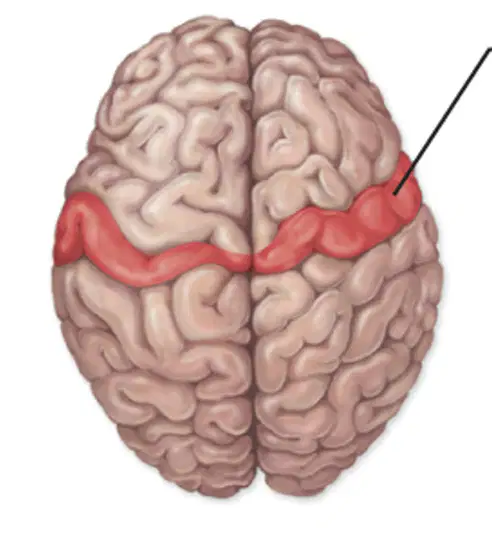
What structure is located in the precentral gyrus (highlighted area in picture), and is responsible for conscious control of precise, skilled, skeletal muscle movement?
Primary motor cortex
Premotor cortex
Prefrontal cortex
Somatosensory cortex
The area of the cerebral cortex responsible for the ability to recognize and remember faces is the:
Primary visual cortex
Visual association area
Primary somatosensory cortex
Somatosensory association cortex
True or False: The area of the parietal lobe that allows me to receive general sensory information from the skin and proprioceptors is the primary somatosensory cortex. The area that allows me to contextualize that sensory information and understand size, texture, and the relationships of parts is the somatosensory association cortex.
True
False
A condition caused by damage to this structure results in unaffected language comprehension, but an inability to physically produce the words needed to speak
Wernicke's Area
Broca's Area
Prefrontal Cortex
Reticular Activating System
The multimodal association area responsible for complex thought, judgement, personality, and more, that is still developing in adolescence is the:
Prefrontal Cortex
Wernicke's Area
Limbic Association Area
The concept that there is a division of labor between hemispheres, and that they are not identical and do not control the same things to the same degree is:
Cerebral Dominance
Petalis
Cerebral Lateralization
Cerebral Specialization
What structure in the diancephalon contains the pineal gland, which releases melatonin?
Epithalamus
Thalamus
Hypothalamus
What structure of the diencephalon is known as the gateway to the cerebral cortex, and is a relay center that regulates which signals are passed onto the cerebral cortex.
Medulla Oblongata
Midbrain
Thalamus
Cerebellum
Which of the following are functions of the hypothalamus?
Autonomic control
Thermoregulation
Endocrine control
Thirst regulation and water intake
Degeneration of this structure found in the midbrain causes Parkinson's disease.
Cardiovascular Center
Pineal Gland
Wernicke's Area
Substantia Nigra
Which of the following are functions of the medulla oblongata?
Controls force and rate of heart contraction
Respiratory rhythm and rate and depth of breathing
Coughing and Sneezing
Blood pressure regulation
What region of the brain is responsible for "fine-tuning" movement, and also plays a role in balance?
Cerebrum
Diancephalon
Brain Stem
Cerebellum
True or False: Your limbic system is your emotional brain, and coordinates multiple structures of the brain to process and experience emotions.
True or False: When you think of the Reticular Activating System, the words "alertness" and "consciousness" should come to mind.
True
False
The spinal cord extends from the foramen magnum to around L1/L2 before branching into the horse-tail-like:
Brachial Plexus
Sciatic Nerve
Cauda Equina
Rami Communicantes
True or False: sensory axons will travel through anterior rootlets and the anterior horn.
True
False
A motor neuron innervating skeletal muscle would travel through the:
Posterior Horn
Anterior Horn
Lateral Horn
Ascending pathways in the spinal cord are ___ while descending pathways are ___.
sensory; motor
motor; sensory
True or False: In a sensory pathway, the beginning of a third order neuron will synapse with the end of a second order neuron in the thalamus.
True
False
The sensory pathway responsible for discriminative touch and vibrations is the:
Dorsal column- medial lemniscal pathway
Spinothalamic pathway
Spinocerebellar tract
Which of the following horns could a motor neuron travel through?
Posterior
Dorsal
Anterior
Lateral
Which pathway is responsible for fast and fine skilled movement?
Motor Indirect
Motor Direct
Sensory Dorsal Column
Sensory Spinothalamic
The "crossing-over" concept of neurons in the spinal cord is known as:
Ipislateralization
Lateralization
Decussation
Reflex Arc
True or False: The lumbar plexus extends from L1-L4
True
False
The phrenic nerve innervates the diaphragm. Which plexus does it arise from?
Cervical
Brachial
Lumbar
Sacral
What nerve branches off the lumbar plexus and innervates the anterior region of the thigh, and the sartorious?
Phrenic
Musculocutaneous
Femoral
Sciatic
The longest nerve in the body is the sciatic nerve, and it branches off the ___ plexus.
Cervical
Brachial
Lumbar
Sacral
True or False: a specific reflex will always have the same response to a stimulus.
True
False
A reflex that requires an interneuron to communicate between the sensory and motor neurons would be classified as:
Monosynaptic
Polysynaptic
Spinal
Cranial
Which cranial nerve is the major source of parasympathetic output, conducts sensation of many viscera, and controls muscles in the pharynx and larynx?
(Hint: Everything happens in ___!!!)
Glossopharyngeal
Vagus
Trigeminal
Accessory
Cranial nerve VI, which abducts the eye, is the:
Oculomotor
Trochlear
Abducens
Optic
What cranial nerve is a motor nerve that moves the muscles of the neck and the pharynx?
Vagus
Trochlear
Glossopharyngeal
Accessory
Place the following events in order:
A. Start at resting membrane potential
B. Repolarization
C. Return to resting membrane potential using Na+/K+ pumps
D. Depolarization
E. Hyperpolarization
ADEBC
ADBEC
ABDEC
AEDBC

