Wayground logo

Free Printable Worksheets

Font size

S
M
L
XL
Worksheets

Physics Ch. 3 Velocity, Acceleration

Total questions: 70

Worksheet time: 3hrs 30mins

Name
Class
Date
1.
What is speed?
a)
how far you go
b)
how much distance is covered over a period of time
c)
how fast you accelerate
d)
the change in the location of a object
2.
65 miles per hour North is an example of an objects what?
a)
Speed
b)
Velocity
c)
Average Speed
d)
Constant Speed
3.
On a distance vs. time graph, the steeper the slope _____
a)
the slower the speed
b)
the faster the speed
c)
less acceleration
d)
greater acceleration
4.
Speed is different from velocity because
a)
Velocity has a direction
b)
Speed uses Distance /Time
c)
Velocity doesn't include time
d)
Velocity doesn't include distance
5.

What is motion?

a)

the stopping of an object to a frame of reference

b)

a change in position relative to a frame of reference

c)

the middle ground between light and shadow, between science and superstition, and it lies between the pit of man's fears and the summit of his knowledge

d)

a change in the time in which it takes to get an office referral

6.
Total distance divided by total time is
a)
average speed
b)
constant speed
c)
instantaneous speed
d)
acceleration
7.
Acceleration is defined as the CHANGE in 
a)
time of motion to another place. 
b)
velocity 
c)
distance 
d)
speed
8.
What is this graph representing?
a)
Constant Speed
b)
Acceleration (speeding up)
c)
Deceleration (slowing down)
d)
No motion
9.
What two measurements are necessary for calculating speed?
a)
Mass and time
b)
Temperature and mass
c)
Mass and distance
d)
Distance and time
10.
What is happening in this graph from point B to C?
a)
The object is going down a hill.
b)
The object is returning to its starting location.
c)
The object is slowing down.
d)
The object is staying still.
11.
If you run around the football field (which is 2 miles) 3 times, what is your distance?
a)
0 miles
b)
3 miles
c)
6 miles
d)
9 miles
12.
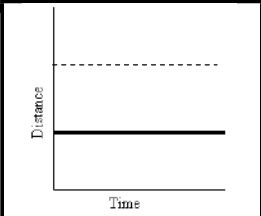
What does this graph represent?
a)
Constant speed
b)
Acceleration
c)
Not moving
13.
What is the speed of an object that travels 60 meters in 4 seconds?
a)
240 m/s
b)
15 m/s
c)
0.067 m/s
d)
15 mph
14.
What is the speed of an object that travels 20 meters in 4 seconds?
a)
80 m/s
b)
0.2 m/s
c)
5 m/s
d)
24 m/s
15.

Part B of the graph is from 25s to 35s. Which of these statements is true about Part B?

a)

The object is at rest.

b)

The object is accelerating (its velocity is increasing)

c)

The object is decelerating (its velocity is decreasing)

d)

The object is moving at a constant velocity.

16.
The scientific (SI) unit for measuring distance is the ________ .
a)
mile
b)
foot
c)
kilometer
d)
meter
17.
Displacement is distance combined with
a)
direction
b)
speed
c)
velocity
d)
magnitude
18.
Because displacement has a magnitude and direction it is called a ______. 
a)
distance
b)
vector
c)
arrow
d)
length
19.
Which of the following describes distance and displacement correctly?
a)
The blue arrow shows distance and the orange arrows show displacement
b)
The blue arrow shows displacement and the orange arrows show distance
c)
Both arrows show distance only
d)
Both arrows show distance and displacement
20.

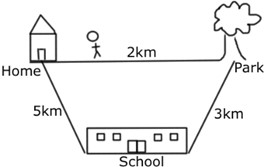
Jerry walked from home to school, then from the school to the park. What is his total distance?

a)

2 km

b)

5 km

c)

8 km

d)

10 km

21.

Jerry walked from home to school, then from the school to the park. What is his total displacement?

a)

2 km

b)

5 km

c)

8 km

d)

10 km

22.
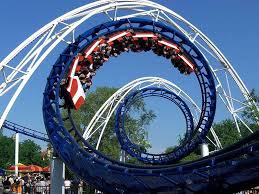
After completing one trip on a roller coaster, the roller coaster's ________ is zero.
a)
displacement
b)
reference point
c)
length
d)
distance
23.
Which of the following is a unit for acceleration?
a)
km/s
b)
m/s2
c)
mi/hr
d)
ft
24.
When a car goes around a corner at 20 mph, why do we say it  accelerates?
a)
The car is accelerating because of the velocity is constant
b)
The car accelerates because it's going 20 mph
c)
Cars always accelerate when they are in motion
d)
The car is accelerating because it's changing direction
25.
A value that only has magnitude (a number)
a)
Scalar
b)
Vector
c)
Speed
d)
Velocity
26.
Of the following, which is a vector?
a)
Mass
b)
Time
c)
Speed
d)
Velocity
27.
Acceleration only takes place when things speed up. 
a)
True
b)
False
28.
In each of the following cases, determine where the car has no acceleration ?
a)
A car shortly after a stoplight turns green.
b)
A car approaching a red light
c)
A car with the cruise control set at 80 km/h
d)
A car turning a curve at a constant speed
29.
A roller coasters accelerates from an initial velocity of 6.0 m/s to a final velocity of 70 m/s over 4 seconds.  What's the acceleration?
a)
24 m/s2
b)
18 m/s2
c)
16 m/s2
d)
16 m/s
30.
Acceleration can be classified as _______________
a)
Speeding up
b)
Slowing Down
c)
Changing directions
d)
All of the above
31.
A box sliding down an inclined plane attains a velocity of 27 m/s in 3 seconds from rest.  Find the acceleration.
a)
30 m/s
b)
24 m/s2
c)
9 m/s2
d)
81 km/hr
32.

What type of acceleration is shown in the graph?

a)

positive

b)

negative

c)

centripetal

d)

Zero

33.
A negative acceleration means that your object is _____. 
a)
not accelerating
b)
not moving
c)
speeding up 
d)
slowing down 
34.

A positive acceleration means that your object is _____.

a)

not accelerating

b)

not moving

c)

speeding up

d)

slowing down

35.

Acceleration is

a)

Vector

b)

Scalar

36.
Why does a car accelerate as it round a corner at a constant speed?
a)
Its direction changes
b)
It doesn't
c)
It slows down
d)
Its speeds up  
37.
Acceleration only takes place when things speed up. 
a)
True
b)
False
38.
A problem that asks "how far did the object move?" is prompting you for an answer measured in
a)
meters.
b)
meters / second.
c)
meters / second^2.
d)
seconds.
39.
A problem that asks "how long did it take" is prompting you for an answer measured in
a)
meters.
b)
meters / second.
c)
meters / second^2.
d)
seconds.
40.
A box sliding down an inclined plane attains a velocity of 27 m/s in 3 seconds from rest.  Find the acceleration.
a)
30 m/s
b)
24 m/s2
c)
9 m/s2
d)
81 km/hr
41.
The picture of the position vs. time graph shows an object that is...
a)
accelerating/speeding up
b)
moving at a constant speed 
c)
not moving 
d)
accelerating/slowing down. 
42.
In each of the following cases, determine where the car has no acceleration ?
a)
A car shortly after a stoplight turns green.
b)
A car approaching a red light
c)
A car with the cruise control set at 80 km/h
d)
A car turning a curve at a constant speed
43.
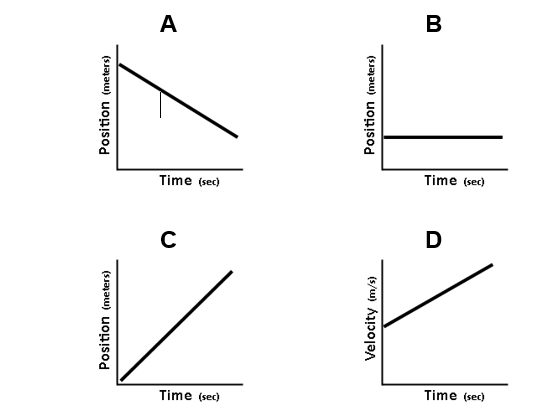
Which graph represents zero acceleration (constant velocity)?
a)
A
b)
B
c)
C
d)
D
44.
Which of the following is a unit for acceleration?
a)
km/s
b)
m/s2
c)
mi/hr
d)
ft
45.
How can acceleration be zero?
a)
a car runs out of gas and slowly rolls to a stop
b)
a car decreases speed at a constant rate until it comes to rest
c)
car has constant speed and is traveling on a straight path
d)
the car travels round trip and is back at the starting point
46.
Acceleration is defined as the CHANGE in 
a)
time it takes for one place to move to another place. 
b)
velocity of an object.
c)
distance divided by the time interval 
d)
velocity divided by the time interval 
47.
A value that only has magnitude (a number)
a)
Scalar
b)
Vector
c)
Speed
d)
Velocity
48.
A dog runs with an initial speed of 7.5 m/s on a waxed floor.  It slides to a stop in 15 seconds.  What is the acceleration?
a)
-7.5 m/s
b)
-7.5 m/s2
c)
-0.5 m/s2
d)
7.5 mi//hr
49.

In which of the following situations would a car be speeding up while traveling forward?

a)

positive velocity and positive acceleration

b)

positive velocity and negative acceleration

c)

negative velocity and positive acceleration

d)

negative velocity and negative acceleration
50.
What is the acceleration of the object between seconds 0 and 2?
a)
8 m/s2
b)
4 m/s2 East
c)
4 m/s2 West
d)
There is no way to tell
51.
How do we find the velocity on a velocity-time graph?
a)
Go up to the line and over to the left and just read the number
b)
Find the area under the graph
c)
Find the slope of the line
d)
There is no good way to do this
52.
Which graph shows the object standing still?
a)
A
b)
B
c)
C
d)
D
53.

Match the following graphs to the right description.

a)

1.

Speeding up

b)

2.

No acceleration (constant velocity)

c)

3.

Slowing down

54.

The Olympian swam 200 meters in 20 seconds.

a)

speed

b)

velocity

c)

acceleration

55.

The geese fly 23 mph to the south when they migrate for the winter.

a)

speed

b)

velocity

c)

acceleration

56.

Changes in our speed, direction or both are called _________.

a)

gravity

b)

changes

c)

acceleration

d)

displacement

57.

You ride your bike in a straight line at a constant speed of 10 km/h.

a)

Acceleration occurred because speed increased.

b)

Acceleration did not occur because neither speed nor direction changed.

c)

Acceleration occurred because you changed directions.

d)

Acceleration occurred because speed decreased.

58.
You are riding your bike at 9 km/h. Ten minutes later, your speed is 6 km/h.
a)
Acceleration occurred because speed increased.
b)
Acceleration occurred because speed decreased.
c)
Acceleration occurred because you changed directions.
59.

The speed of a car will increase if the car’s

a)

initial velocity is positive and its acceleration is zero.

b)

initial velocity is positive and its acceleration is positive.

c)

initial velocity is positive and its acceleration is negative.

d)

initial velocity is negative and its acceleration is positive.

60.

A quantity that has only magnitude associated with it is called a(n) _______ quantity

a)

scalar

b)

vector

c)

instantaneous

d)

derived

61.

If an object's position or its velocity is constant, then its _____ is zero

a)

position

b)

acceleration

c)

velocity

d)

displacement

62.

One common example of uniformly accelerated motion is

a)

free fall

b)

launching in a rocket

c)

rolling down a hill

d)

sitting still

63.

A ball is dropped from an 70.0 m building. What is the ball's velocity after 3.00 s?

a)

-2.9 m/s

b)

-29.4 m/s

c)

-8.8 m/s

d)

-88.3 m/s

64.

If I travel 3 blocks north, 2 blocks east 5 block south, and 2 blocks west, what is my total distance I traveled

a)

12 blocks

b)

8 blocks

c)

2 blocks

d)

0 blocks

65.
During which interval is the object not moving?
a)
B to C
b)
C to D
c)
D to E
d)
only at point A
66.
During which interval is the object speeding up?
a)
A to B
b)
B to C
c)
D to E
d)
E to F
67.
Acceleration occurs when an object changes its speed or ______.
a)
direction
b)
force
c)
inertia
d)
mass
68.
Acceleration of an object happens when things ________
a)
slow down
b)
go faster
c)
change direction (turn)
d)
All of the above
69.
The SI unit for acceleration is
a)
mph
b)
m/s
c)
m/s2
70.
Acceleration: is the rate of change in ___________.
a)
speed
b)
distance
c)
velocity 
d)
displacement