
 Worksheets
2025 Matter & Its Interactions Test Practice
Total questions: 57
Worksheet time: 57mins
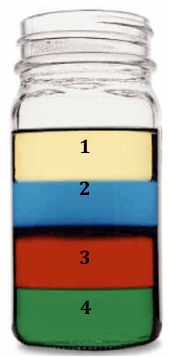
A scientist has four different liquids and pours them all into a bottle. The silver liquid sinks to the bottom, the red liquid settles on top of the silver one, and the pink liquid stays at the surface. Which liquid is the least dense?
the pink liquid
the silver liquid
the red liquid
the water

A sample has a mass of 4 g and a volume of 4 cm3. What is the name of this substance?
wood
water
ice
aluminum

The table shows the densities of several substances. If you have a sample that has a mass of 3.5 g & a volume of 7 cm3, what substance is the sample made of?
Pyrite
Zinc
Cedarwood
Glass

If you poured 3 liquids that do not mix into a graduated cylinder, how could you tell which liquid is the most dense?
The liquid on top
The liquid in the middle
The liquid at the bottom
Two students were studying properties of water. One student placed 100 mL of water into a beaker on a burner to boil. Another student placed 200 mL of water in an identical beaker on another burner to boil. Which of the following will be the same for both beakers of water?
The volume of the boiling water
The time it takes the water to boil
The mass of the boiling water
The temperature at which the water boils
If a substance has a melting point of 26oC & a boiling point of 98oC, what state of matter would the substance be if it was at 105oC?
Solid
Liquid
Gas
If a substance has a melting point of 26oC & a boiling point of 98oC, what state of matter would the substance be if it was at 15oC?
Solid
Liquid
Gas
If a substance has a melting point of 26oC & a boiling point of 98oC, what state of matter would the substance be if it was at 48oC?
Solid
Liquid
Gas
If a substance has a melting point of 78oC & a boiling point of 327oC, what state of matter would the substance be if it was at 105oC?
Solid
Liquid
Gas
If a substance has a melting point of 78oC & a boiling point of 327oC, what phase change would the substance go through as it was heated from 45oC to 250oC?
Freezing
Melting
Condensing
Vaporizing
Salt is mixed into water, which causes it to "disappear". The water is then heated until all the water boils away, which leaves salt in the bottom of the pot. Which physical property of matter does this demonstrate?
mass
solubility
density
melting
solute + solvent =
solution
equation
Fish breathe oxygen, which is dissolved in water. Is the oxygen the fish breathe considered to be the solute or solvent?
Solute
Solvent
You make a pitcher of lemonade by adding lemon juice, sugar, ice and water. Which of the following are the 2 solutes in the solution?
Lemon juice
Sugar
Water
Lemon seeds
When you open a bottle of sparking water, gas bubbles suddenly appear. These gas bubbles are dissolved in the water. Which is the solute in this solution?
water
gas bubbles
Which of the following are examples of matter?
Water
Energy
Soil
Heat
The temperature at which a substance changes from a liquid to a gas.
density
odor
boiling point
buoyancy
Which of the following are chemical properties of matter?
Color
Shape
Odor
Flammability
True or False: If a substance is above its melting point it will be a solid.
True
False
Which of the following involves a change in chemical properties?
Boiling water to make steam
mixing vinegar and baking soda to make bubbles of CO2
melting a bar of solid gold to make liquid gold
tearing a piece of paper into smaller pieces
If you are given 2 unknown samples of gray metals, how can you use physical properties to determine if they are the same?
you can use their masses
compare their densities
compare their ability to react with acid
you can identify the elements that they are made of
An atom is the ___________ particle of an element that still has properties of that element?
fastest
slowest
smallest
largest

Chemical or Physical Change?
Chemical Change
Physical Change

Chemical or Physical Change?
Chemical Change
Physical Change

Chemical or Physical Change?
Chemical Change
Physical Change
In a _______ change, a substance changes into a different substance
physical
chemical
Which of these is NOT a sign a chemical change has occurred?
color change
temperature change
bubble formation
cutting material
SELECT 2: Which of the following 2 are chemical reactions?
sugar dissolving in water
water turning into steam
burning wood
mixing baking soda and vinegar
tearing paper
What is the main difference between physical and chemical changes?
Physical changes only affect the physical properties of a substance, while chemical changes result in the formation of new substances.
Physical changes only affect the chemical properties of a substance, while chemical changes result in the formation of new substances.
Physical changes involve a change in state, while chemical changes involve a change in color.
Physical changes are reversible, while chemical changes are irreversible.
In the laboratory, a blue liquid is mixed with a yellow liquid. What would be the best evidence that a chemical change took place as the liquids were mixed?
The new liquid is green.
The yellow liquid floats on top of the blue.
The formation of a gas.
No change in the temperature of the new solution.
All of the following are evidences of a chemical change except -
a change in temperature
the production of a gas
a change in state of matter
an odor being given off
Every chemical change results in -
a change in temperature.
the formation of a new substance.
a color change.
the formation of a precipitate.

The precipitate formed in the reaction is evidence of a chemical change because -
a new substance has been formed.
a change in the state of matter has occurred.
a color change has taken place.
a change in temperature has taken place.
During digestion the body uses both physical and chemical changes to move and process food. Which of the following is an example of a physical change?
Teeth breaking food down into smaller pieces.
Protein breaking down into amino acids in the stomach.
Enzymes breaking down carbohydrates into simple sugars.
Hydrochloric acid breaking down fats in the stomach.
Which of the following is an example of both a physical and a chemical change?
chopping vegetables with a knife
burning a candle
dissolving hot cocoa mix in water
pouring cold water on a hot object
When two liquids are mixed, the container feels cold to the touch. This is evidence of what?
physical change
chemical change
state of matter change
no change
Which of the following would indicate the formation of a new substance?
A liquid turns to a solid.
A sample of metal melts.
Bubbles and fizzing occur.
A solid dissolves in a liquid.

How many grams are soluble in 100 g of water at 100 ºC?
300 grams
250 grams
100 grams
50 grams
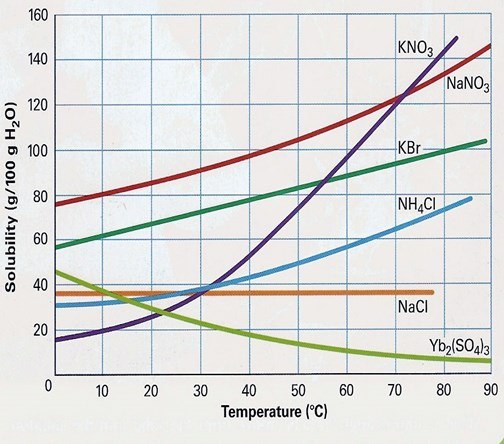
At 30'C, which substance has the lowest solubility?
KNO3
KBr
NaCl
Yb2(SO4)3

Which substance is least soluble at 0 ºC?
KI
KNO3
KClO3
Ce2(SO4)3

