
 Worksheets
SCIENCE - REVIEWER 3
Total questions: 75
Worksheet time: 55mins

Technology is the proper application of gained knowledge in Science.
True
False
The ring used in the game of basketball has a height of 10 feet is an example of a Qualitative observation.
True
False
Which lab tool is use to transfer large volume of liquid from one container to another without spilling?
Pipette
Medicine dropper
Funnel
Erlenmeyer flask

Which among the following is a characteristic of Prokaryotes?
They have membrane bound organelles
They are larger in size
They do not have a nucleus
They are multicellular

Which of the following is found in an animal cell but NOT in a plant cell?
Cell Wall
Choloroplast
Centriole
Nucleus

Why is the cell called the basic unit of life?
Because it can grow in length.
Because each cell can breathe in carbon dioxide like every other organism.
Because a cell is has the capacity to convert nutrients into energy
Because a cell spontaneously arose by chance

Viruses attack and infect human cells. Once a host human cell is infected, the virus will control its processes to generate other virus-infected cells. Which is TRUE about viruses?
Viruses are not living things because they do not have a DNA.
Viruses are living things because they came from previously existing cells .
Viruses are not living things because they don’t have the capacity to reproduce on their own so they need a host cell to reproduce.
Viruses are living things because they are cells.

Which among the statements are NOT supported by the modern cell theory?
I. All organisms are capable of making their own food.
II. All organisms are made of cells.
III. No cell came from previously existing cells.
I and III
II and III
II only
I and II

Which of the following organelle is found both in a plant cell and in an animal cell but is different in size?
Vacuole
Nucleus
Mitochondria
Cell wall
Temperature of a material depends upon the average —————— of its particles
Kinetic energy
Thermal energy
Heat energy
Particle energy
Thermal energy is transferred from————-
A cooler object to a hotter one
A hotter object to a cooler one
The movement of thermal energy from a hotter object to a colder one is called
Motion
Kinetic energy
Temperature
Heat
Molecules with more kinetic energy move ———- than molecules with less kinetic energy
Lower
Faster
Higher
Slower

In this picture, heat is being transferred from sample B to sample A. When will the heat transfer stop?
Heat transfer will keep on until object B has zero thermal energy
Heat transfer will not stop, it will keep going
Heat transfer will stop when sample A and sample B have reached the same temperature.
Think about a pan of water sitting on an electric stove. The stove is then turned on to high.
How is heat transferred from the stove to the pan?
conduction
convection
radiation
temperature
Think about a pan of water sitting on an electric stove. The stove is then turned on to high.
What will happen to the movement of the particles in the pan?
They will slow down
They will stay the same speed
They will stop moving
They will speed up
Suppose that you are at the beach.
Energy from the Sun reaches you mainly through
conduction
convection
radiation
temperature
Water currents can transfer heat by
conduction
convection
radiation
temperature
Most of the energy we use on Earth originally came from _____________________.
the center of the Earth
the equator
the sun
the moon
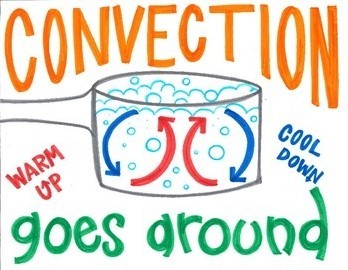
Which of the following is an example of heat transfer by Convection?
Burning your fingers on a hot iron.
Heat from a heater warming up your whole house
Standing by a campfire and feeling the heat.
All of the above.
. A scientist plans to conduct a six month study on a particular species of bear found in western Virginia. To make the most valid and meaningful observations, the scientist should —
observe a large number of bears in their natural forest habitat
observe small groups of bear in the same artificial habitats created in the laboratory
observe a small number of bears in the natural forest habitat
observe small groups of bears in different artificial habitats created in the laboratory
Which experimental design would best determine the effect of low temperatures on growth in bean plants?
Measure the rate of growth in 20 bean plants of the different species, each grown at a different low temperature.
Measure the rate of growth in 20 bean plants of the same species, each grown at a different low temperature.
Measure the rate of growth in 20 bean plants of the same species, each grown at the same low temperature.
Measure the rate of growth in 20 bean plants of the different species, each grown at the same low temperature.

This student's data is valid because —
two variables were used
eight trials were conducted
a graph was formed from the data
the data forms a pattern

Why are the shown results considered valid?
Data was only collected on one bird.
Data was collected over a ten year period.
Information did not produce a pattern between precipitation and beak size.
Information on precipitation was not included.
A researcher designed an experiment to demonstrate the process of soil erosion. He placed a bar of soap in a flat dish and left it under a slow running tap so that water falls directly on the soap bar. After two hours, the researcher noticed that the part of the soap on which water was falling had been washed away and a hole had formed in the bar. The researcher concludes that the rate of soil erosion can be calculated by using the soap bar model and can be applied to real-life scenarios. Is the researcher’s technique reliable for testing real-life erosion rates? (TWO ANSWERS)
No, because the flow of tap water is not comparable to the flow of water in natural conditions.
Yes, because it shows the erosion of the top layer of a surface by water.
Yes, because it demonstrates the speed with which erosion of soil can take place.
No, because the texture of soap is not comparable to the texture of soil.
Which of the following must be done for the results of an experiment to be considered valid?
The experiment must be repeated numerous times and the same results are obtained.
The results must be only quantitative.
The results must be shown in a graph.
The results must be published in a national journal.

Wyatt conducted an experiment to test the effectiveness of three different household cleansers to destroy colonies of bacteria. Wyatt predicted that Cleanser 3 would be the most effective. In his experiment, he collected samples from each surface before and after using the cleanser. The samples were then transferred to a culture medium where Wyatt would count the number of colonies that grew on each culture. Wyatt is missing a control for his experiment. Which of the following would be the best control for his experiment?
Use Cleanser 1 and 2 on the kitchen counter and Cleanser 3 on the bathroom sink.
Test the number of bacteria on the kitchen counter and bathroom sink before and after scrubbing with water.
Use only Cleanser 1 on both the kitchen counter and bathroom sink.
Test the number of bacteria on the counters and sinks without scrubbing with water or cleansers.
Which procedure should NOT be used to safely dissect an organism?
The student should cut away from himself during dissection.
The student should hold the organism in his hand while cutting open the organism.
The student should wear gloves.
The student should secure the organism in a pan with dissecting pins.
Which statement describes the proper way to smell a substance in a beaker in the laboratory?
The beaker should remain on the counter, the student should wave his hand over the top of the beaker and his face should remain several inches above the beaker.
The beaker should be heated and then placed directly under the student’s nose.
The beaker should remain on the counter and the student should bring his nose in very close contact with the top of the beaker.
The beaker should be placed directly under the student’s nose.
Antonio is conducting a science experiment during class that requires him to use glass beakers. He accidentally drops one of the beakers on the floor and it breaks into multiple pieces. Who is responsible for cleaning up the broken glass?
Antonio
The entire class
The teacher
Antonio's lab partner
Kim and Jacob are conducting a science experiment. Which diagram correctly shows Kim and Jacob following the laboratory safety rules?


Which statement is a correct safety procedure?
Do not place anything in your mouth unless advised by the teacher.
Do not wash your hands before or after a science experiment.
Do not use caution when working with heated items.
Do not inform the teacher of any spills or accidents.

A probeware instrument, such as the one shown here, can be used to collect data and then graph that data on a graphing calculator. What types of data could be collected and graphed from probeware
Dissolved oxygen content of a liquid
Temperature of a liquid
pH of a liquid
Mass of 100 mL of a liquid
Which statement is true about microscopy?
Electron microscopes have much greater magnification power than light microscopes.
Electron microscopes have much less magnification power than light microscopes.
Magnification power is the only difference between a light and electron microscope.
Electron microscopes can detect very small details inside of living organisms.
What is the best measurement to use when determining the width of a human hair?
Millimeter
Micrometer
Meter
Centimeter
Which of the following would NOT be used in a biology laboratory investigation?
Graphing calculator
Microscope
Test tube
Telescope
Which of the following is the theory that deals about the study of the chance or likelihood of events to happen?
Combination
Combinatorics
Permutation
Probability
Which of the following is used to name the part of the population in which information is gathered?
Data
Sample
Sampling
Example


Brown eyes (B) is dominant over blue eyes (b).
If a man is heterozygous for eye colour and his wife is homozygous Brown. What are the possible genotypes of the child?
SELECT ALL THAT APPLY
Bb
BB
bb
Brown eyes (B) is dominant over blue eyes (b).
A blue-eyed woman gives birth to a child with blue eyes. What are the possible genotypes of her husband?
SELECT ALL THAT APPLY
Bb
BB
bb
A couple is both blood type AB
What are the possible blood types of their children?
SELECT ALL THAT APPLY
A
B
O
AB
A woman is heterozygous A while her husband is heterozygous B.
What are the possible blood types of their children?
SELECT ALL THAT APPLY
A
B
O
AB
If a pair of red Snapdragon produces a purple offspring, red offspring and Blue offspring what must be true about them?
Select all that apply.
Both of them are homozygous recessive for blue
Both of them are heterozygous.
Both of them are homozygous Dominant for red.
One of them is heterozygous while the other is homozygous recessive.
Which statement does not describe Mendel's laws of Inheritance.
Two alleles determine a trait.
Parents pass on their traits to their off spring
One allele can control more than one trait.
The recessive trait will be masked by the dominant trait.
Which statement is true about non-mendelian inheritance pattern?
SELECT ALL THAT APPLY.
There is a intermediate expression of traits.
Traits are found in a chromosome
Dominant traits are always expressed.
Some traits can be expressed at the same time.
Only one of the two alleles are expressed.
Which among the following DOES NOT describe a gene?
It codes for a trait.
It is found in the nucleus.
It is a segment of DNA.
It is larger than a chromosome.
Which among the following statement is FALSE?
Chromosomes are passed on to offsprings.
Karyotype is a picture of you chromosomes.
Chromosomes are found only in the nucleus.
Chromosomes do not hold genetic information.
Which among the following statements is true?
SELECT ALL THAT APPLY.
There are 23 pairs of chromosomes inside a nucleus of a person.
All organisms have the same number of chromosomes.
There are 46 pairs chromosomes inside a nucleus of a person.
All organisms have chromosomes.
Which among the following shows a Mendelian inheritance pattern?
A brown and white cow produce a roan cow.
A couple who are type A have a child who is type O.
A tall man and a tall woman have children who are short, medium, and tall.
A man with cleft chin and a woman with smooth chin have children who have smooth and cleft chin.


A 10°C water was boiled until it reached the boiling point. What happens to its total kinetic energy as its temperature increases?
It remains the same
It increases
It decreases
It is doubled

