Wayground logo

Free Printable Worksheets

Font size

S
M
L
XL
Worksheets

Chemical Reactions + Atomic Structure

Total questions: 75

Worksheet time: 38mins

Name
Class
Date
1.

A substance that is formed as the result of a chemical reaction is a __________________

a)

Product

b)

Reactant

c)

Starters

d)

Enders

2.

Which of the following is an example of a chemical change?

a)

water freezes to form ice

b)

sugar dissolves in water

c)

gasoline burns in a car engine

d)

a piece of metal expands when it is heated

3.

A change in the shape of an object is an example of _________________.

a)

a chemical change

b)

energy

c)

an endothermic change

d)

a physical change

4.
Which of the following is an example of a chemical change?
a)
rusting of a bicycle
b)
painting a house
c)
washing a dog
d)
tearing up a newspaper
5.
In a ___________change, a substance changes into a different substance.
a)
Physical
b)
Chemical
6.

What is the BEST definition of a chemical reaction?

a)

A change in matter that produces one or more NEW substances

b)

When two things combine and EXPLODE.

7.

According to the law of conservation of mass, matter cannot be created or (a)  

8.

True or False: In a complete chemical equation, there must be the same number of atoms of each element on the reactants and products side.

a)

True

b)

False

9.

How many Carbons are present on the reactant side?

a)

1

b)

2

c)

3

d)

4

10.

How many Hydrogens are on the product side of this chemical equation?

a)

1

b)

2

c)

3

d)

4

11.

How many Oxygens are on the product side of this chemical equation?

a)

1

b)

2

c)

3

d)

4

12.

Which of the following is a common sign that a chemical change has occurred?

a)

A chemical has turned a different color, bubbled, and/or changed temperature.

b)

A chemical has changed to a different state of matter, such as a liquid to a solid.

c)

A chemical has changed size.

d)

A chemical has become a different shape.

13.
A metal like copper is said to be ductile. This means it can be ... 
a)
corroded easily
b)
bent into wires 
c)
heat up and conduct heat
d)
bent into sheets 
14.
The number of atoms of oxygen in 
Cu(NO3)2 is ...
a)
2
b)
5
c)
6
d)
zero 
15.
What is the left part of a chemical equation called?
2H2 + O2 --> 2H2O
a)
Reactants
b)
Products 
c)
Yields 
d)
Chemical Equation 
16.
What is the right part of a chemical equation called...
2H2 + O2 --> 2H2O
a)
Reactants
b)
Products 
c)
Yields 
d)
Chemical Equation 
17.
How many elements are in C6H12O6?
a)
1
b)
2
c)
3
d)
4
18.
How many Hydrogen are in 4H2O?
a)
6
b)
8
c)
2
d)
4
19.
Is the following equation balanced?...
Al + O2 --> 2Al2O3
a)
Yes!
b)
No!
20.
Which of the following reactions is balanced?
a)
2CH4 + O2 -> CO2 + H2O
b)
CH4 + 2O2 -> CO2 + H2O
c)
CH4 + 2O2 -> CO2 + 2H2O
d)
None of the chemical equations are balanced.
21.
Element or compound?
H2O
a)
element
b)
compound
22.
How many atoms are there TOTAL in:
H2SO4
a)
6
b)
5
c)
7
d)
3
23.
How many TOTAL atoms are in the following chemical formula?
3H2O
a)
7
b)
6
c)
9
d)
8
24.
At the end of chemical reactions, what is the total mass of the reactants compared to the total mass of the products?
a)
the product is doubled
b)
the product is half the mass of the reactants
c)
the mass is the same
d)
the mass changes depending on the reaction
25.

Which are the reactants in the following reaction?

2Mg + O2 ---> 2MgO

a)

Mg and O2

b)

MgO

c)

Mg and MgO

d)

O2 and MgO

26.
How many oxygens are in Al₂(SO₄)₃?
a)
4
b)
12
c)
7
d)
24
27.

What is the total number of atoms present in 5Na3PO4?

a)

5

b)

55

c)

40

d)

8

28.

How many Mn atoms are found in the following compound?

2MnO4

a)

1

b)

2

c)

4

d)

8

29.

What is the little number after an element in a chemical equation called?

Example: H2

a)

Coefficient

b)

Atom

c)

Subscript

d)

Equation

30.

How many Oxygen atoms are in 2SO4?

a)

1

b)

2

c)

4

d)

8

31.
Which of the following is a positively charged subatomic particle found in the nucleus of an atom?
a)
Electron
b)
Proton
c)
Neutron
d)
Quark
32.

An atom has an atomic number of 15 and a mass number of 31. How many protons are there in the atom?

a)

15

b)

31

c)

16

d)

47

33.
The noble gases have how many valence electrons?
a)
1
b)
2
c)
7
d)
8
34.
Which is the smallest?
a)
electron
b)
proton
c)
atom
d)
neutron 
35.
An atom has 5 protons and 7 neutrons. What is the mass number of the atom?
a)
5
b)
7
c)
2
d)
12
36.
Which of the following examples shows that a chemical reaction has occurred? 
a)
A rock breaks into smaller pieces when it is struck with a hammer.
b)
Rust forms on a hammer that has been left outside to long. 
c)
A cup of water turns pink when a few drops of red food coloring are added. 
d)
A solid is formed when heat is removed from a sample of water. 
37.
A student places a piece of a potato into a container of hydrogen peroxide. One observation the student makes is that bubbles form around the potato. The presence of bubbles might indicate the formation of a new substance because bubbles - 
a)
could show that a gas is forming
b)
always rise to the top of a liquid. 
c)
are almost always perfectly spherical.
d)
usually burst after a few minutes.
38.
Four students performed four different investigations by combining different substances. Their results are shown in the table provided. In which experiment are new substances being formed?
a)
Experiment 1
b)
Experiment 2
c)
Experiment 3
d)
Experiment 4
39.
Hydrogen peroxide breaks down to form water and oxygen gas. Which observation is evidence that a chemical reaction has occurred?
a)
The mass of the solution remains the same.
b)
 Phase changes are observed.
c)
 The color of the solution remains clear.
d)
The temperature of the solution increases. 
40.
A clear liquid from a flask is poured into another clear liquid in a beaker. Which of the following results of this procedure would indicate a new substance was formed?
a)
The level of the substance in the beaker is higher after the other liquid is added.
b)
A yellow solid forms and then settles to the bottom of the beaker.
c)
Small white crystals are left behind in the flask that held the first liquid.
41.
Evidence of a chemical reactions is anything that shows - 
a)
a new substance has formed
b)
a solid dissolved in a liquid
c)
interaction between 2 gases
d)
a change in the state of matter
42.
Which of the following is NOT evidence that that a chemical reaction has occurred?
a)
produces light/heat
b)
production of a gas
c)
formation of a precipitate
d)
melting
43.
The chemical formula for glucose, a simple sugar, is C6H12O6. The formula for ethanol is C2H6O. What accounts for the differences in these compounds?
a)
The elements that make up glucose are different than the elements that make up ethanol
b)
The ratio of the elements is different in ethanol than in glucose
c)
The chemical properties of the elements are different in glucose and ethanol
d)
Glucose has more elements than the ethanol
44.

How many atoms in all are in a molecule of serotonin?

C10H12N2O

a)
22
b)
24
c)
25
d)
4
45.
The first part of a balanced chemical equation is shown:  H2SO4 + 2NaOH → ________.  In order for this equation to be balanced, how many hydrogen (H) atoms must be present in the products?
a)
2
b)
3
c)
4
d)
5
46.
What does the Law of Conservation of Mass state?
a)
Matter cannot be gained or lost in a chemical reaction.
b)
Matter can only be lost in a chemical reaction.
c)
Matter can only be gained in a chemical reaction.
d)
Matter can be gained and lost in a chemical reaction. 
47.
What is the arrow in a chemical equation...
H2 + O --> H2O
a)
Reactants
b)
Products 
c)
Yields 
d)
Chemical Equation 
48.
Which of the following is evidence of a chemical reaction?
a)
fizzing
b)
water changing to ice
c)
saltwater
d)
paper being cut in half
49.
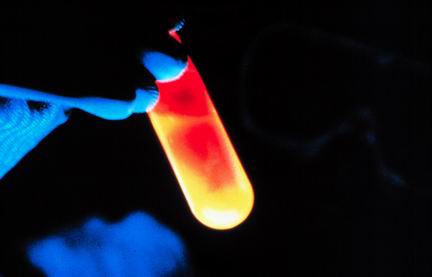
Which is the name of the kind of solid substance formed in this figure?  
a)
aqueous 
b)
precipitate
c)
acid
d)
synthesis 
50.
example of physical change
a)
mixing paint together
b)
making pancakes
c)
breaking glow sticks
d)
fireworks
51.
Fe2O3 has
a)
2 Iron atoms, 3 oxygen atoms
b)
6 iron atoms, 6 oxygen atoms
c)
3 iron atoms, 2 oxygen atoms
d)
1 iron atom, 6 oxygen atoms
52.

6CO2 + 6H2O contains how many elements

a)

4

b)

36

c)

3

d)

2

53.
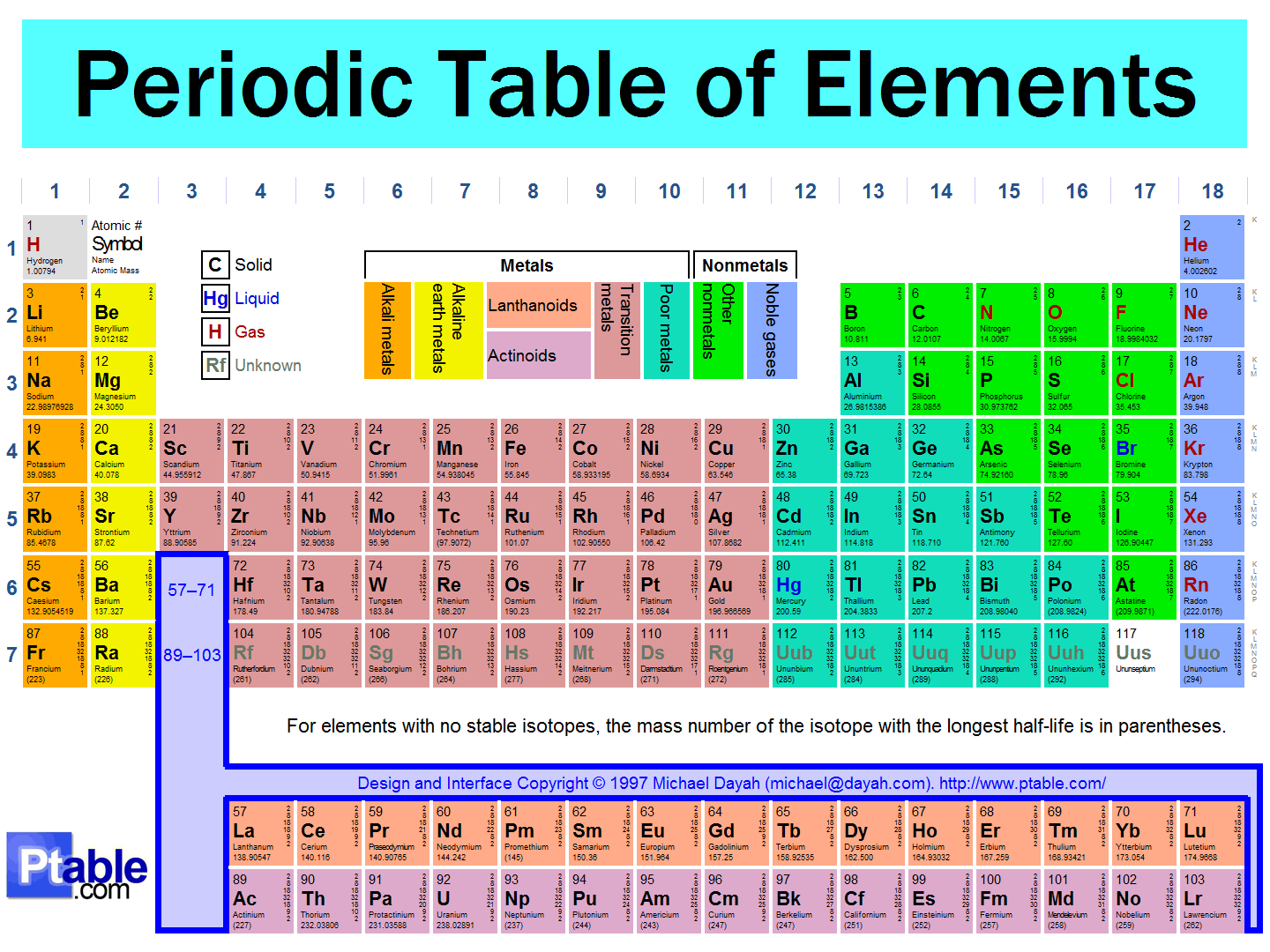
In the modern periodic table elements are arranged by:
a)
atomic mass
b)
atomic number
c)
valence electrons
d)
number of isotopes
54.
Each column in the periodic table is called a 
a)
period
b)
group
c)
cluster
d)
unit
55.
The atomic number tells you what?
a)
number of electrons
b)
number of protons
c)
number of neutrons
d)
both electrons and protons in an atom.
56.
Beryllium is in group number______.
a)
Group 2
b)
Group 3
c)
Group 4
d)
Group 7
57.
The period for Bromine is ___________.
a)
3
b)
2
c)
4
58.
The horizontal row on the periodic table is called a
a)
group
b)
family
c)
period
d)
atomic number
59.
Elements which are shiny, conduct electricity and heat are called
a)
metal
b)
nonmetal
c)
metalloid
d)
nonexistent
60.
Which group of the periodic table is composed of inert (not reactive)  gases?
a)
alkali metals
b)
alkaline earth metals
c)
halogens
d)
noble gases
61.
The atoms along the staircase are called 
a)
metals
b)
nonmetals
c)
metalloids
d)
noble gases
62.
How many neutrons are in a Gold atom?
a)
79
b)
196
c)
118
d)
275
63.

What is the atomic number?

a)

the number of protons in the nucleus

b)

the number of protons and neutrons in the nucleus

c)

the number of neutrons in the nucleus

d)

the number of protons in the energy levels

64.

What is the mass number?

a)

the number of protons in the nucleus

b)

the number of protons and neutrons in the nucleus

c)

the number of neutrons in the nucleus

d)

the number of protons and electrons in the atom

65.
If an atom has 12 positively charged subatomic particles, which of the following must it also have to be considered a neutral atom?
a)
12 neutrons
b)
12 electrons
c)
12 protons
d)
24 protons and neutrons
66.

An atom has 10 protons, 15 neutrons and 10 electrons what is its mass number.

a)

20

b)

10

c)

35

d)

25

67.

Which of the following determines the identity of an element?

a)

number of protons

b)

atomic mass

c)

number of neutrons

d)

number of shells

68.
Where is most of the mass in an atom located?
a)
in the nucleus
b)
in the protons
c)
in the neutrons
d)
in the electrons
69.

Subatomic particle that has a positive charge

a)

electron

b)

poitron

c)

neutron

d)

proton

70.

Which parts of the atom move around the nucleus?

a)

electrons

b)

protons

c)

electrode particles

d)

neutrons

71.
The electrons that are on the outer most region of the atom
a)
Shell Electrons
b)
Violent Electrons
c)
Valence Electrons
72.
The different energy levels of electrons as they orbit the nucleus
a)
Electron Cloud
b)
Orbitals (Energy Levels)
c)
2, 8, 18, 32
73.
If an element has 14 protons, 15 neutrons, and 14 electrons, what is that elements atomic mass
a)
28
b)
14
c)
29
74.
Alkali metals are located where on the periodic table?
a)
Group (column 1)
b)
Group 8 and Period 4
c)
Period 7
75.
The first energy level can hold up to how many electrons?
a)
8
b)
4
c)
2
d)
5