wayground logo

Free Printable Worksheets

Font size

S
M
L
XL
Worksheets

DA review (hall

Total questions: 71

Worksheet time: 1hrs 11mins

Name
Class
Date
1.
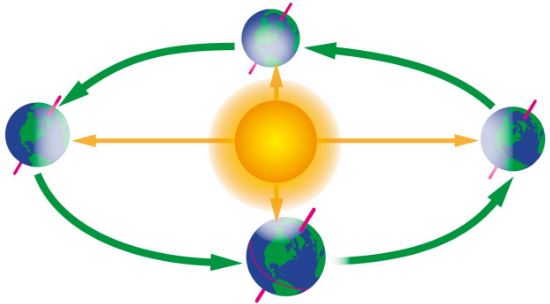
What season is when the north pole is tilted toward the sun?
a)
summer
b)
winter
c)
fall
d)
spring
2.

The earth's axis is tilted (a)   degrees off center.

3.
What effect does the tilt of the earth have?
a)
It changes the angle that the sun strikes the earth in different land areas
b)
It causes the earth to be farther away from the sun at different times of the year
c)
When the earth is tilted away from the sun we have night
d)
When the earth is tilted away from the sun we have day
4.

1. Based on the model above, which season is point X most likely experiencing?

a)

spring

b)

summer

c)

winter

d)

fall or autumn

5.

In the diagram below, the Northern hemisphere would be in what season at position A?

a)

Fall or Autumn

b)

Spring

c)

Winter

d)

Summer

6.
In spring/summer, the axis of the earth is pointed away or toward the sun?
a)
towards
b)
Neither away or toward
c)
away
7.
Which season is taking place in the Southern Hemisphere in Position 1?
a)
Winter
b)
Spring
c)
Summer
d)
Fall
8.
Which season is taking place in the Northern Hemisphere in Position 1?
a)
Winter
b)
Spring
c)
Summer
d)
Fall
9.
Which season is taking place in the Northern Hemisphere in Position 2?
a)
Winter
b)
Spring
c)
Summer
d)
Fall
10.
What season is letter A in the northern hemisphere?
a)
Winter
b)
Summer
c)
Spring
d)
Fall
11.

Most geologists think that the movement of Earth’s plates is caused by _______

a)

convection.

b)

continental drift.

c)

subduction.

d)

conduction.

12.

A place where two plates slip past each other, moving in opposite directions, is known as a _______

a)

transform boundary

b)

divergent boundary.

c)

convergent boundary.

d)

rift valley.

13.

The place where two plates come together is known as a _______

a)

transform boundary.

b)

divergent boundary.

c)

convergent boundary.

d)

rift valley.

14.

Below is a picture of sea-floor spreading. How are the ocean crusts moving?

a)

Converging

b)

Diverging

c)

Sliding

d)

No movement

15.

The San Andreas Fault in California is known as an active earthquake area. What type of

boundary is it?

a)

Converging

b)

Diverging

c)

Transform

d)

Sea Floor Spreading

16.
What are the two types of crust
a)
continental and oceanic
b)
ocean and upper
c)
lower and upper
d)
pizza and subway
17.

What is a plate boundary where both plates move away from each other?

a)

divergent

b)

plate

c)

convergent

d)

transform

18.

According to Wegener's theory of continental drift,

a)

Earth's surface is made up of seven major landmasses

b)

the continents do not drift

c)

Earth is slowly cooling and shrinking

d)

the continents were once joined together in a single landmass and have slowly moved.

19.

What is Pangea?

a)

the name of a German scientist

b)

the name of a supercontinent that existed millions of years ago

c)

another name for continental drift

d)

the name of an ancient fossil

20.
In the diagram given, what happens as we move to the left?
a)
Stars Get Larger
b)
Stars get Colder
c)
Stars get hotter
21.
Which star is the coldest?
a)
Yellow Star
b)
Red Star
c)
Orange Star
d)
Blue Star
22.
Red stars are the _____________.
a)
hottest
b)
coolest
c)
biggest
23.
What determines the color of a star? 
a)
It's size
b)
It's temperature
c)
It's composition
d)
They are all the same color 
24.
As you move from the bottom to the top of the H R diagram the __________ changes.
a)
Temperature
b)
Luminosity or Brightness
25.
Which is an example of a Main Sequence star?
a)
Betelgeuse
b)
our Sun
c)
Sirius B
d)
Polaris
26.
Which star has the lowest temperature?
a)
A
b)
B
c)
C
d)
D
27.
In the diagram given, what happens as we move to the left?
a)
Stars Get Larger
b)
Stars get Colder
c)
Stars get Hotter
d)
Stars get Brighter
28.

Is the surface temperature of White Dwarf stars higher or lower than Red Supergiants?

a)

Higher

b)

Lower

29.

The fluid that surrounds the organelles is... (hint... "Try to pull a fast one and..."

a)

chloroplast

b)

cytoplasm

c)

vacuole

d)

cell wall

30.
What do vacuoles do? 
a)
They actually do not have an important role
b)
They protect the cell
c)
They are the brain of the cell
d)
storage area for cells; water storage in plants 
31.
If you were some bad guy trying to sneak into an animal cell, who would be there to stop you?
a)
nucleus
b)
mitochondria
c)
cell membrane
d)
cell wall
32.
Which of the following, found ONLY in plant cells, provides structure?
a)
cell wall
b)
chloroplast
c)
mitochondria
d)
vacuole
33.

Cells that are only made of (a)   cell are called unicellular.

34.

Which of the following statements is true?

a)

Plants and animal cells have cell walls for protection.

b)

Animal cells have one large vacuole; the plant cell has tiny ones.

c)

Plant cells contain chlorophyll; animal cells have lysosomes.

d)

Animal cells are box shaped; plant cells are circular.

35.

Bacteria is classified as a what?

a)

Prokaryote

b)

Eukaryote

36.
Directs all cell activities through the DNA located there.
a)
Lysosomes
b)
Nucleus
c)
ribosomes
d)
Mitochondria
37.
Where are proteins made?
a)
Golgi body
b)
Mitoichondria
c)
Chromosomes
d)
Ribosomes
38.
What are tiny organelles that convert glucose into ATP?
a)
Ribosomes
b)
Vesicles
c)
Cytoskeleton
d)
Mitochondria
39.
Plants and animal cells are examples of ___ cells 
a)
prokaryotic cells 
b)
eukaryotic cells 
40.
Which of the following would be found in both eukaryotic AND prokaryotic cells?
a)
chloroplast
b)
DNA
c)
nucleus
d)
endoplasmic reticulum
41.

What does the mitochondria do for the cell?

a)

Converts food into energy

b)

Photosynthesis to make food

c)

Makes proteins

d)

Tells the other organelles what to do

42.

Beak shape depends on...

a)

where birds live

b)

who they hang out with

c)

diet (fish or seeds)

d)

exercise

43.

This is the organisms with traits best suited to their environment are more likely to survive and reproduce.

a)

Variation

b)

Mutation

c)

Natural Selection

d)

Gradualism

44.

This is an inherited trait that makes an individual different from other members of its species.

a)

Variation

b)

Mutation

c)

Punctuated Equilibrium

d)

Embryology

45.

A giraffe has a long neck in order to better reach leaves to eat. This is an example of _____.

a)

an adaptation

b)

environment

c)

response

d)

stimulus

46.

How do adaptations help animals?

a)

To escape animals

b)

to hunt for food

c)

to survive in their habitats

d)

All of these are correct

47.

Plants with spines and waxy leaves are well suited for life in which environment?

a)

Desert

b)

Temperate forest

c)

Grassland

d)

Tropical Rainfroest

48.
The seasonal movement of an organism from one place to another
a)
camouflage
b)
migration
c)
hibernation
d)
function
49.
EVOLUTION
a)
A trait that helps an organism survive and reproduce
b)
Competition where offspring compete for food and other resources in order to survive
c)
The gradual change of species over time
d)
Most species produce far more offspring than can possibly survive
50.
VARIATION
a)
The gradual change of species over time
b)
Differences in traits between members of the same species
c)
Organisms develop in similar ways in the womb
d)
Survival of the fittest
51.
What is the reactant in the following equation?
2NaHCO3  -> Na2CO3  +  CO2  + H2O
a)
NaHCO3
b)
Na2CO3
c)
CO2
d)
H2O
52.
Which of the following describes the law of conservation of mass?
a)
In a reaction, atoms are created or destroyed.
b)
In a reaction, atoms are not lost or made.
c)
In a reaction, the mass of the product may be more or less than the reactants.
d)
In a reaction, mass never stays the same.
53.
For the equation:
2H2 +  O2 --> 2H2O
How much H2O will be produced if we react 4g of H2 and 32g of O2?
a)
4g
b)
32g
c)
36g
d)
28g
54.

The number in front of a compound or element is a  (3H2O)

a)
Subscript
b)
Coefficient
c)
Superscript
d)
Charge
55.

Is this equation balanced?

a)

Yes

b)

No

56.

Is this equation balanced?

a)

Yes

b)

No

57.

What does the number 3 represent in 4NH3?

a)

Subscript

b)

Superscript

c)

Coefficient

58.
A chemical reaction is balanced when
a)
both sides have the same elements
b)
Both sides have the same  number of atoms
c)
Same subscripts
d)
Same coefficients
59.
Measure of the amount of matter 
a)
mass
b)
volume
c)
weight
d)
density
60.
What is the Law of Conservation of mass?
a)
Mass is created in a chemical reaction
b)
Mass is created in a physical change
c)
New chemicals formed from a chemical reaction have a larger overall mass than the original reactants
d)
Mass is never created or destroyed
61.
What type of tides would this arrangement of earth-moon-sun create?
a)
neap tide
b)
spring tide
c)
new moon tide
d)
full moon tide
62.

What type of tide would this arrangement of earth-moon-sun create?

a)
full moon tide
b)
new moon tide
c)
neap tide
d)
spring tide
63.
Which phase of the moon is represented in this diagram?
a)
new moon
b)
first quarter
c)
full moon
d)
last quarter/third quarter
64.
Which body has the greater effect on Earth's tides?
a)
Sun
b)
Saturn
c)
Moon 
d)
Venus
65.
What type of tide will occur at 9:30 a.m.?
a)
low 
b)
high 
c)
none
d)
high and low
66.
The bulge of water on the side of the Earth closest to the moon produces ___________.
a)
high tide
b)
low tide
c)
neap tide
d)
spring tide
67.

Spring tides have the largest tidal ranges because...

a)

the earth, moon, and sun are aligned for greater gravitational force.

b)

the moon has the strongest gravitational force.

c)

the sun has the most gravitational force.

d)

none of the above

68.

High tides and low tides each happen _____ times per day.

a)

4

b)

2

c)

1

d)

24

69.

Janis lives near the ocean. What observations can Janis make about the moon's phases that she can relate to the ocean's tides?

a)

that the moon phases effect high tides and low tides

b)

the moon does not affect the tides

c)

waxing and waning crescents affect the tides

d)

only new moon and full moon affect the tides

70.

During a neap tide, the sun, moon, and earth are at a ___________ angle.

a)

360 degree

b)

23.5 degree

c)

45 degree

d)

90 degree

71.

What type of tide is evident when the moon is in the full moon phase?

a)

high tide

b)

low tide

c)

spring tide

d)

neap tide