Wayground logo

Free Printable Worksheets

Font size

S
M
L
XL
Worksheets

Review for 1st Nine Weeks Test - Physics

Total questions: 60

Worksheet time: 41mins

Name
Class
Date
1.

A measure of how quickly an object gets from one place to another is:

a)

acceleration

b)

displacement

c)

speed

d)

position

2.

To elude a pack of wolves, an elk runs 15 kilometers in 0.75 hours. What is the speed of the elk?

a)

5 km/h

b)

10 km/h

c)

12 km/h

d)

20 km/h

3.

The term that refers to the location of an object is:

a)

distance

b)

displacement

c)

position

d)

All of the above

4.

The term that describes the amount of change in a certain direction in the location of an object is:

a)

distance

b)

displacement

c)

position

d)

none of the above

5.

The total length of a journey from start to finish with no regard to direction is called:

a)

distance

b)

displacement

c)

position

d)

velocity

6.

The slope of a distance versus time graph represents:

a)

position

b)

displacement

c)

speed

d)

acceleration

7.

The graph represents the motion of a student on in-line skates. The speed of the student in m/sec is:

a)

10

b)

20

c)

30

d)

40

8.

Which graph in Figure 3-1 represents an object whose speed is zero?

a)

1

b)

2

c)

3

d)

4

9.

Which graph in Figure 3-1 represents an object with non-zero uniform speed?

a)

1

b)

2

c)

3

d)

4

10.

Which graph in Figure 3-1 represents an object whose speed is increasing?

a)

1

b)

2

c)

3

d)

4

11.

Which graph in Figure 3-1 represents an object whose speed is decreasing to zero?

a)

1

b)

2

c)

3

d)

4

12.

The slope of a graph line is determined by calculating the:

a)

change in the horizontal values divided by the change in the vertical values.

b)

change in the horizontal values multiplied by the change in the vertical values.

c)

change in the vertical values divided by the change in the horizontal values.

d)

change in the vertical values divided by the change in the horizontal values.

13.

The graph below represents the motion of a cart along a straight line. During which time intervals is the cart moving with non-zero uniform speed?

a)

AB and BC

b)

AB and CD

c)

BC and CD

d)

BC and DE

14.

Many cars are made with an automatic feature called cruise control. When the driver sets a car on cruise control, a computer adjusts the engine to maintain the car’s speed constant. When a car is on cruise control on a straight road, the acceleration of the car is best described as:

a)

equal to the initial speed when the cruise control was set.

b)

equal to zero.

c)

greater than it was before the cruise control was set.

d)

less than it was before the cruise control was set.

15.

A car goes from 30 miles per hour (mph) to 60 mph in six seconds. The acceleration of the car is:

a)

5 mph/s

b)

6 mph/s

c)

30 mph/s

d)

180 mph/s

16.

Which point on the speed versus time graph in Figure 4-1 has the highest acceleration?

a)

A

b)

B

c)

C

d)

D

17.

Which of the following statements about the graph in Figure 4-1 is FALSE?

a)

The speed of the car at point D is twice the speed of the car at point A.

b)

The speed of the car is increasing at point B.

c)

The speed of the car is constant at point D.

d)

The speed of the car is increasing at point C.

18.

A rocket has an acceleration of 50 m/sec2. How long does it take the rocket to reach a speed of 1,000 m/sec?

a)

0.05 s

b)

20 s

c)

50 s

d)

50,000 s

19.

A sports car reaches a speed of 50 m/sec in 12 seconds after starting from rest. The acceleration of the car is:

a)

0.24 m/sec2.

b)

4.17 m/sec2.

c)

38 m/sec2.

d)

50 m/sec2.

20.

Between two and three seconds, the speed of the object shown in Figure 4-2:

a)

is approximately 1.33 m/sec.

b)

is approximately 3 m/sec.

c)

increases from 1 m/sec to 4 m/sec.

d)

increases from rest to 4 m/sec.

21.

The acceleration of the object in Figure 4-2 is:

a)

1 m/sec2 between 0 and 2 seconds.

b)

4 m/sec2 between 2 and 3 seconds.

c)

-1 m/sec2 between 6 and 8 seconds.

d)

4 m/sec2 between 3 and 6 seconds.

22.

According to Figure 4-2, in the first 5 seconds the object moves a distance of approximately:

a)

5 m

b)

10 m

c)

12.5 m

d)

20 m

23.

Which of the following statements CANNOT ever be true?

a)

An object can have a speed of zero and an acceleration that is not zero.

b)

An object can have an acceleration of zero and a speed that is not zero.

c)

An object can have a speed that is changing and still have zero acceleration.

d)

An object can have a speed that is decreasing and still have acceleration.

24.

The graph in Figure 4-3 shows an acceleration of:

a)

0 m/sec2.

b)

0.2 m/sec2.

c)

0.4 m/sec2.

d)

2.0 m/sec2.

25.

The initial speed (vi) shown in Figure 4-3 is:

a)

0.0 m/sec.

b)

0.2 m/sec.

c)

0.4 m/sec.

d)

2.0 m/sec.

26.

An object falls for 2 seconds after being dropped from rest. Its speed is approximately:

a)

19.6 m/sec.

b)

4.9 m/sec.

c)

9.8 m/sec.

d)

-19.6 m/sec.

27.

A object is thrown straight upwards with a speed of 19.6 m/sec. Three seconds later, its speed is:

a)

zero

b)

9.8 m/sec downward.

c)

49 m/sec upward.

d)

29.4 m/sec downward.

28.

The acceleration of gravity on the moon is about 1.6 m/sec2. A 2-kilogram object on the moon is dropped from rest. After ten seconds, the speed of the object is:

a)

1.6 m/sec.

b)

-9.8 m/sec.

c)

-16 m/sec.

d)

98 m/sec.

29.
What is a PUSH or PULL of an object?
a)
Motion
b)
Force
c)
Friction
d)
Gravity
30.
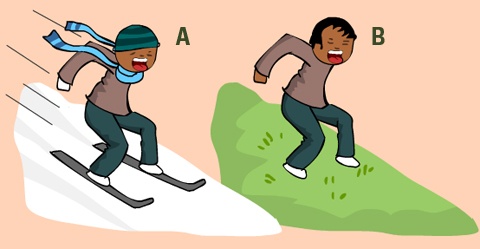
Why is it harder for the boy in Image B to get down the hill?
a)
Motion
b)
Friction
c)
Work
d)
Displacement
31.
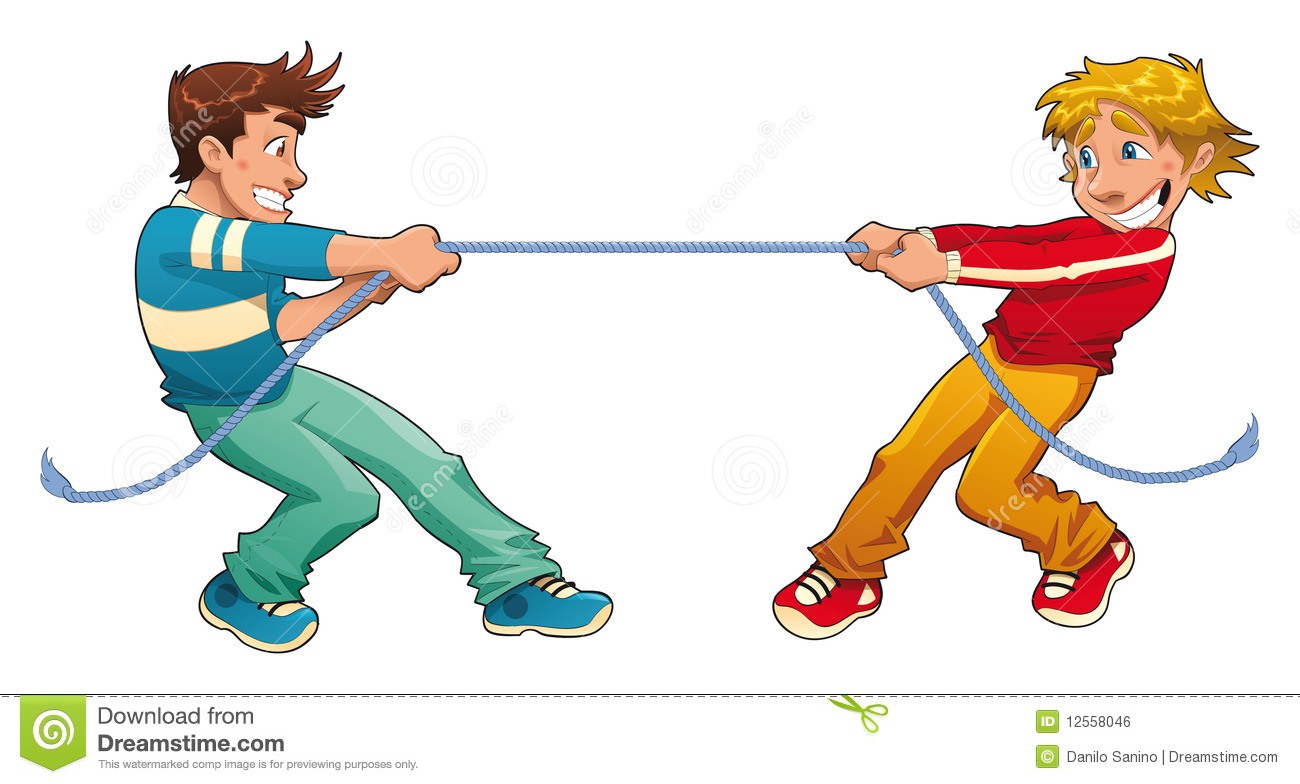
If these boys are pulling with the same amount of force.  What will happen?
a)
The boy in blue will win.
b)
They will not move at all.
c)
The boy in red will win.
d)
Both will fall down.
32.
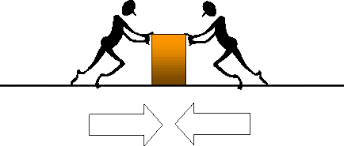
It takes more force to accelerate the iron man on the left than the iron man on the right because the iron man on the left has more mass. This best describes
a)
Newton's first law, the law of inertia
b)
Newton's second law, the law of acceleration
c)
Newton's third law, the law of action reaction 
d)
The law of universal gravitation
33.
The formula 
? = mass x acceleration
or 
? = m x a 
is used to find 
a)
Force
b)
Velocity
c)
Momentum
d)
Gravity
34.
For every action, there is an equal and opposite reaction.
a)
Newton's
1st
Law of Motion
b)
Newton's
2nd
Law of Motion
c)
Newton's
3rd
Law of Motion
35.
What is the attractive force that exists between all objects that have mass?
a)
Weight
b)
Mass 
c)
Gravity
d)
Viscosity
36.
If an object is stationary (not moving) the forces acting upon it are _____________
a)
unbalanced
b)
weak
c)
balanced
d)
Hulk Smash!
37.
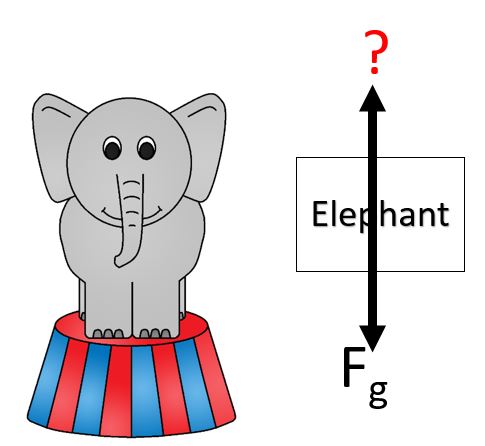
Name the missing force...
a)
weight force
b)
normal force
c)
applied force
d)
frictional force
38.
What is the net force
a)
10 N
b)
0 N
c)
25 N
d)
1 N
39.

A squirrel sits on the ground and eats a donut. We know the forces on him must be balanced because...

a)

Forces are always balanced

b)

the squirrel is not accelerating

c)

squirrels are projectiles

d)

he's eating a donut

40.
Name the missing force...
a)
weight force
b)
normal force
c)
buoyant force
d)
applied force
41.
Are forces balanced or unbalanced when a marble speeds up rolling down a ramp?
a)
Balanced
b)
Unbalanced
42.
Which one needs a greater net force to move, a kilogram of feathers or a kilogram of iron? 
a)
feathers 
b)
iron
c)
same
d)
depends on their friction
43.
Which force produces a change in motion?
a)
unbalanced force
b)
balanced force
c)
gravitational force
d)
frictional force
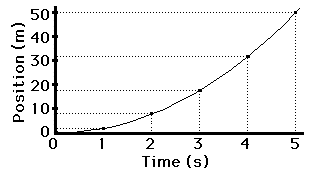
44.
The picture of the position vs. time graph shows an object that is...
a)
accelerating/speeding up
b)
moving at a constant speed 
c)
not moving 
d)
accelerating/slowing down. 
45.
What is the standard unit force is measured in?
a)
Newtons
b)
pounds
c)
grams
d)
meters
46.
What is Newton's First Law known as? The Law of
a)
Friction
b)
Mass
c)
Inertia
d)
Gravity
47.
What is the formula for force?
a)
F=M/A
b)
F=MA
c)
F=AX
d)
what is force?
48.
What is Newton's Third Law?
a)
Object in motion stays in motion and an object at rest stays at rest unless acted on by a outside force
b)
Force = mass x acceleration
c)
For every action there is an equal and opposite reaction
49.
According to Newton's second law, if you increase the force applied to an object :
a)
it accelerates more
b)
it doesn't move
c)
you get more inertia
d)
it decelerates
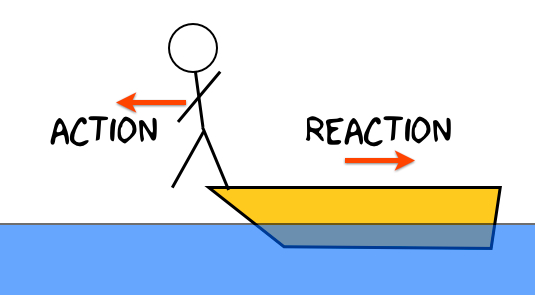
50.
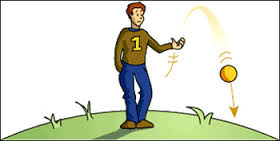
What law of motion does this picture represent?
a)
Newtons 1st law
b)
Newtons 4th law 
c)
Newtons 3rd law 
d)
Newtons 2nd law
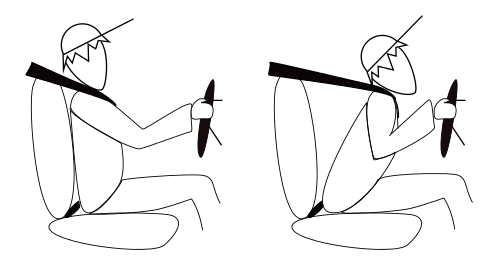
51.
What Newtons law does this picture represent
a)
Newtons 2nd law 
b)
Law of gravity 
c)
Newtons 1st law
d)
Newtons 5th law
52.
A distance vs. time graph shows an object's
a)
frame of reference
b)
speed
c)
acceleration
d)
favorite food
53.
When something has speed in a certain direction it is called ___________.
a)
motion
b)
position
c)
velocity
d)
speed
54.
Acceleration of an object happens when things ________
a)
slow down
b)
go faster
c)
change direction (turn)
d)
All of the above
55.
LT4: The graph shows Ashley riding her bike to Maria's house. 
What is occurring from point A to point B?
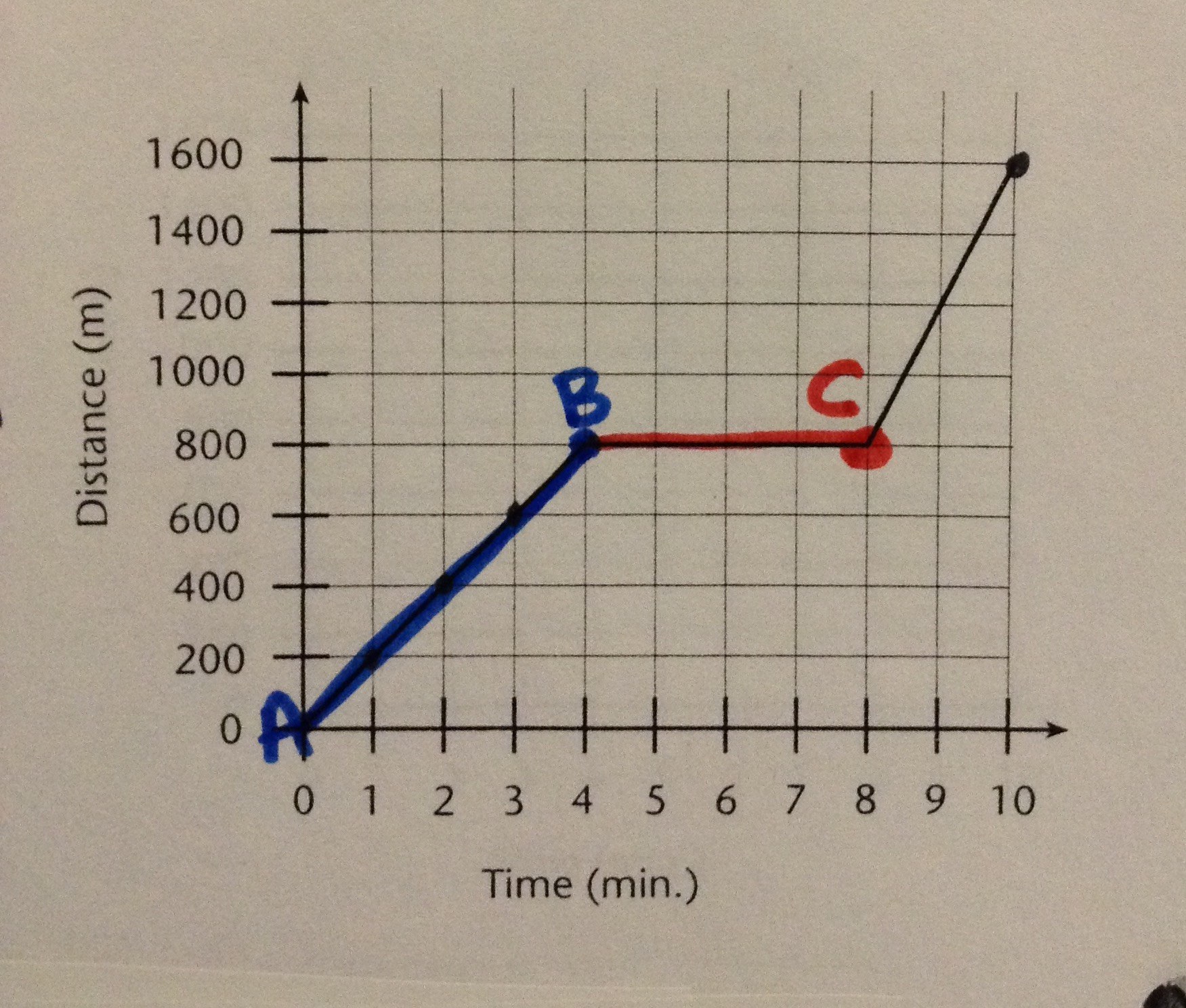
a)
they are traveling at a constant speed
b)
they are decreasing in speed
c)
they stopped to take a break
56.
LT4: The graph shows Ashley riding her bike to Maria's house. 
What was occurring from point B to point C?
a)
She was increasing her speed.
b)
She stopped for 4 minutes
c)
She was decreasing in speed
57.
The graph represents
a)
no motion
b)
Constant velocity
c)
Acceleration
d)
negative acceleration
58.
The graph represents
a)
no motion
b)
constant velocity
c)
acceleration
d)
negative acceleration
59.
Forces always act in equal and opposite pairs.
a)
Newton's 1st Law
b)
Newton's 3rd Law
c)
Newton's second law
60.
Newton's first law of motion states that __________.
a)
when a force is applied on an object, there is an equal force applied by the object in the opposite direction
b)
hen a force acts on an object, its acceleration is in the same direction as the force
c)
an object will remain at rest or keep moving with a constant velocity unless a force acts on it
d)
cceleration is calculated by dividing the force exerted on an object by the mass of the object