
 Worksheets
Plate Motion
Total questions: 43
Worksheet time: 14mins
Earths outer layer is made up of:
Continents and Oceans
Mantle
Hard, Solid Rock
Water
What is responsible for the movement of tectonic plates?
Oceans
Gravity
Mantle
Wind
Earth's outer layer is broken up into...
Bowls
Continents
Rocks
Plates
A diagram that shows what the inside of something looks like
Cross Section
Model
Fossil
System
An oceanic trench is caused by what kind of plate boundary?
Divergent
Convergent
Transform
The Mid-Ocean ridge is an underwater mountain range formed from what type of plate boundary?
Divergent
Convergent
Transform

What type of plate boundary is this?
Divergent
Convergent
Transform

What type of plate boundary is this?
Divergent
Convergent
Transform
Which one of these can serve as evidence for plate boundary movement?
Fossils
Mountains
Earthquakes
All

Which statement best describes what Earth’s outer layer is like underneath the surface in the image?
Underneath both the ocean and land the Earth is made of water
Underneath both the ocean and land the Earth is hard, solid rock
Underneath the land is rock. Underneath the ocean the Earth is water
Underneath the ocean and land is sand and water.

Which diagram shows what happened between the two plates as they moved away from each other?
A
B
C
D

If we took a cross section of a potted plant by cutting it vertically, what would the cross section look like?
A
B
C
D

How could these fossils be found in both South Africa and India?
India and South Africa are on different plates. They were separated from many earthquakes and volcanic activity over time.
India and South Africa are on different plates. They floated away from each other across the ocean.
India and South Africa are on different plates. The plates slowly moved apart as new plates from underneath got added between them over millions of years.
India and South Africa are on different plates. Suddenly, many years ago, they split apart to where they are now.

What happens when two plates move apart?
a new plate from underneath fills in the gap created by the plates moving apart
sand and dirt fill in the gap created by the plates moving apart
water fills in the gap created by the plates moving apart
soft, solid rock from underneath the plates rises up and hardens, adding solid rock to the edges of both plates.

What happens when two plates are moving toward each other?
The plates hit each other and break into pieces making sand.
One plate goes underneath the other plate into the soft rock below.
The plates push against each other, making the edges bend upward.
One plate goes underneath the other plate into the ocean below.

What patterns can you see on this map?
Earthquakes happen in similar places.
Earthquakes and volcanoes happen in similar places on plate boundaries.
Volcanoes happen in similar places.
Volcanoes and earthquakes happen in this order: volcano, earthquake, volcano, earthquake, and so on.

The plates of the Earth moved
suddenly.
gradually.

How often or how fast something happens is...
rate.
to analyze.
a relationship.
a claim.
What is the effect of plates moving?
volcanoes
earthquakes
tornadoes
both volcanoes and earthquakes
Can you feel the plates moving?
Yes
No
The place where two plates meet.
Plate
Continent
Plate Boundary
Landform
An underwater mountain range formed when two plates move apart.
Plate Boundary
Mid-Ocean Ridge
Trench
Cross-Section
A long, deep indentation in the ocean floor formed when two plates move together.
Plate Boundary
Mid-Ocean Ridge
Trench
Cross-Section
something we observe to be similar over and over again
pattern
mantle
eruption
rifiting
mantle: the layer of soft, solid rock underneath Earth's plates
True
False
divergent: moving apart in different directions
True
False
a diagram that shows what the inside of something looks like
convergent
plate boundary
earthquake
cross section
mid-ocean ridge
the place where two plates meet
convergent
plate boundary
earthquake
cross section
surface
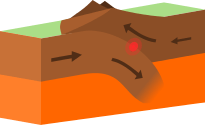

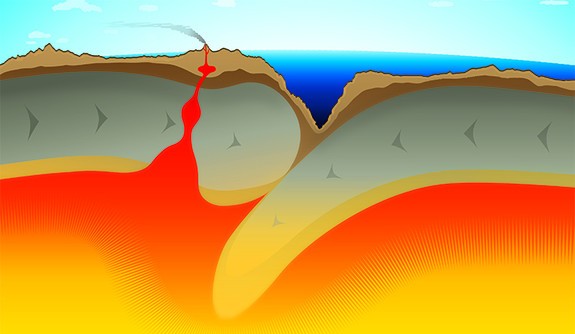
At which boundary do you find a trench?
Transform
Divergent
Convergent
Strike-Slip
Earthquakes are caused by
activity on Earth's surface
extreme weather
Earth's rotation
plate motion
Which Image represent a divergent boundary?


Which area has the LEAST amount of earthquake activity?


What land feature does X represent?
valley
trench
mid-ocean ridge
sink-hole


The older layers are at the bottom and the younger layers are at the top.
True
False
Layers of rocks take _______________ years to form.
ten
million
fifty
hundred

Which rock layer is probably the oldest?
A
B
C
What do scientists learn from studying rock layers?
The date the plant/animal died
The exact date the animal/plant died
The relative date the animal/plant died

