
 Worksheets
Refraction of light 9
Total questions: 83
Worksheet time: 47mins
What letter is used to represent refractive index?
c
n
v
θ
What letter is used to represent the speed of light?
c
n
v
θ
What is a line drawn at 90° to a surface called?
incident ray
normal line
refracted ray
tangent
What causes refraction?
A change in frequency of a wave.
A change in amplitude of a wave
A change in speed of a wave.
A change in phase of a wave.
What direction does the ray bend when entering a more optically dense material, where the wave travels more slowly?
Towards the normal.
Away from the normal.
No change.
Answer is not listed above.
What is the refractive index of air?
1.5
1.2
0.5
1.0
Which is the correct equation for refractive index?
n = v /c
n = v × c
n = c / v
n = c v
Which of the following is true about a wave that has been refracted?
The speed and frequency changes, but the wavelength stays the same.
The speed and wavelength changes, but the frequency stays the same.
The wavelength and frequency changes, but the speed stays the same.
The speed and frequency changes, but the amplitude stays the same.
What is the speed of light in water of refractive index 1.33?
3.0×10⁸m/s
2.0×10⁸m/s
2.3×10⁸m/s
3.9×10⁸m/s
Which of the following is true?
When light travels from a vacuum into glass it speeds up.
When light travels from a vacuum into glass it bends away from the normal.
When light travels from a vacuum into glass the frequency decreases.
When light travels from a vacuum into glass the wavelength decreases.
Which of the following is a correct representation of snell's law?
n1sinθ2=n2sinθ1
n1sinθ1=n2sinθ2
n2sinθ1=n1sinθ2
n1/sinθ1=n2/sinθ2
flint glass n=1.70
barium glass n=1.60
crown glass n=1.523
water n=1.33
diamond n=2.45

Based on the image, which medium has a larger index of refraction?
Medium 1 has a larger index of refraction.
Medium 2 has a larger index of refraction.
Both mediums have the same index of refraction.
Cannot be determined.

Based on the image, as light passes from medium 1 to medium 2
light speeds up and bends towards the normal
light speeds up and bends away from the normal
light slows down and bends towards the normal
light slows down and bends away from the normal

What is it called when light bends as it moves from one substance to another?
Absorption
Reflection
Refraction
Incidence
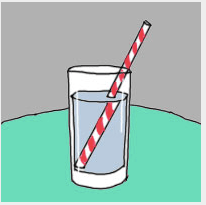
Why does the straw appear to be bent?
light is reflected
light is absorbed
light is turned
light is refracted


Which of the following statements is NOT TRUE?
B is the incident ray
D is not lie in the same plane as A, B and C
B and D are parallel light rays
incident angle is greater than the refracted angle
Given the refractive index of:
flint glass n=1.70
crown glass n=1.523
water n=1.33
diamond n=2.45
Light has the highest velocity in which medium?
flint glass
crown glass
water
diamond
According to Willebord Snell, light passing from air to glass will cause the light to
maintain its speed in glass
increase its speed in glass
bend towards the normal
accelerate in the glass
Light travels through a liquid at 2.25 x 10 8 ms-1. What is the refractive index of the liquid? (speed of light in vacuum = 3.00 x 10 8 ms-1)
1.33
1.18
1.00
0.75

Which one shows the angle of refraction of the light?
A
B
C
D

A ray of light in air is incident at an angle on one side of a rectangular glass block, as shown. Which ray diagram correctly describes the complete path of the ray of light?
(Determine if light bends towards or away from normal at each boundary)


When does the light is refracted?
When light travels in a straight line
When light is bounced
When light travels in two different mediums
When light cannot pass through an opaque object

Diagram shows the condition of a spoon in a glass of water.
What can be observed about the spoon?
The spoon looks bent.
The water is clearer.
The water level rises.
Light is refracted.

What is the conclusion from your observation in this picture?
Light travels in a straight line
Light can be refracted
Light can be reflected
Light can pass through a transparent material

Light passes into a glass block. Which is the angle of refraction?
A
B
C
D
What direction does the ray bend when entering a more optically dense material, where the wave travels more slowly?
Towards the normal.
Away from the normal.
No change.
Answer is not listed above.


Refraction is when light__________.
Is bounced by an object or material.
Changes speed as it travels in different materials which causes bending.
When light speeds up to over 300,000 km/s
Light emerging from water to air will bend ______ due to the change of speed as it crosses the boundary.
toward the normal
away from the normal
along the normal
Light travels through air, water, glass and many other materials. What path does it travel to get from one place to another?
sideways
back and forth
straight
up and down


Which of the following is correct about refraction of light?
Velocity of light is equal to zero as it propagates through the medium of different optical densities
Velocity of light is changes as it propagates through the medium of different optical densities
Velocity of light is constant as it propagates through the medium of different optical densities
Velocity of light does not exist it propagates through the medium of different optical densities
Which of the following statement is correct?
Light rays that propagate from a denser medium to less dense medium will refracted towards the normal line
Light rays that propagate from a denser medium to less dense medium will refracted parallel to the normal line
Light rays that propagate from a denser medium to less dense medium will refracted away the normal line
Light rays that propagate from a denser medium to less dense medium will show no reaction
How many law of refraction of light that we have learnt?
1
2
3
4
What is the velocity of light in sodium chloride, NaCl of reflective index, n = 1.54?
5.13 ×10⁻⁹ms−1
1.95×10⁸ ms−2
5.13×10⁻⁹ms−2
n =vc
The above formula is one of the way to determine the refractive index. What is the value of c?
3×10⁻⁸ms−1
3 ×10⁻⁸ms−2
3×10⁸ms−2
3×10⁸ms−1
All the following are true about total internal reflection except
incident angle, i = critical angle, c
incident angle exceeds the critical angle for two mediums
light ray propagates from a denser medium to a less dense medium
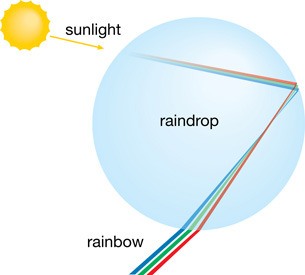
total internal reflection helps in the formation of rainbow
Which of the following is false about optical fibre?
Use in the field of medicine and telecommunication
Undergoes repeated refraction
Fibres are cheap and easy to handle
No electomagnetic interference
Total internal reflection can only occur if
Angle of incident, i = Angle of critical angle, c
Angle of incident, i < Angle of critical angle, c
Angle of incident, i > Angle of critical angle, c
Which of the following factors change when light refracts?
Frequency only
Wavelength only
Speed and frequency
Wavelength and speed

A straight glass rod appears to bend when placed in a beaker of water, as shown in the diagram below. What is the best explanation for this phenomenon?
The water is warmer than the air
Light travels faster in water than in air
Light is reflected at the air-water interface
Light is refracted as it crosses the air-water
interface
What happens to the speed and frequency of a light ray when it passes from air into water?
The speed decreases and the frequency increases
The speed decreases and the frequency remains the same
The speed increases and the frequency increases
The speed increases and the frequency remains the same

A ray of red light from a laser passes into a semi- circular glass block.What is shown at M?
Dispersion
Rarefaction
Reflection
Refraction
Which quantity is equivalent to the product of the absolute index of refraction of water and the speed of light in water?
wavelength of light in a vacuum
frequency of light in water
sine of the angle of incidence
speed of light in a vacuum

The diagram below shows a ray of monochromatic light incident on a boundary between air and glass. Which of the letters represent the path after it strikes the glass?
A
B
C
D
If the index of refraction of a certain material is n = 2, the speed of light in this material is ________.
6.7 × 10⁷
1.5 × 10⁸
3.0× 10⁸
6.0 × 10⁸
The speed of light in a piece of plastic is 2.00 × 10⁸ m/s. What is the absolute index of refraction of this plastic?
0.67
1.0
1.33
1.5
light does not require a medium to move through
true
false
light does not require a medium to move through
true
false
an object that is transparent allows light to pass through it. Select the one below that is transparent.
glass
brick
car
timber
translucent means...
all light easily passes through
no light passes through
light is absorbed
some scattered light passes through

the law of refraction is the angle a refracted ray makes with the normal
true
false

angle of incidence is
the angle incoming ray makes with normal
angle between refracted ray and normal

angle of refraction is the
angle between refracted ray and normal
angle incoming ray makes with normal
Refractive index measures how easily light travels through a substance. The higher the refractive index, the more the light bends when it enters the substance.
true
false
When the angle of refraction is 90 ° the angle of incidence is called the...
Angle of incidence
Critical angle
Angle of total internal reflection
Angle of refraction

_____ cables transmit beams of light without allowing any of the light to escape until it gets to the end of the cable.
Ethernet
Fiber optic
Armored
Coaxial

Which diagram correctly describes the critical angle c for air-water surface?
A
B
C
D

Light travels through a glass block as shown. Which angle is the critical angle for light in the glass?
A
B
C
D

Which letter refers to the normal line?
A
B
F
E
Why does light refract when it enters a medium?
light changes color
light changes frequency
light changes speed
light changes density
Which diagram shows a ray hitting a semicircular glass block at the critical angle, θ?


Diagram 20 shows a light ray, P is directed to the centre, O of semicircular glass block. Refractive index of the glass is 1.57.
At which direction A, B, C or D does the light propagate after point O?
A
B
C
D
If Total Internal Reflection occurs the light will bounce back at the same angle it came in
True
False
If light hits at an angle larger than the critical angle it will refract and pass through the material
True
False
Refraction occurs when light changes mediums, but does not change speeds
True
False
The higher the index of refraction, the faster light travels in that medium
True
False
Light traveling from a higher index of refraction to a lower index of refraction will bend towards the normal (refract at a smaller angle)
True
False

