
 Worksheets
Unit 3 - APES - Populations
Total questions: 102
Worksheet time: 5hrs 6mins
Which factor below is least likely to affect birth and fertility rates today?
number of people 60 or older
cost of raising and educating children
religious beliefs
educational and employment opportunities for women
average age at marriage
A metropolitan region of 100,000 people has 2000 births, 500 deaths, 200 emigrants, and 100 immigrants over a 1-year period. Its population growth rate is
1.2 percent.
1.4 percent
1.6 percent.
1.8 percent.
2.0 percent.
Which of the following pairs of indicators best reflects the availability of health care in a country?
Crude death rate and growth rate
Crude death rate and crude birth rate
Growth rate and life expectancy
Infant mortality rate and life expectancy
Infant mortality rate and crude death rate
Which of the following characteristics are typical of developed countries?
I High technology use
II Low GDP
III Small-scale sustainable agriculture
I only
II only
I and III only
II and III only
I, II and III
Which of the following statements about total fertility rate is correct
TFR is equal to the crude birth rate minus the crude death rate.
TFR is the average number of children each woman must have to replace the current population.
TFR is generally higher in developed countries than in developing countries
TFR is equal to the growth rate of a country
TFR is the average number of children each woman will give birth to during her childbearing years.
Even if a country reduces its birth rate and maintains replacement-level fertility, its population will still continue to grow for several decades because of
lower death rates
increased income.
population momentum
better health care.
increased life expectancy.
At current growth rates, which country will probably be the most populous in the world after 2050?
China
Brazil
India
Indonesia
United States
Which of the following countries best exemplifies phase 4 of a demographic transition?
Argentina
China
India
Mexico
Japan
Using the rule of 70, a population growing at 10% would double in
7 years
10 years
17 years
15 years
not enough information to tell
Populations whose age structure diagrams are narrower at the bottom than at the top have
high death rates
the same proportion of individuals in each age group
a declining population
a high growth rate
all of the above
A particular country has a Total Fertility Rate equal to replacement level fertility and emigration equal to immigration. Which of the following must be true?
The population will begin shrinking within ten years, based on the Rule of 70.
The population must be stable.
The population will begin growing as soon as TFR = 2.1.
Infant mortality must also be less than Crude Death Rate.
There is not enough information to tell.
Population size can be estimated using the formula
CBR + Immigration + CDR + Emigration
CBR + Immigration – CDR – Emigration
CBR + Immigration + CDR – Emigration
CBR – Immigration – CDR – Emigration
CBR – Immigration + CDR – Emigration
What factor describes when populations decrease because animals are moving out of a population?
Emigration
Limiting Factors
Immigration
Exponential Growth


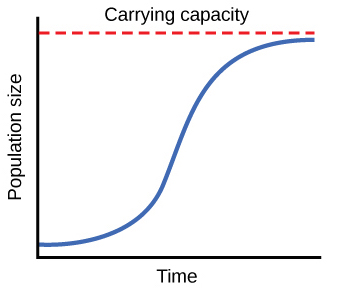
What point on the graph represents the carrying capacity?
A
B
C
D
A population is...
All members of one species in one area
All members of all species that live in one area
All of the living and nonliving things in an area
None of these

What is happening at the 'A' on the graph?
the population overshoots above the carrying capacity
the population stops growing
growth begins to slow down due to limited resources
growth is speeding up due to an abundance of resources
Two male Giraffes are fighting over the last green leaf of a tree that is dying.
Intraspecific Competition
Mutualsim
Predation
Commensalism
Interspecific Competition


Identify two main contributors for the dramatic increase in the world population over the last century.
increased access to birth control
development of modern medicine
increased immigration
introduction of the Industrial Revolution

If a country has a crude birth rate of 22 and a crude death rate of 7, what is the Annual Growth Rate? AGR = (cbr-cdr)/10
0.7%
1.5%
2.2%
7.0%

According to the graph, what can have the greatest impact on reducing global TFR?
increasing access to healthcare
increasing access to immigration
women empowerment

What is the dispersion pattern of herding animals, birds that flock together, and fish that form schools?
clumped
random
uniform
unpredictable
If angel fish produce hundreds of young several times a year, which statement below is true?
Angelfish have a k-strategy reproductive pattern
Angelfish have an r-strategy reproductive pattern
Angelfish probably have a low mortality rate
Angelfish provide a lot of care for their young
What term refers to the number of males and females in various reproductive age groups?
age structure
carrying capacity
reproductive dispersal
birth rates

Type III survivorship is characterized by
extremely high juvenile mortality
mortality that is not age dependent
most mortality occurring among the elderly
most juveniles surviving to a critical age


The basic facilities and services that support a community.
arable land
demographic transition
infrastructure
urbanization

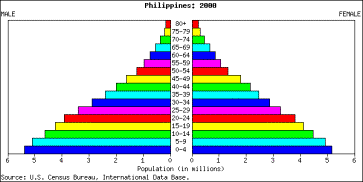
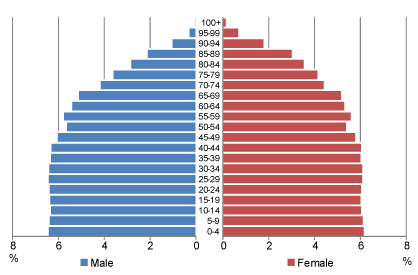
Which of the following characteristics is most closely associated with a country that demonstrates the age structure diagram show above?
There is a low infant mortality rate
A high percentage of the population has access to medical care
There is a low population growth
There is a high total fertility rate
What type of age structure diagram represents a population with negative growth rate?


Countries undergoing rapid populations growth include which of the following?
I only
II only
III only
II and III
I, II, and III

Represents the biotic potential of the species
A
B
C
D
E

Represents the maximum number of individuals that can be supported by a particular ecosystem on a long-term basis
A
B
C
D
E
Which of the following is a true statement about the total fertility of a society?
The total fertility of a society is the difference between the crude birth rate and the crude death rate.
The total fertility of a society is the number of children necessary for a couple to replace themselves in the next generation.
The total fertility of a society is positively correlated with the average education of women.
The total fertility of a society is negatively correlated with the number of women of child-bearing age.
The total fertility of a society decreases as the society progresses through the demographic transition.
Which of the following is most typically associated with the transition from a rural to an urbanized society?
Reduced birth rates
Reduced need for sewage-treatment facilities
Increased rates of population growth
Increased air quality in urban areas
Increased stabilization of microclimate in urban areas
The current global human population is about 6.1 billion and is growing at an annual rate of 1.35 percent. If world population were to grow at this rate for the next year, approximately how many people would be added?
8 × 10⁵
8 × 10⁶
8 × 10⁷
8 × 10⁸
8 × 10⁹
If a country has a crude birth rate of 24 per 1,000 and a crude death rate of 8 per 1,000, the natural annual percent increase of its population is
0.6%
1.6%
3%
16%
32%

The total fertility rate in country A was 6.8 in 1980. Which of the following statements best supports the change in the total fertility rate in country A between 1980 and 2015?
The total fertility rate increased as a result of improved health care and better nutrition.
The total fertility rate remained constant even though there was improved access to clean water.
The total fertility rate decreased as a result of a delay in age of first marriage and increased contraceptive use.
The total fertility rate decreased as a result of increased infant mortality rate.
Members of an r-selected species characteristically
grow slowly
produce few offspring
reach sexual maturity quickly
have long life spans
are very protective of their offspring
Correct statements about the northern spotted owl include which of the following?
I. It is a pioneer species that is an opportunistic feeder.
II. It is dependent on mature, old-growth forest for its habitat.
III. It is a carnivore at or near the top of the food chain.
I only
II only
III only
I and II
II and III

Which of the following characteristics in the table best supports the claim that:
Country A is a more developed country and that Country
B is a less developed country?
population size
land area
infant mortality rate
net migration rate
The crude growth rate, r , of a population is calculated by
multiplying the existing population size by life expectancy
dividing the crude birth rate by 2
dividing the doubling time by 70
adding the crude birth rate to the crude death rate
subtracting the crude death rate from the crude birth rate

Cycads are gymnosperms that were diverse and abundant during the Mesozoic era. Extant species of cycads share many traits with those from the Mesozoic era. Cycads bear cones, are long-lived with slow growth rates, show late reproductive maturity, and have very few offspring. Based on this description, the cycads are
K-strategists with a Type I survivorship curve.
r-strategists with a Type III survivorship curve.
K-strategists with a Type III survivorship curve.
r-strategists with a Type II survivorship curve.
In a certain country, the birth rate is high, the death rate is high, and there are many children that are part of the workforce. The country is most likely in which of the following stages of the demographic transition?
Stage 1
Stage 2
Stage 3
Stage 4

During which stage of the demographic transition shown above does a population begin to experience an explosive increase in growth?
Stage 1
Stage 2
Stage 3
Stage 4
After Stage 4
In a human population undergoing the demographic transition, which of the following generally decreases first?
Birth rate
Death rate
Average family size
Life expectancy
Level of education
If the population of a country grows at a rate of approximately 5 percent per year, the number of years required for the population to double is closest to
5 years
10 years
15 years
25 years
35 years
Factors that affect the total fertility rate of a human population include which of the following?
I. Cultural traditions
II. Government policies and economic incentives
III. Education level and economic opportunities for females
I only
II only
I and II
II and III
I, II and III
What is a primary producer?
autotrophs (plants, algae, phytoplankton)
heterotrophs
carnivores
herbivores
What is an omnivore?
animals that eats plants
animal that eat meat
animal that eats both plants and meat
What is a generalist species?
Species with a broad range of tolerance
Species with a narrow range of tolerance
A metropolitan region of 100,000 people has 2000 births, 500 deaths, 200 emigrants, and 100 immigrants over a 1-year period. Its population growth rate is
1.2 percent.
1.4 percent
1.6 percent.
1.8 percent.
2.0 percent.
Which of the following pairs of indicators best reflects the availability of health care in a country?
Crude death rate and growth rate
Crude death rate and crude birth rate
Growth rate and life expectancy
Infant mortality rate and life expectancy
Infant mortality rate and crude death rate
Which of the following variables increase population size?
Deaths
Emigration
Immigration
Small populations that lead to a greater likelihood of harmful alleles spreading in a population is a result of
metapopulation
genetic inbreeding
k-selected communities
This type of species puts energy into reproduction not survival.
r-selected
k-selected
s-selected
j-selected
This type of species has many offspring with little to no parental care.
k-selected
r-selected
s-selected
j-selected
Which type of survivorship curve represents an r-selected species?
Type I survivorship curve
Type II survivorship curve
Type III survivorship curve
Which type of survivorship curve represents an k-selected species?
Type I survivorship curve
Type II survivorship curve
Type III survivorship curve
Bacteria, algae, and dandelions are an example of
r-selected species
k-selected species
s-selected species
This type of species population remains close to carrying capacity (k) over long periods of time.
r-selected
k-selected
s-selected
This type of species population is controlled by density-dependent factors
r-selected
k-selected
j-selected
humans, polar bears, and elephants are an example of
r-selected species
k-selected species
j-selected species
Which type of survivorship curve represents animals that have constant mortality?
Type I
Type II
Type III
Which type of survivorship curve represents organisms that produce many offspring that mainly die early in life
Type I
Type II
Type III
Which of the following is not a characteristic of rapidly growing populations?
Short generation time
Long length of reproductive life
Low fecundity
Reproduce early in life
The definition of fecundity is...
number of offspring
amount of generation time
the carrying capacity
exponential growth
A J-curve represents
exponential growth
logistic growth
no growth
When a population goes over the carrying capacity this is known as
oscillation
overshoot
dieback
exponential
As a population reaches carrying capacity what happens to mortality
increases
decreases
As a population reaches carrying capacity what happens to fecundity?
Increases
decreases
Which type of species would you expect to have a s-curve graph?
k-selected
r-selected
s-selected
When a population rises and falls in a predictable pattern this is known as what type of fluctuation
stable
irrupt
cyclic
irregular
What factor describes when populations decrease because animals are moving out of a population?
Emigration
Limiting Factors
Immigration
Exponential Growth
What is happening at the 'A' on the graph?
the population overshoots above the carrying capacity
the population stops growing
growth begins to slow down due to limited resources
growth is speeding up due to an abundance of resources



