wayground logo

Free Printable Worksheets

Font size

S
M
L
XL
Worksheets

12/9 Benchmark Review

Total questions: 100

Worksheet time: 1hrs 15mins

Name
Class
Date
1.

Pigments in the chloroplast absorb ________________

a)

heat

b)

sunlight

c)

carbon dioxide

d)

water

2.

The process of creating ATP out of glucose occurs in the _____________

a)

chloroplast

b)

roots

c)

mitochondria

d)

nucleus

3.

The chloroplasts have

a)

a smooth outer membrane

b)

a folded inner membrane

c)

membrane folds called thylakoids

d)

stacks of folds called grana

4.

Photosynthesis and Respiration are related because

a)

they are opposite processes

b)

they both take place in all eukaryotes

c)

they both use carbon dioxide

d)

they both are driven by the sun

5.

Cell that contain chloroplasts include

a)

bacteria cells

b)

algae cells

c)

plant cells

d)

animal cells

6.

What is the molecule in the image?

a)

Nucleotide

b)

Deoxyribose Sugar

c)

Nitrogenous base

d)

Phosphate

7.

What is "A"?

a)

Nucleotide

b)

Deoxyribose Sugar

c)

Nitrogenous base

d)

Phosphate

8.

What is "B"?

a)

Nucleotide

b)

Deoxyribose Sugar

c)

Nitrogenous base

d)

Phosphate

9.

What is "C"?

a)

Nucleotide

b)

Deoxyribose Sugar

c)

Nitrogenous base

d)

Phosphate

10.
a)
Anaphase
b)
Cytokinesis
c)
Telophase
d)
Metaphase
11.
a)
Cytokinesis
b)
Anaphase
c)
Telophase
d)
Prophase
12.
a)
Anaphase
b)
Cytonkinesis
c)
Interphase
d)
Prophase
13.
a)
Cytokinesis
b)
Interphase
c)
Anaphase
d)
Metaphase
14.
During osmosis
a)
water moves from high to low concentration
b)
large or oddly shaped molecules move across a cell membrane
c)
water moves when energy is used
d)
proteins are built
15.
An animal cell placed in a hypertonic (salty) solution will
a)
Shrink
b)
Swell
c)
Stay the same
16.

If the dots represent sugar, what direction will water flow?

a)

Into the cell

b)

Out of the cell

c)

Into and out equally (equilibrium)

17.

What happens when enzymes are heated to a high temperature?

a)

The enzymes die.

b)

The shape of the enzyme are changed and it denatures

c)

The enzymes' amino acid sequence changes.

d)

The enzymes remain the same

18.
Which of these is NOT true?
a)
Enzymes can denature (change shape) when the temperature gets too high.
b)
Enzymes can only be used once in a chemical reaction. 
c)
Extreme pH can denature enzymes.
d)
Enzymes speed up chemical reactions. 
19.

What is the function of the Golgi apparatus?

a)

Gives energy to the cell

b)

Are the site of protein synthesis

c)

It packaged proteins and send them off

d)

It regulates what goes In and out

20.

What organelle is used as storage?

a)

Ribosome

b)

Cell Wall

c)

Vacuole

d)

Cell

21.
What are the products of aerobic respiration?
a)
Glucose and oxygen
b)
Carbon dioxide and water
c)
Lactic acid
d)
Carbon monoxide
22.

Name of this organelle structure.

a)

chloroplast

b)

mitochondria

c)

vacuole

d)

cytoplasm

e)

nucleus

23.
What is the correct equation for cellular respiration?
a)
6O2 + C6H12O6 -> 6CO2 + 6H2O + Energy
b)
6O2 + C6H12O6 + Energy -> 6CO2 + 6H2O
c)
6CO2 + 6H2O -> 6O2 + C6H12O6 + Energy
d)
6CO2 + 6H2O + Energy -> 6O2 + C6H12O6
24.
Two brown eyed parents (Bb) have a baby. What is the chance the baby is blue eyed?
a)
0 %
b)
25%
c)
50%
d)
75%
25.
What is the dominant trait?
a)
yellow pea seeds
b)
green pea seeds
c)
there is no dominant seed
d)
Jolly green giant
26.

Which of the following is correctly matches: ATT GTA CGA

a)

TAA CAT GCT

b)

ATT GTA CGA

c)

TAA GTA TCG

d)

GCC ACG TAC

27.

The shortest of all the phases; chromosome replication is complete.

a)

G1

b)

S

c)

G2

d)

M

28.

The result is two daughter cells, each with 46 chromosomes.

a)

G1

b)

S

c)

G2

d)

M

29.

Synthesis of mRNA from DNA

a)

Transcription

b)

Translation

c)

Mutation

d)

Introns

30.

Segment of nucleic acid that travels from the nucleus to the ribosome

a)

Transfer RNA

b)

DNA

c)

RNA polymerase

d)

Messenger RNA

31.

The type of RNA that associates with ribosomes

a)

MRNA

b)

RRNA

c)

QRNA

d)

TRNA

32.

Small segments of RNA that transport amino acids to the ribosomes

a)

TRNA

b)

RRNA

c)

MRNA

d)

QRNA

33.
Which part of this phospholipid is hydrophobic?
a)
fatty lipid tails
b)
head
c)
all of it is hydrophobic
d)
none of it is hydrophobic
34.
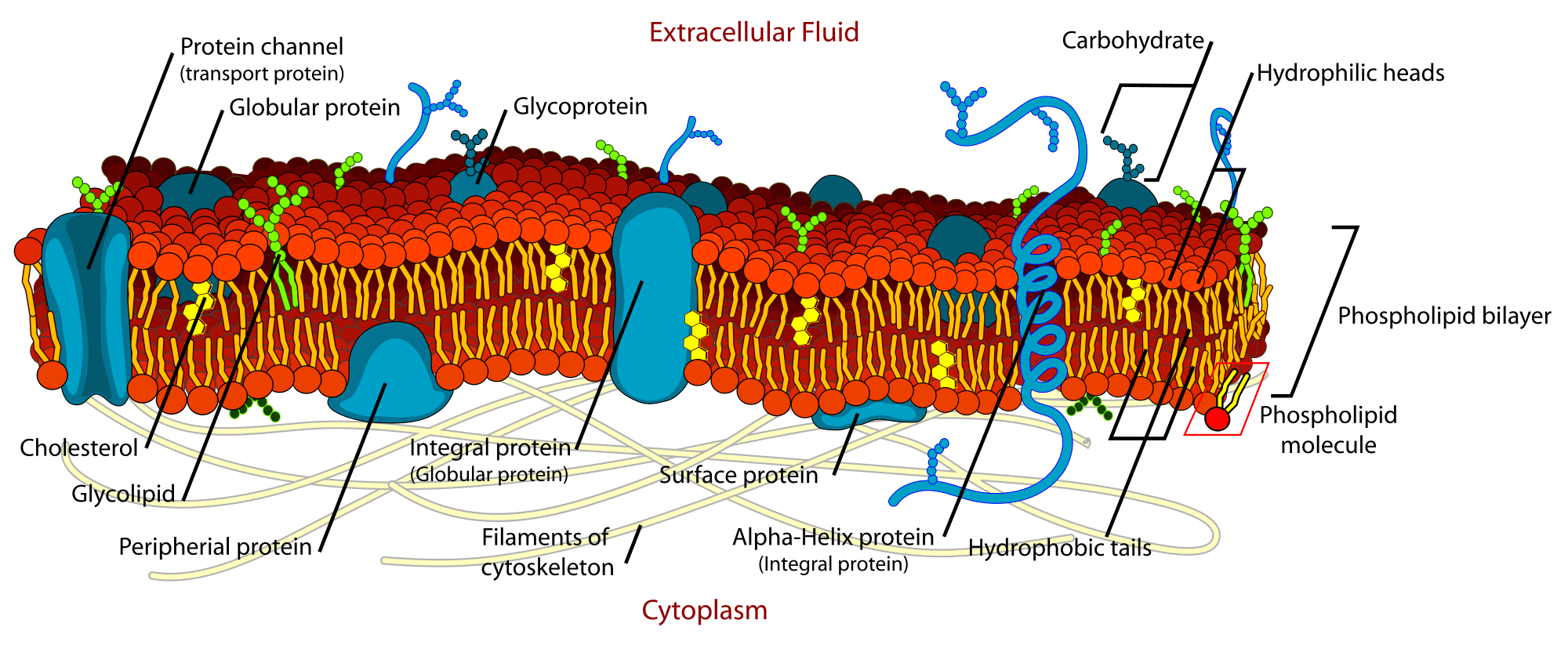
What is this image?
a)
cell membrane
b)
proteins
c)
carbohydrates
d)
lipids
35.
Hydrophilic portion of cell membrane?
a)
A
b)
C
c)
D
d)
36.
If a section of DNA has 13% thymine, then there is _____ adenine
a)
13%
b)
26%
c)
37%
d)
74%
37.
Who said, "The amount of A = the amount of T, and the amount of G = the amount of C"?
a)
Chargaff
b)
Avery
c)
Griffith
d)
Franklin
38.

WHAT does replication produce?

a)

DNA

b)

RNA

c)

proteins

d)

amino acids

39.

WHAT does translation produce?

a)

proteins

b)

DNA

c)

RNA

d)

carbohydrates

40.

WHERE in the cell does translation occur?

a)

nucleus

b)

cell membrane

c)

golgi apparatus

d)

cytoplasm

41.

What type of gene mutation has occurred here?

T-G-A-C-C-A

T-G-A-C-C-A-A

a)

Substitution

b)

Deletion

c)

Insertion

42.

Which do BOTH prokaryotes and eukaryotes contain?

a)

nucleus

b)

mitochondria

c)

ribosomes

d)

cell wall

43.

Prokaryotes do NOT have....

a)

membrane bound organelles

b)

DNA or RNA

c)

Cell membrane

d)

Life

44.
A fossilized cell is discovered, and evidence suggests it reproduced on its own and had DNA, but a membrane did not enclose its DNA. Which type of organism would this most likely be?
a)
prokaryote
b)
eukaryote
c)
plant cell
d)
animal cell
45.

Prokaryotic cells do not have…….

a)

membrane bound organelles

b)

cell membrane

c)

DNA or RNA

d)

life

46.

What do the dotted lines between the nitrogenous bases (A,T,C,G) represent in the image provided?

a)

Covalent bonds

b)

Ionic bonds

c)

Peptide bonds

d)

Hydrogen bonds

47.

What determines the specific traits in an organism?

a)

The number of carbons in the DNA molecule.

b)

The number of hydrogen bonds that hold the strands of DNA together. 

c)

The sequence of nucleotide bases in the DNA molecule.

d)

The sequence of phosphates along each DNA strand. 

48.
Reasons that viruses are considered to be nonliving is because
a)
They are not cellular
b)
They cannot reproduce on their own
c)
They cannot make proteins
d)
all of the above
49.
How could you describe the size of a virus?
a)
Smaller than bacteria
b)
Larger than a parasite
c)
About the size of a dime
d)
Smaller than a proton
50.
All viruses contain-
a)
nucleic acids
b)
ribosomes
c)
mitochondria
d)
cytoplasm
51.
What part of a virus is the protein capsule that houses the genetic material (DNA/RNA)?
a)
tail
b)
nucleus
c)
capsid
d)
glycoprotein
52.
Which of the following is not a characteristic of a Prokaryotic cell?
a)
unicellular
b)
floating DNA
c)
very small
d)
complex
53.

Green plants produce their own food through the process of photosynthesis. Which characteristic of life does this represent?

a)

All living things use energy

b)

All living things contain cells

c)

All living things maintain homeostasis

d)

All living things grow

54.
Rocks are not living because
a)
they never move
b)
they aren't needed for humans
c)
they are not made of cells
d)
they don't break down
55.

Which gas do plants release during photosynthesis?

a)

oxygen

b)

carbon

c)

helium

d)

carbon dioxide

56.
What is one of the reactants of cellular respiration?
a)
energy
b)
glucose
c)
carbon dioxide
d)
water
57.

Which of the following is produced during the process of cellular respiration?

a)

carbon dioxide

b)

sodium chloride

c)

oxygen

d)

sugar

58.

Features of plant cells that clearly make them different from animal cells are -

a)

larger and fewer chromosomes.

b)

rigid cell wall and chloroplasts.

c)

more cytoplasm and smaller vacuoles.

d)

changing size and indefinite shape.

59.
Provides support and protection for the cell while also controlling the movement of materials in and out of the cell.
a)
Cellular Membrane
b)
Nucleus
c)
Ribosomes
d)
Vacuole
60.
Consists of a jellylike substance that contains many organelles.
a)
ribosomes
b)
cytoplasm
c)
chloroplasts
d)
cell wall
61.
This organelle makes proteins. 
a)
Cell membrane
b)
Nucleus
c)
Ribosome
d)
ER
62.
Which of the following units are repeatedly joined together to form a strand of DNA?
a)
amino acids
b)
nucleotides
c)
fatty acids
d)
polysaccharides
63.
Why is DNA important?
a)
it is very small and very complicated
b)
it's in everything
c)
it serves as the blueprint for traits of all living things
d)
because we eat it every day for energy
64.
A process in which DNA has the unique ability to make an exact copy of itself.
a)
Replication
b)
Translation
c)
Transcription
65.
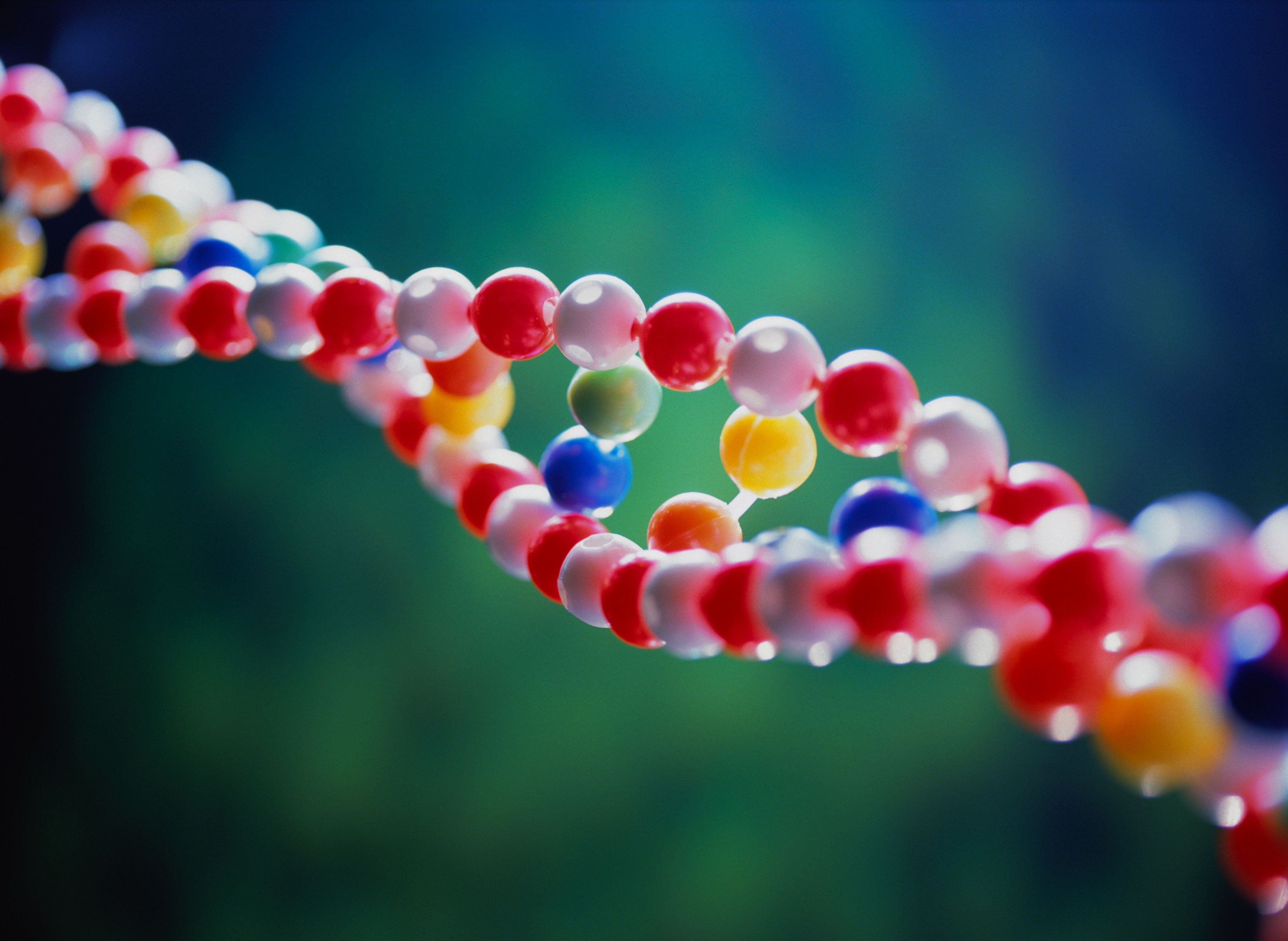
The following picture must be
a)
DNA because it's double stranded
b)
RNA because it's single stranded
c)
DNA because it's single stranded
d)
RNA because it's double stranded
66.

DNA replication results in

a)

2 completely new DNA molecules

b)

2 DNA molecules that each contain a strand of the original

c)

1 new DNA molecule and 1 old

d)

1 new molecule of DNA

67.

Enzyme that breaks hydrogen bonds (unzips)

a)

Ligase

b)

Polymerase

c)

Primase

d)

Helicase

68.

Restriction enzymes are analogous to what common school supply?

a)

glue

b)

scissors

c)

paper

d)

highlighter

69.

Active transport is the movement of large materials across a cell membrane from ______ to ______ concentration

a)

high to low

b)

low to high

c)

high to high

d)

low to low

70.

Active transport across a cell membrane from low to high concentration, requires

a)

energy (ATP)

b)

no energy

c)

water

d)

oxygen

71.

In the cell pictured, which way would water move?

a)

Into the cell, causing the cell to swell

b)

Out of the cell, causing the cell to shrink

c)

In and out of the cell equally, keeping the shape the same

72.

In the cell pictured, which way would water move?

a)

Into the cell, causing the cell to swell

b)

Out of the cell, causing the cell to shrink

c)

In and out of the cell equally, keeping the shape the same

73.

What type of solution is this healthy looking red blood cell in?

a)

Isotonic

b)

Hypertonic

c)

Hypotonic

74.
What type of solution allows water to enter the plant cell?
a)
hypotonic solution
b)
hypertonic solution
c)
isotonic solution
d)
active transport
75.
Which cell is in a hypertonic environment?
a)
A
b)
B
c)
C
76.

Diffusion & Facilitated Diffusion are both __________ transport.

a)

Passive

b)

Active

c)

Easy

d)

Free

77.

The cell membrane contains channels and pumps that help move materials from one side to the other. What are these channels and pumps made of?

a)

Carbohydrates

b)

Lipids

c)

Bilipids

d)

Proteins

78.
What is the function of a carbohydrate?
a)
Stores energy
b)
Movement
c)
Stores genetic information
d)
Speeds up reactions
79.

Which of the following is the monomer of carbohydrates?

a)

monosaccharides

b)

amino acids

c)

glycerol

d)

nucleotides

80.

Many monomers put together make a

a)

dimer

b)

trimer

c)

polymer

d)

monosaccharide

81.

What type of carbohydrate is this?

a)

polysaccharide

b)

disaccharide

c)

monosaccharide

d)

it isn't a carbohydrate

82.
What is the function of nucleic acids?
a)
store genetic information
b)
store energy (long-term)
c)
store energy (short-term)
d)
build skin, hair, nails, muscles
83.
Waxes, oils and fats are examples of
a)
Carbohydrates
b)
Lipids
c)
Proteins
d)
Nucleic Acids
84.
Nucleotides are monomers of
a)
Carbohydrates
b)
Lipids
c)
Proteins
d)
Nucleic Acids
85.
Proteins are made of monomers called ___________
a)
Nucleotides
b)
Monosaccharides
c)
Amino Acids
d)
Glycerol and fatty acids
86.
This organic molecule is the main component of biological membranes.....
a)
carbohydrates
b)
lipids 
c)
proteins 
d)
nucleic acids
87.

What is the outer most part of a cell?

a)

cell wall

b)

nucleus

c)

cell membrane

d)

cell skin

88.
Which of the following is the smallest unit of life that can carry out all life functions?
a)
the mitochondria
b)
the vacuoles
c)
the nucleus
d)
the cell
89.
What is the function of a cell wall?
a)
to protect and support the cell
b)
to perform different functions in each cell
c)
to prevent water from passing through it
d)
to prevent oxygen from entering the cell
90.

A student noticed that the freshwater plant, Elodea, produced bubbles when placed in direct light. What could the student most likely conclude?

a)

Bubbles of carbon dioxide were produced as a result of photosynthesis.

b)

Bubbles of oxygen were produced as a result of photosynthesis.

c)

Bubbles of carbon dioxide were produced as a result of cellular respiration

d)

Bubbles of oxygen were produced as a a result of cellular respiration

91.

These diagrams show a variety of cells from the same organism. How can cells from the same organism have such different shapes and functions?

a)

As each cell differentiates, the DNA changes so that each type of cell has different DNA once it reaches maturity.

b)

Mutations in the cells' nuclei lead to new combinations of DNA, resulting in different shapes and functions in the different types of cells.

c)

During differentiation, different parts of the DNA in each type of cell are activated, resulting in the different structure and function of the cells.

d)

During differentiation, different types of cells produce proteins which destroy the nonactive DNA, leading to cell specialization.

92.

Which statement best explains how sweating during exercise maintains homeostasis?

a)

It regulates mineral concentrations in cells.

b)

It regulates body temperature.

c)

It maintains water balance.

d)

It maintains sugar balance in cells.

93.
Enzymes are proteins that help increase the rate of chemical reactions inside cells. These proteins are composed of many simpler molecules called amino acids. Which of the following suggests that the shape of an enzyme determines the enzyme’s function?
a)
Enzymes are specific to a substrate
b)
 Enzymes can operate in a wide range of conditions.
c)
Enzymes are activated by neighboring molecules.
d)
Enzymes can be found in all life-forms.
94.

Which statement best describes the relationship between the products of photosynthesis and the reactants in cellular respiration?

a)

The products of photosynthesis serve as the reactants in cellular respiration to provide chemical energy.

b)

The products of photosynthesis combine with the reactants in cellular respiration to remove ATP from cells.

c)

The products of photosynthesis inhibit the reactants in cellular respiration in the presence of light.

d)

The products of photosynthesis change the structure of the reactants in cellular respiration in the presence of light.

95.
What type of transport is this?
a)
facilitated diffusion
b)
active transport
c)
diffusion
d)
osmosis
96.
What are two types of passive transport?
a)
endo and exocytosis 
b)
cookies and milk
c)
active and passive 
d)
Osmosis and diffusion
97.
Special proteins help move particles, but NO energy is needed. This is..
a)
facilitated diffusion
b)
exocytosis
c)
active transport
d)
equilibrium
98.
What pigment absorbs sunlight for photosynthesis?
a)
chloroplast
b)
thylakoid
c)
grana
d)
chlorophyll
99.
Glucose is broken down during which process
a)
Krebs cycle
b)
Calvin cycle
c)
Glycolysis
d)
Photosynthesis
100.
Which is not a waste product of cellular respiration?
a)
Water
b)
Heat
c)
Carbon Dioxide
d)
Oxygen